
Form Follows Failure: Queering Function and Masculinity in the Comme des Garçons x Nike Premier Heels
By Ulvi Aliyev
DOI: 10.38055/UFN050207
MLA: Aliyev, Ulvi. “Form Follows Failure: Queering Function and Masculinity in the Comme des Garçons x Nike Premier Heels.” Unravelling Fashion Narratives, special issue of Fashion Studies, vol. 5, no. 2, 2026, pp. 1-27. https://doi.org/10.38055/UFN050207
APA: Aliyev, U. (2026). Form Follows Failure: Queering Function and Masculinity in the Comme des Garçons x Nike Premier Heels. Unravelling Fashion Narratives, special issue of Fashion Studies, 5(2), 1-27. https://doi.org/10.38055/UFN050207
Chicago: Aliyev, Ulvi. “Form Follows Failure: Queering Function and Masculinity in the Comme des Garçons x Nike Premier Heels.” Unravelling Fashion Narratives, special issue of Fashion Studies 5, no. 2 (2026): 1-27. https://doi.org/10.38055/UFN050207
Volume 5, Issue 2, Article 7
Keywords
Rei Kawakubo
Sportswear
Masculinity
Queer Theory
Avant-Garde Fashion
Abstract
This article examines Rei Kawakubo's Comme des Garçons x Nike Premier Heels (Fall/Winter 2021) as a critical intervention that queers the ideological foundations of sportswear. While athletic attire is often celebrated under the modernist dictum "form follows function," this study argues that sportswear is a cultural system deeply entangled with gendered norms and disciplinary codes. The Tiempo Premier, a football boot historically associated with hyper-functional, hegemonic masculinity epitomized by figures like Eric Cantona, serves as Kawakubo's specific target. By grafting the boot with a stiletto heel, she renders it functionally absurd, transforming it from a tool of performance into an artifact of critique.
Through a methodology combining semiotics, critical discourse analysis, and queer theory (Barthes, Butler, Halberstam), this analysis demonstrates how the Tiempo Heels perform a parasitic subversion of Nike’s own branding. The hybrid design creates a productive sign collision that unsettles the binary codes of masculine utility and feminine spectacle. Framing this gesture through Halberstam’s “queer art of failure,” the article contends that the shoe’s inherent impracticality becomes its critical power, subverting the masculinist logics embedded in football culture and exposing functionality itself as a cultural fiction. Ultimately, this paper expands fashion studies by reframing sportswear as an ideological field, showcasing avant-garde fashion’s capacity to expose and disrupt the naturalized narratives of gender and utility encoded in our clothing.
Introduction
Fashion exists in constant tension between utility and expression. While garments have long been justified in terms of covering, protecting, or enabling the body's movement, they have equally operated as cultural codes that communicate identity, hierarchy, and belonging. Nowhere is this tension clearer than in sportswear. From tennis whites to football boots, athletic attire has been celebrated as a triumph of "form follows function" modernism, a domain where comfort, efficiency, and performance dictate design. Yet, sportswear is not neutral. It is a cultural category infused with gendered expectations, disciplinary norms, and ideological claims about what bodies should do and how they should appear (Whannel, 2002; Evans, 2013).
This paper argues that avant-garde fashion makes these hidden codes visible, and that Rei Kawakubo's Comme des Garçons x Nike Premier Heels (Fall/Winter 2021) offer a paradigmatic example. At first glance, the Tiempo Heels seem like a novelty hybrid: a football boot mounted on an elegant high heel. Yet their provocation lies deeper. The Tiempo Premier is one of Nike's most tradition-laden football boots, historically associated with defenders and midfield generals, players whose identities are built on resilience, aggression, and discipline. Eric Cantona, perhaps the most iconic Tiempo wearer, epitomized this ethos with his physical presence, authoritarian style, and notorious aggression toward fans and opponents alike (Giulianotti, 2005). The boot thus operates as a semiotic anchor for hyper-functional, masculinist football culture.
Seen this way, the Tiempo Heels are not simply an eccentric collaboration. They are a continuation of Kawakubo's long-standing interrogation of gender, form, and function. Her Transcending Gender collection (Spring/Summer 1995) fused feminine decoration with masculine tailoring, producing hybrid garments that destabilized the sexual politics of dress (Evans, 2013). Later collections such as Dark Romance, Witch (Autumn/Winter 2004-05) and Adult Delinquent (Spring/Summer 2010) similarly undermined sartorial coherence, combining incongruous fragments and collapsing distinctions between categories. Within this trajectory, the Tiempo Heels should be understood not as a playful collaboration but as part of Kawakubo's avant-garde practice of using absurdity and incongruity to reveal the ideological underpinnings of fashion.
The choice of the Tiempo Premier is crucial here. Other Nike models such as the Mercurial or Hypervenom carry associations of speed, creativity, and spectacle. By contrast, the Tiempo embodies heritage, seriousness, and grit. It is Nike's boot of "function," symbolizing tradition and durability rather than style. By targeting this model, Kawakubo intervenes at the heart of sportswear's claim to functional neutrality. She does not parody an already spectacular boot, but destabilizes the one most strongly associated with utilitarian design and hegemonic masculinity. The irony of transforming the most functional boot into the least functional fashion object (a heeled football shoe) intensifies her critique of sportswear's ideological foundations.
This article develops three central arguments. First, it demonstrates that sportswear's celebrated functionality is not an apolitical principle of design but a cultural fiction, historically entangled with gender norms, discipline, and heteronormativity. Second, it shows how Kawakubo's Tiempo Heels destabilize these norms by queering one of sportswear's most functional icons, employing absurdity as a critical strategy. Finally, it situates Kawakubo's intervention within a broader avant-garde and queer lineage, demonstrating that her approach exemplifies fashion's capacity to expose ideology, not simply produce garments. The article will conclude by addressing the potential for commodification to neuter such critique, arguing that the Tiempo Heels' inherent absurdity allows them to function as a parasitic, and ultimately potent, intervention.
Methodologically, this study treats garments as cultural texts. It draws on semiotics (Barthes, 1983), queer theory (Butler, 1990; Halberstam, 1998, 2011), and critical discourse analysis to interpret the Tiempo Heels in their cultural and historical context.
By combining visual analysis of the object with contextual readings of football culture, Nike branding, and Kawakubo's oeuvre, the article positions the Tiempo Heels as a unique intervention into sportswear's modernist logic.
The contribution of this research lies in expanding fashion studies’ understanding of sportswear along an underexplored axis. Existing scholarship on sportswear tends to address two dominant concerns: the sociology of sport and athletic performance (Messner, 2002; Giulianotti, 2005), or the lifestyle and branding dimensions of athleisure (Andrews, 2001; Kawamura, 2018). What this body of work has not systematically pursued is an analysis of sportswear as an ideological system legible through the methods of semiotic and queer theory—that is, a reading that treats athletic garments not as neutral tools or consumer objects but as cultural texts encoding gender norms, bodily discipline, and heteronormative assumptions. Furthermore, while avant-garde fashion has been extensively analyzed for its disruption of silhouette, gender, and aesthetic convention (Evans, 2013), its engagement with the specific cultural politics of sportswear has received little dedicated attention. This study addresses that gap: by bringing queer theory and critical discourse analysis to bear on a single hybrid object—Kawakubo’s Tiempo Heels—it demonstrates how avant-garde fashion can expose the ideological underpinnings of functionalism itself, offering a methodological template for reading sportswear as cultural critique rather than merely as design or branding.
Literature Review / Theoretical Framework
Sportswear and the Ideology of Function
Sportswear has historically been framed as the epitome of functional design. Rooted in the modernist dictum that "form follows function," athletic attire has been celebrated for its capacity to enhance bodily performance by prioritizing ergonomics, mobility, and efficiency (Whitford, 2010; Droste, 2002). Football boots, tennis uniforms, and running gear are thus imagined as instruments of optimization, where aesthetic flourishes are secondary to the demands of utility. This narrative aligns with Bauhaus principles and the rationalist ideal that design must serve purpose above all else.
Yet, as cultural historians argue, functionality in sportswear is never neutral. Clothing that appears to be designed purely for performance often encodes social hierarchies and gendered expectations. For example, tennis has long enforced rigid dress codes, particularly at Wimbledon, where women are required to wear white skirts or dresses. Ostensibly justified on grounds of tradition and propriety, this regulation illustrates how sportswear functions as a disciplinary technology: clothing is not simply enabling movement but also policing gender norms and maintaining an image of respectability (Steele, 2010; Evans, 2013). Similarly, football kits not only allow athletic performance but also symbolize team loyalty, cultural identity, and gendered aggression (Whannel, 2002; Giulianotti, 2005).
In this sense, sportswear represents what Foucault might describe as a "technology of the body"—a system that shapes conduct, appearance, and subjectivity under the guise of neutrality (Foucault, 1977).
The Nike Tiempo Premier epitomizes this paradox: marketed as a boot of durability and tradition, it becomes a cultural symbol of toughness, discipline, and football masculinity.
Avant-Garde Fashion and Rei Kawakubo
Avant-garde fashion disrupts the narratives of coherence, utility, and beauty that structure mainstream clothing. Designers like Rei Kawakubo have consistently challenged the notion that garments should conform to the body, enhance movement, or stabilize identity. Instead, her work foregrounds incongruity, exaggeration, and absurdity, producing garments that unsettle rather than confirm (Evans, 2013).
Kawakubo's oeuvre is particularly relevant to this study because of her sustained interrogation of gender and function. In Transcending Gender (Spring/Summer 1995), Kawakubo fused masculine tailoring with feminine ornamentation, creating hybrids that destabilized the sexual politics of dress. In Dark Romance, Witch (Autumn/Winter 2004-05), she disrupted tailoring with asymmetrical frills and explosions of tulle, producing garments that resisted conventional gender categorization. Similarly, Adult Delinquent (Spring/Summer 2010) presented incongruous fragments, pinstripes, sequins, and brocade collaged into absurd hybrid forms (Wilcox, 2010). Across these collections, function was undermined by exaggeration, and gender coherence dissolved into ambiguity.
The Nike Premier Heels extend this logic into the realm of sportswear. By fusing the most functional of football boots with an impractical high heel, Kawakubo both mocks and destabilizes the ideology of performance. This move is not an isolated act of commercial collaboration but part of a lineage of avant-garde interventions that expose the constructedness of utility, masculinity, and propriety in clothing.
Semiotics of Fashion and Sportswear
Barthes (1983) argued that clothing operates as a sign system, communicating meanings that extend beyond its material form. In The Fashion System, he demonstrated that garments do not simply cover the body but encode and transmit cultural messages through a structured language of signs. For Barthes, fashion writing transforms material objects into ideological statements: the same garment can signify freedom, elegance, rebellion, or propriety depending on how it is framed and circulated. Crucially, this sign system naturalizes cultural meanings, making ideological constructions appear as obvious, inevitable facts of clothing. A football boot is never just a boot: it carries symbolic associations of toughness, tradition, and athleticism. Similarly, a high heel is not merely footwear but a signifier of femininity, sexuality, and impractical elegance (Steele, 2005). The Tiempo Heels create a productive disruption of these codes: the masculine-coded football boot and the feminine-coded heel coexist in a hybrid form that exposes both sets of meanings as arbitrary rather than natural.
From a semiotic perspective, Kawakubo's Tiempo Heels expose the arbitrariness of sportswear's supposed neutrality. Functionality is revealed as a cultural fiction, supported by symbolic associations of masculinity and performance rather than intrinsic necessity. By queering the boot, Kawakubo demonstrates that the meanings attached to sportswear are contingent, unstable, and open to disruption.
Gender, Queer Theory, and Fashion
The Tiempo Heels also demand interpretation through the lens of queer theory. Butler's (1990) foundational text Gender Trouble introduced the concept of gender performativity, arguing that gender is not an innate, stable property of individuals but is instead constituted through repeated acts, gestures, and embodied styles. Crucially, Butler contends that what appears to be an expression of an inner gender identity is in fact produced by those very performances: there is no original gender behind the performance, only the performance itself. This challenges the assumption that clothing reflects a pre-existing gender identity, revealing instead that dress actively constructs and iterates gendered subjectivity. Football boots like the Tiempo participate in this process of gendered iteration, helping to perform masculinity by embodying strength, resilience, and aggression through design, material, and cultural association. High heels, conversely, have historically participated in the performance of femininity by embodying elegance, fragility, and spectacle (Steele, 2005). Kawakubo's hybrid collapses these iterative performances, revealing gender as a set of citations that can be recombined, parodied, or subverted rather than as a fixed, biological truth.
Halberstam's (1998, 2011) concepts of female masculinity and the "queer art of failure" further illuminate the Tiempo Heels.
The Tiempo Heels do not simply parody masculinity but suggest that its codes are malleable, available for re-signification. Their inherent "failure" as functional sportswear becomes their critical power, resisting the logics of efficiency and success that underpin both sport and normative gender performance.
This aligns with broader discussions in queer fashion studies, which emphasize the role of clothing in destabilizing normative gender and sexuality (Geczy & Karaminas, 2020). Kawakubo's work contributes to this discourse by showing that even the most utilitarian of garments—a football boot designed for defenders—is a site of gender performance and therefore open to critique.
Theoretical Synthesis
Drawing together these strands, this study adopts a three-pronged framework:
Semiotics (Barthes, 1983; Eco, 1976): Garments are read as cultural texts that signify beyond utility.
Critical Discourse Analysis (Fairclough, 1992; Evans, 2013): Sportswear is analyzed as discourse, a system of meaning that enforces functionality, masculinity, and discipline.
Queer Theory (Butler, 1990; Halberstam, 1998, 2011): The Tiempo Heels are understood as a queer disruption that scavenges and re-signifies heteronormative codes embedded in sportswear.
This framework allows the Tiempo Heels to be read not as novelty but as a critical intervention. Kawakubo's gesture is situated at the intersection of avant-garde fashion, sportswear ideology, and queer cultural critique, expanding the possibilities of how clothing can be theorized in relation to identity and social norms.
Methodology
The methodological approach of this article is qualitative, interpretive, and interdisciplinary, grounded in cultural analysis rather than empirical testing. At its core, the study treats Rei Kawakubo's Comme des Garçons x Nike Premier Heels as a cultural text whose meaning cannot be reduced to material function. Instead, the garment is analyzed for its symbolic, discursive, and ideological significance. This approach aligns with the broader tradition in fashion studies that privileges interpretation, context, and theory to reveal how clothing operates as a mediator of identity, social norms, and cultural values (Barthes, 1983; Evans, 2013; Geczy & Karaminas, 2020).
The Tiempo Heels demand this approach: as avant-garde objects designed for symbolic provocation rather than athletic use, their critical force resides in the questions they raise about gender, functionality, and the cultural logic of sportswear—questions that only an interpretive methodology, attentive to theory and context, can adequately address.
Research Design
The research design follows an interpretive model grounded in cultural semiotics and critical discourse analysis, departing from positivist assumptions that objects have fixed functions or stable meanings.
The central research question guiding this design is: How do the Comme des Garçons x Nike Premier Heels destabilize the ideology of function embedded in sportswear? This question is addressed through close reading of the garment as a hybrid sign and through contextualization within broader discourses of sport, gender, and fashion.
Sources and Materials
The study draws upon a combination of primary visual sources and secondary textual sources to construct a multi-layered analysis.
Primary visual materials include high-resolution imagery and video recordings of the Comme des Garçons Fall/Winter 2021 runway, where the Tiempo Heels were first unveiled. These materials allow for detailed examination of silhouette, proportion, and aesthetic juxtaposition between the football boot and the stiletto heel. Archival materials from Nike's promotional campaigns for the Tiempo Premier are also essential: advertisements and catalogues consistently emphasized values such as toughness, tradition, and durability, positioning the Tiempo as the embodiment of football's functionalist ethos. Finally, football culture itself serves as a contextual visual archive.
Secondary sources comprise designer interviews, exhibition catalogues, and scholarly analyses of Kawakubo's oeuvre. This literature situates the Tiempo Heels within her broader practice of deconstruction, incongruity, and gender interrogation (Wilcox, 2010; Kawamura, 2018). Additional sources include scholarship in fashion theory, queer theory, and sports studies, which provide conceptual frameworks for interpreting the ideological stakes of the object (Butler, 1990; Halberstam, 1998, 2011; Whannel, 2002; Giulianotti, 2005). These sources ensure that the analysis is not an isolated visual reading but embedded in the cultural, social, and theoretical discourses that give the object its resonance.
Analytical Framework
The analytical framework integrates three theoretical approaches: semiotic analysis, critical discourse analysis, and queer theory.
First, semiotic analysis provides a lens to interpret the Tiempo Heels as a sign system. Following Barthes (1983) and Eco (1979), the study reads the football boot and the high heel as culturally coded objects. The football boot signifies strength, resilience, and masculine-coded functionality; the high heel signifies femininity, spectacle, and impracticality (Steele, 2005). When fused, the two create a hybrid sign that is excessive, ironic, and destabilizing. This semiotic collision reveals the arbitrary nature of both codes and calls into question the assumption that sportswear's meaning is anchored in neutrality or universality.
Second, critical discourse analysis (CDA) extends the inquiry beyond the object itself to the discourses that shape its reception. Following Fairclough (1992), CDA views language, imagery, and marketing as vehicles through which ideology is reproduced. In this context, sportswear is not merely functional but discursively constructed as performance-oriented, masculine, and naturalized. The Tiempo Heels disrupt this discourse by making its assumptions visible: if function can be mocked or hybridized, then function is not inherent but ideological.
Third, queer theory offers the conceptual tools to interrogate the gender politics of the object. Butler's (1990) notion of gender performativity highlights how clothing constitutes identity through repeated acts rather than expressing an innate truth. Halberstam's (1998, 2011) theorization of female masculinity and the "queer art of failure" similarly illuminates how the Tiempo Heels disrupt normative associations of masculinity and femininity. By scavenging a football boot—a footwear item deeply entangled with masculine aggression—and combining it with a stiletto heel, Kawakubo undermines binary logics of gender and creates space for alternative readings of identity and embodiment.
Analytical Strategy
The analysis unfolds in four stages. The first contextualizes the Nike Tiempo Premier culturally, foregrounding football’s associations with toughness and masculinity, particularly through the boot’s adoption by players such as Eric Cantona, to establish why the Tiempo is a more significant target than other Nike models. The second examines the Tiempo Heels as material and visual hybrids, situating Kawakubo’s intervention as intentional critique rather than superficial collaboration. The third undertakes semiotic interpretation, reading how the combination of masculine and feminine codes produces meanings that exceed either original form. The fourth situates the object within Kawakubo’s broader oeuvre and within contemporary debates in fashion and gender theory, articulating its contribution to the field.
The first stage is contextualization, in which the cultural significance of the Nike Tiempo Premier is established. Here, football's associations with aggression, toughness, and masculinity are foregrounded, particularly through the Tiempo's adoption by players such as Eric Cantona. This establishes why the Tiempo, rather than other Nike boots such as the Mercurial, is significant: it represents the purest expression of football's functionalist ethos.
The second stage is object analysis, which examines the Tiempo Heels as material and visual hybrids. The object's silhouette, juxtaposition of boot and heel, and transformation of utilitarian footwear into theatrical spectacle are examined in detail. This close reading situates the garment as an intentional disruption rather than a superficial collaboration.
The third stage is semiotic interpretation, which reads the hybrid's signifying force. Here, the focus is on how the combination of codes destabilizes both sportswear and high fashion, producing meanings that exceed either original form.
The final stage is cultural critique, which situates the Tiempo Heels within Kawakubo's broader oeuvre and within contemporary debates in fashion and gender theory. This stage articulates how the object contributes to literature by exposing the ideological underpinnings of sportswear and opening new avenues for queer interpretations of fashion.
Reflexivity and Limitations
As with any qualitative inquiry, reflexivity is crucial. The analysis is shaped by the researcher's disciplinary positioning within fashion studies and by the interpretive nature of the methods. While efforts are made to ground interpretations in theory and historical context, the conclusions inevitably reflect the subjectivity of critical reading.
Limitations include the reliance on visual documentation rather than physical access to the garments. While images capture design and silhouette, they cannot reproduce the tactile, material, or kinesthetic qualities of the objects. However, given that the Tiempo Heels are not designed for athletic performance but for symbolic provocation, their critical force resides in their visual and cultural impact, making visual analysis an appropriate method.
A further limitation lies in the single-case focus. While this depth-oriented approach enables close analysis, it cannot claim universal applicability across all sportswear or avant-garde fashion. Rather, its contribution is illustrative: the Tiempo Heels are a lens through which broader cultural and ideological dynamics can be revealed.
Ethical Considerations
Because the study deals exclusively with visual and textual materials already in the public domain, there are no human participants or sensitive data. Ethical responsibility here lies in accurate attribution of sources and in the respectful engagement with designers, cultural texts, and theoretical traditions.
Case Study and Analysis: From Nike Tiempo Premier to Comme des Garçons Heels
The Nike Tiempo Premier: Function, Masculinity, and Cultural Symbolism
The Nike Tiempo Premier, first released in 1994, is widely regarded as one of the brand's most emblematic football boots. It is important to situate the Tiempo within the broader genealogy of football footwear to understand its symbolic position. While Nike's Mercurial, Hypervenom, or CTR360 Maestri lines have often been associated with speed, innovation, and forward-thinking design, the Tiempo has remained steadfastly attached to notions of tradition, solidity, and reliability (Figure 1). It is a leather boot designed not to dazzle with flashy colours or lightweight technology but to endure the rigours of the game. From its inception, Nike marketed the Tiempo as a classicist's boot—heavy, stable, and dependable (Goldblatt, 2006).
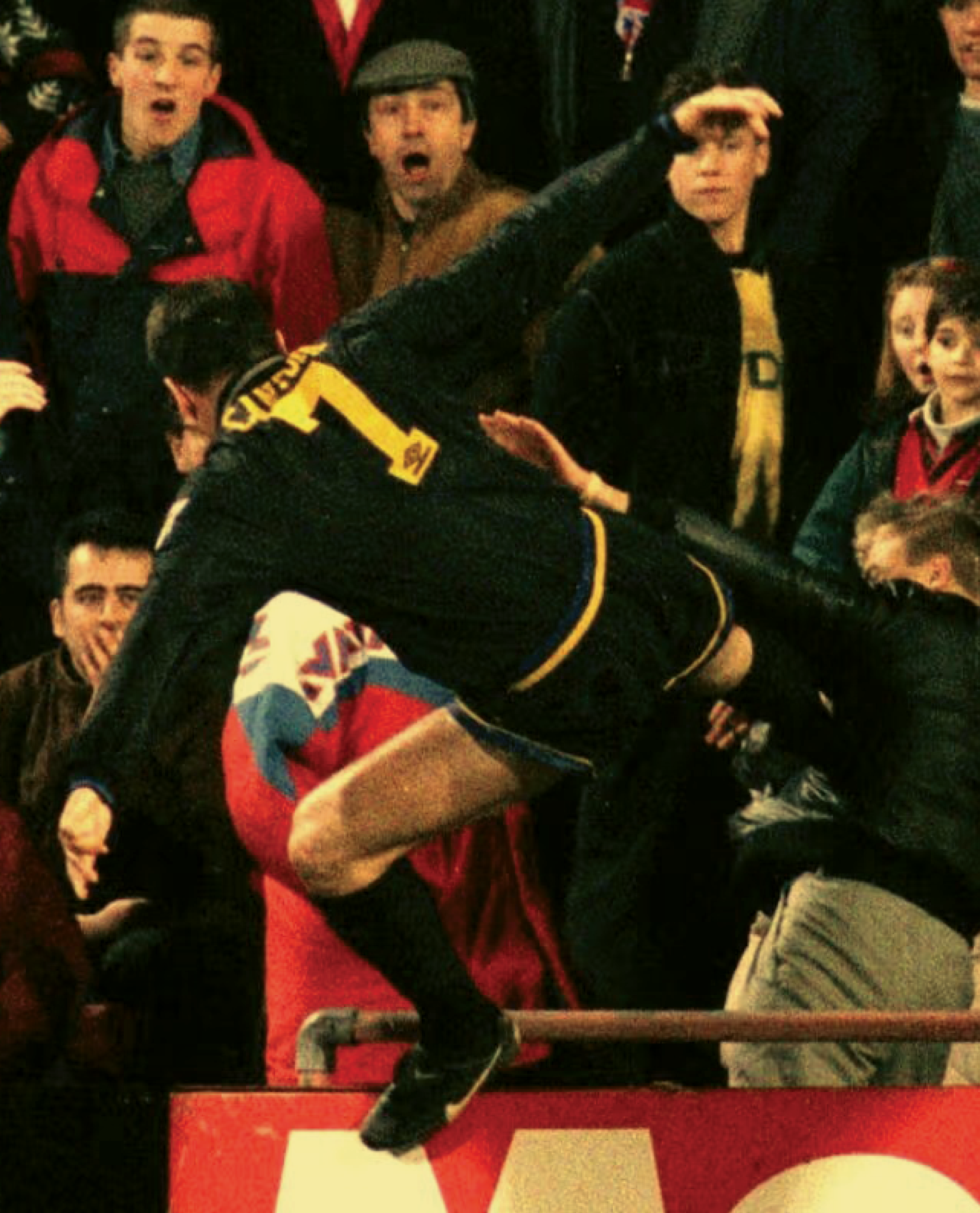
The cultural semiotics of the Tiempo became further entrenched through its association with defenders and midfielders, positions in football often characterized by resilience, toughness, and the ability to withstand physical confrontation. Players such as Carles Puyol, Gerard Piqué, Sergio Ramos, and notably Eric Cantona became synonymous with the boot. Cantona, in particular, epitomized the Tiempo ethos. Known for his aggressive style, uncompromising presence, and volatile temperament, Cantona embodied the kind of masculinity that the Tiempo symbolized: confrontational, physical, and authoritative. His infamous January 1995 incident—widely described as the "kung-fu kick"—crystallized this reputation. During a Premier League match at Selhurst Park, Cantona was sent off for Manchester United against Crystal Palace. As he walked toward the tunnel, a Palace supporter named Matthew Simmons ran down to the front of the stands to confront and verbally abuse him. Cantona responded by launching a two-footed flying kick at the supporter, followed by a series of punches (Figure 2). The incident prompted a worldwide media storm, resulted in Cantona's suspension from football for nine months, and sparked sustained debate about the culture of aggression in the sport. Far from permanently damaging his reputation, the incident paradoxically deepened his mythologized status as football's "rebel king," a figure whose violence and charisma became inseparable in the popular imagination (Whannel, 2002; Giulianotti, 2005).
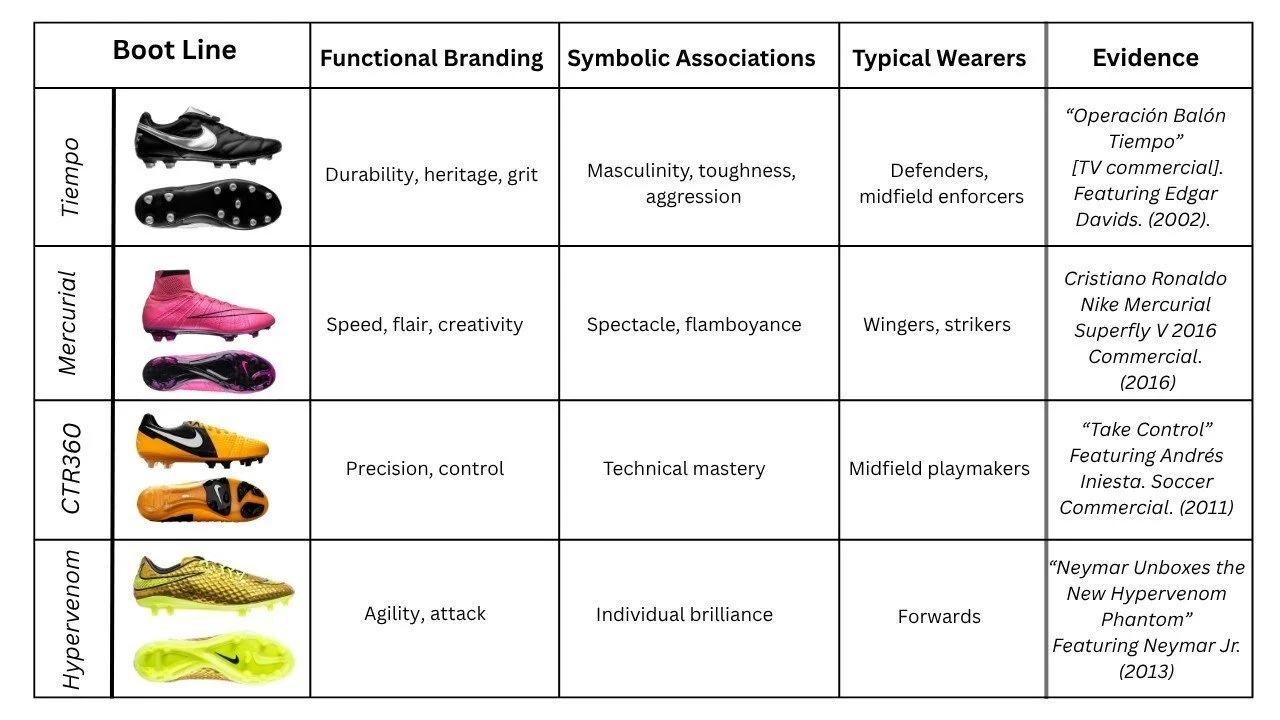
figure 1
Comparison of Nike Boot Lines and Symbolic Associations
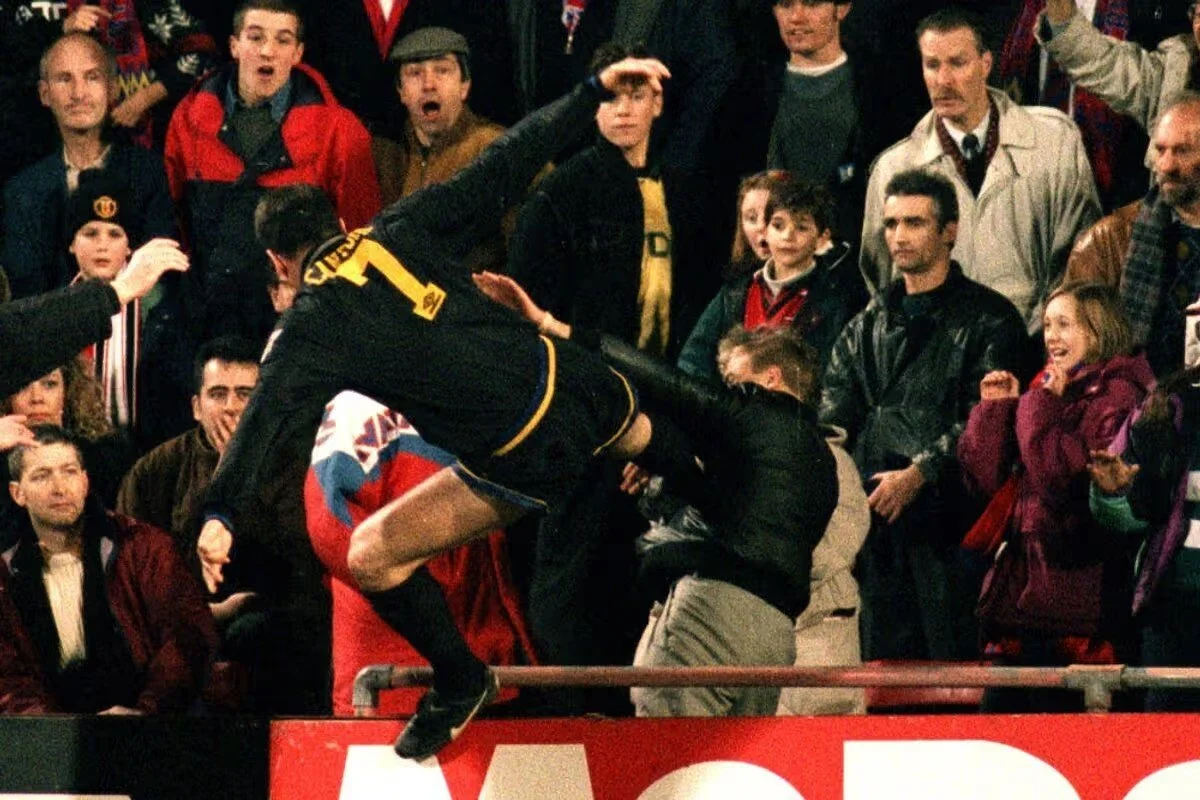
Figure 2
Cantona's defining moment(Image: Action Images)
In semiotic terms, the Tiempo thus became more than a functional boot. It was invested with symbolic codes of hegemonic masculinity (Connell, 1995). The dark leather, its traditional silhouette, and its association with defensive positions rendered it a signifier of strength, authority, and even aggression.
As with uniforms in other sports, the boot's "functionality" was never purely technical but always overlaid with cultural and ideological meaning (Bale, 1994; Andrews, 2001).
Functionality as Ideology: Sportswear and the Myth of Neutrality
To describe the Tiempo as merely "functional" is to fall into what Roland Barthes (1983) calls the "mythology" of fashion—the belief that garments simply fulfil practical needs. Sportswear brands often present design choices as rational, universal, and scientifically inevitable: the shape of a stud guarantees traction; the thickness of leather ensures protection. Yet such narratives obscure the ideological dimension of functionality. As Baudrillard (1994) argues, the "function" of objects always includes their symbolic and cultural roles.
The Tiempo's symbolic coding illustrates this point. Its durability and heft were framed as functional necessities for defenders, but these qualities also aligned with cultural constructions of masculinity: durability as stoicism, weight as gravitas, toughness as emotional hardness. Function became indistinguishable from ideology. As sport sociologists note, football culture is deeply implicated in the reproduction of hegemonic masculinity, rewarding aggression, dominance, and heteronormative identity (Connell, 1995; Messner, 2002). The Tiempo thus functioned not only as equipment but also as an ideological tool, reinforcing football's gendered and cultural norms.
It is precisely this ideological "masking" of function that Rei Kawakubo would target in her Comme des Garçons x Nike Premier Heels. By transforming the boot into an object that could no longer perform its athletic role, she exposed the cultural constructions that functionality had previously concealed.
Kawakubo's Intervention: The Heeled Tiempo
When Rei Kawakubo introduced the heeled version of the Nike Tiempo Premier in her Fall/Winter 2021 collection, the design immediately generated both fascination and bewilderment. Before interpreting what the object means, it is worth describing what it is. The CDG x Nike Premier Heel retains the full upper construction of the Nike Tiempo Premier: a smooth, full-grain kangaroo leather upper in classic black, with the boot’s characteristic low-profile silhouette, minimal external seaming, and traditional lace closure. The ankle collar and tongue follow the original Tiempo’s relatively modest, workmanlike cut—there is none of the padding or exaggerated ankle support found in lifestyle sneakers. The familiar Nike Swoosh is positioned on the lateral side, and the outsole preserves the Tiempo’s original stud configuration: a conventional arrangement of bladed and conical studs designed for natural-grass traction. It is precisely from this unmodified functional base that Kawakubo’s intervention departs most dramatically. Where the heel counter of the original boot meets the ground in a flat, stable platform, the CDG version replaces this with a narrow, approximately ten-centimetre stiletto heel in matching black, visually echoing the sleekness of the leather upper but structurally transforming the object entirely. The result is a shoe that reads, from the ankle upward, as a functional football boot, and, from the heel downward, as high fashion—a sharp bifurcation that makes the contradiction impossible to overlook. A football boot historically associated with the masculine culture of mud and exertion has been grafted with a stiletto heel, an emblem of feminine glamour and bodily restriction. The hybrid object produces immediate cognitive dissonance through its deliberate dysfunctionality. Yet it is also quintessentially Kawakubo, aligning with her long history of deconstruction, irony, and gender critique.
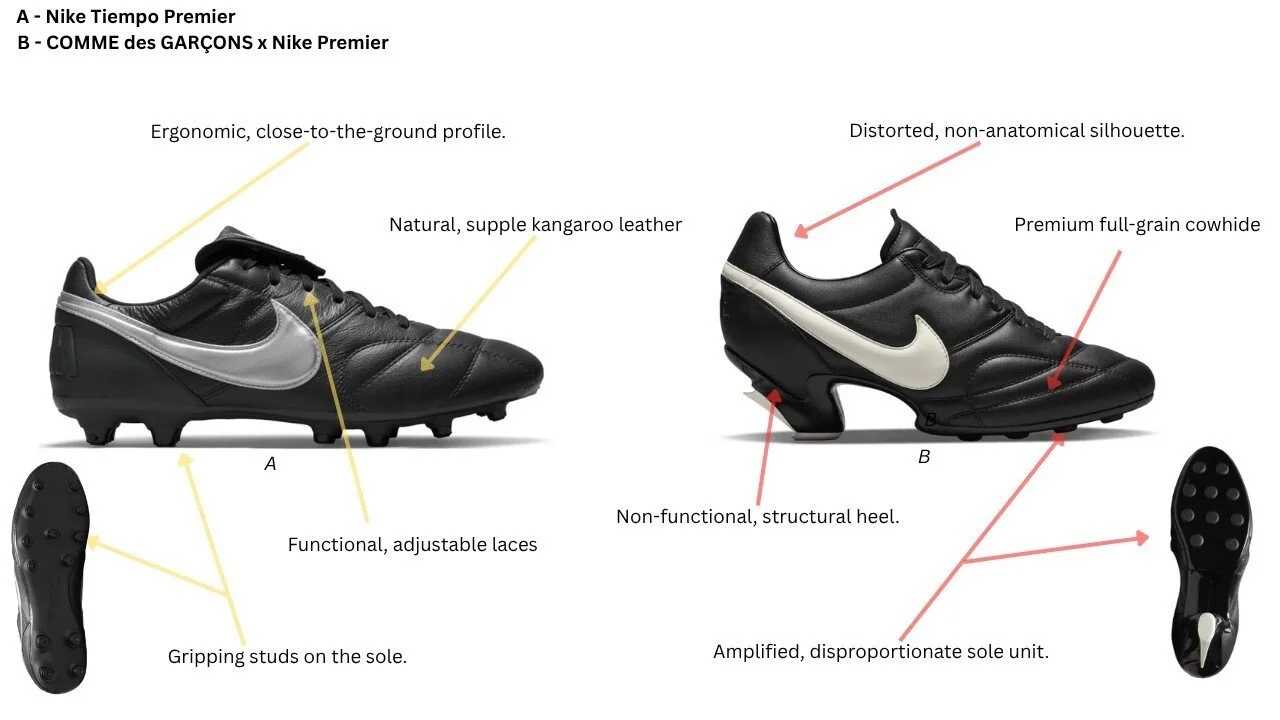
Figure 3
Construction of the Nike Tiempo Premier and the CDG × Nike Premier Heel (created by author)
By inserting the heel, Kawakubo fundamentally dismantled the modernist principle of "form follows function" that has governed sportswear design since the early twentieth century (Whitford, 2010; Droste, 2002).
What was once "functional" is re-signified as conceptual, aesthetic, and critical.
The Heeled Tiempo also destabilizes gender norms encoded within both of its source objects. On the one hand, the football boot connotes toughness, masculinity, and working-class physicality; on the other, the stiletto heel connotes femininity, sexualization, and bodily restriction (Entwistle, 2000). Their fusion creates a hybrid sign that resists both categories, producing what Judith Butler (1990) would describe as a performative disruption of gender binaries. The object "queers" both sportswear and womenswear, unsettling the stable categories upon which each depends.
Parasitic Subversion: Nike’s Branding and the Ideology of Just Do It
The article’s claim that the Tiempo Heels perform a “parasitic subversion of Nike’s branding” requires closer examination of what Nike’s visual and discursive identity actually communicates, and how the CDG collaboration intervenes within it. Nike’s corporate brand identity has been constructed over decades around a tightly consistent set of values: performance, aspiration, determination, and the erasure of physical limitation. Its “Just Do It” slogan, introduced in 1988, condenses these values into a rhetoric of individual will and bodily conquest. Crucially, Nike’s advertising imagery for the Tiempo line has consistently foregrounded this ideology of mastery: campaigns have emphasized the boot’s leather durability, its connection to professional defenders who “do the dirty work,” and its heritage as a tool for those who prioritize effectiveness over flash. In this visual grammar, the Tiempo boot is coded as serious, utilitarian, and implicitly masculine—a product for athletes who let their performance speak rather than their style.
The CDG x Nike Premier Heel does not abandon this visual language but turns it inside out. The Nike Swoosh remains prominently visible on the lateral side of the hybrid boot, ensuring the brand’s identity is legible. Yet the object violates every value that Swoosh is meant to anchor. Where Nike branding promises optimization, the stiletto heel guarantees dysfunction: a wearer attempting to sprint or tackle in this shoe would be immediately incapacitated. Where Nike’s Tiempo campaigns invoke professional credibility and heritage, the stiletto transforms the boot into a runway spectacle whose reference is theatrical rather than athletic. The effect can be read as a form of semiotic parasitism: the CDG collaboration latches onto Nike’s established symbolic infrastructure—the Swoosh, the Tiempo silhouette, the leather upper—only to subvert the foundational promise those elements are supposed to deliver.
This is what distinguishes the intervention from a simple parody or pastiche: it requires Nike’s own branding to remain intact and visible in order to expose the ideological fiction that branding conceals.
This also reframes the significance of the collaboration’s runway context. The Fall/Winter 2021 CDG show did not place the Tiempo Heels in athletic settings or use the visual conventions of sportswear photography (action, motion, sweat, effort). Instead, the heels appeared in a fashion show environment (stillness, deliberate pacing, theatrical presentation). This shift in presentation context performs the subversion at the level of display. Nike’s brand identity relies on the body in motion; Kawakubo’s show arrests that motion entirely, substituting the disciplined, striding model for the fashion runway walk—a gait that the stiletto heel makes, paradoxically, the only one available. The runway context thus becomes part of the critical apparatus, ensuring that Nike’s performance ideology is visibly neutralized rather than merely theoretically disrupted.
Cantona, Toxic Masculinity, and the Politics of Subversion
The significance of Kawakubo's choice of the Tiempo rather than, say, Nike's Mercurial or CTR360 Maestrii models becomes clearer when one considers its cultural associations with Cantona and defensive toughness. The Tiempo is not a neutral boot but one marked by its connection to physical aggression, tradition, and masculine dominance. Kawakubo's intervention can thus be read as a deliberate affront to the hyper-masculine mythology embodied by figures like Cantona.
Cantona’s infamous incident is often remembered as both shocking violence and iconic rebellion. Yet it also illustrates how football culture tolerates and sometimes glorifies male aggression, framing it as passion or authenticity rather than as problematic behaviour (Whannel, 2002). By feminizing the Tiempo with a heel, Kawakubo’s design can be read as holding this tolerance up to scrutiny—as if asking: what happens to football’s mythology of toughness when its most masculine-coded boot becomes a symbol of theatrical excess and camp?
This reading aligns with queer theoretical frameworks, particularly Jack Halberstam's (1998, 2011) exploration of how "failure" and absurdity can be strategies of resistance against hegemonic norms. The Heeled Tiempo is an object that fails at functionality and in that failure lies its critical power. It mocks not only the boot's utilitarianism but also the toxic masculinity embedded in its cultural mythology. This act of queer scavenging repurposes a symbol of dominant masculinity, holding it up for ridicule and re-imagination.
Sporting Dress Codes and the Policing of Bodies
Kawakubo's Tiempo Heels should also be understood in relation to sporting dress codes, which have long operated as mechanisms of control, particularly over women's bodies. Wimbledon's all-white rule, for instance, has been criticized for its rigidity and gendered implications. Female athletes such as Serena Williams have faced censure for wearing non-traditional or "inappropriate" outfits, underscoring how dress codes are used to police femininity and propriety in sport (Lake, 2018).
The football boot, too, operates as a kind of dress code, encoding masculine ideals of strength and aggression. By rendering the boot dysfunctional, Kawakubo challenges the assumption that sporting attire is neutral. Instead, she reveals that such codes are ideologically loaded, enforcing hierarchies of gender, sexuality, and identity.
The Tiempo Heels therefore join a broader avant-garde tradition of using fashion to critique the regulation of bodies through clothing. They highlight the arbitrariness of rules and norms, revealing that what is presented as "functional necessity" is often cultural policing in disguise.
The Semiotics of Absurdity and Avant-Garde Strategy
Absurdity has long been central to avant-garde practice. From Dada collages to Duchamp's urinal, absurd juxtapositions expose the contingency of cultural categories by rendering them ridiculous. Kawakubo's Tiempo Heels operate in a similar register. They take two objects whose meanings are highly stable—the football boot and the high heel—and combine them in a way that destroys their original logics.
In semiotic terms, this is what Umberto Eco (1976) calls an "aberrant decoding": the signifier (the boot) no longer matches the expected signified (functionality, toughness). Instead, it generates new meanings: absurdity, parody, critique.
The Heeled Tiempo also invites a queer semiotic reading. Susan Sontag's (1964) notion of camp as "love of the unnatural" resonates here. The hybrid shoe is camp precisely because it revels in its unnaturalness, its impossibility. Yet camp, as scholars have emphasized, is not apolitical; it destabilizes normative categories, producing space for queer expression and critique (Cleto, 1999). In this sense, the Tiempo Heels are not just absurd but also politically charged, mocking the masculinist culture of football while celebrating hybridity, parody, and play. The object functions as a Foucaultian heterotopia, a single, impossible space that makes the "normal" spaces of the stadium and the fashion show seem equally strange and constructed.
Discussion
From Function to Ideology: The Broader Stakes of Sportswear
The analysis of the Comme des Garçons x Nike Premier Heels demonstrates that what is often described as "function" in sportswear is not a neutral property of garments but a culturally and ideologically charged discourse. Functionality appears as a naturalized truth—boots must be durable, tennis skirts must allow mobility, jerseys must be breathable—but these truths conceal the deeper work of ideology. As Bourdieu (1984) reminds us, taste and design always encode social hierarchies. In sportswear, what appears "functional" in fact reproduces values of masculinity, heteronormativity, discipline, and control (Connell, 1995; Messner, 2002).
Rei Kawakubo's Tiempo Heels expose this ideological underpinning by producing a garment that fails spectacularly at its functional role. The object becomes unwearable for sport yet hyper-visible as critique. In Barthesian terms, the Tiempo Heels unmask the "myth" of function, showing that its aura of necessity is in fact a cultural narrative. For sportswear scholars, this expands the field: garments cannot be studied solely through performance or material science but must also be analyzed semiotically and ideologically.
Masculinity, Aggression, and the Queering of Football Icons
The significance of Kawakubo's choice of the Tiempo Premier lies in its cultural entanglements with football's mythology of toughness and masculinity. Figures such as Eric Cantona exemplify how the boot is not simply footwear but a signifier of hegemonic masculinity. Cantona's aggressive style, his refusal to conform, and his violent outbursts cemented the Tiempo as an icon of uncompromising physicality.
By attaching a heel to this symbol, Kawakubo disrupts what Judith Butler (1990) would describe as gender performativity in sport. The Tiempo Heels can be read as queering Cantona’s legacy: by feminizing the boot associated with his mythology into something deliberately theatrical, the object holds that mythology up to ironic scrutiny.
This aligns with Halberstam’s (1998, 2011) theory of failure as resistance: the shoe “fails” at sport but succeeds at destabilizing the ideology sport embodies. This act of queer scavenging repurposes a symbol of dominant masculinity, opening a space to imagine alternative, non-normative masculinities within the realm of sport and its associated apparel.
Here, Kawakubo also participates in a longer history of feminist and queer interventions into sport. Scholars have noted how women's sports have been policed through dress codes (Lake, 2018), while queer athletes often find themselves marginalized within football's hyper-masculine culture (Roy & Caudwell, 2014). The Tiempo Heels can be read as a symbolic reversal: rather than women or queer bodies being disciplined by sporting dress codes, the most masculinized boot itself is forced into drag, its normative identity rendered unstable and ridiculous.
Absurdity as Critical Strategy
Kawakubo's intervention aligns with the avant-garde's use of absurdity to critique social norms. Much like Dadaist practices or Duchamp's readymades, the Tiempo Heels create a cognitive dissonance that forces viewers to confront the arbitrariness of categories. As Umberto Eco (1976) explains, aberrant decoding occurs when signs are reconfigured in ways that break with their conventional meanings. The Tiempo Heels are precisely this: a football boot that cannot function, a stiletto that cannot seduce.
In this sense, absurdity is not frivolous but critical. Susan Sontag's (1964) famous account of camp emphasizes the subversive power of "the unnatural." The Tiempo Heels are camp objects: excessive, impractical, knowingly theatrical. Yet camp here is weaponized against sportswear's masculine seriousness. Where football boots are coded as serious tools of discipline and control, the Tiempo Heels revel in parody, exaggeration, and failure. This destabilizes not only the boot's meaning but also the seriousness of sport itself, which has long resisted queer and feminine disruption (Whannel, 2002).
Sportswear as Policing
The Tiempo Heels also highlight the role of sportswear in regulating bodies through dress codes. Football boots, with their stud configurations and leather weight, discipline male players into certain styles of play, valorizing aggression and stoicism. Similarly, women's tennis skirts particularly under Wimbledon's all-white rule have historically disciplined female athletes into narrow ideals of propriety, purity, and femininity (Lake, 2018).
Kawakubo's intervention destabilizes both systems. By queering the Tiempo, she exposes how football equipment enforces masculinity. By rendering the boot useless for sport, she gestures toward the comparable arbitrariness of tennis's insistence on white purity. The broader argument is clear: sportswear is never simply about movement; it is always about ideology, gender, and power. This builds on Entwistle's (2000) analysis of the dressed body as a site where social and cultural norms are inscribed and policed.
Contribution to Fashion Studies
The Tiempo Heels make three significant contributions to fashion studies when analyzed through this lens:
Reframing Functionality: They demonstrate that sportswear's functionality is an ideological construct, not a neutral property. This challenges modernist design narratives and aligns with postmodern theories of fashion as signification (Baudrillard, 1994; Barthes, 1983).
Expanding Avant-Garde Methodologies: They show how absurdity, parody, and queering can function as avant-garde strategies for deconstructing cultural myths. Kawakubo's work extends avant-garde practice beyond silhouette play into the politics of sport.
Bridging Fashion and Sport Studies: By situating a high-fashion object within the cultural politics of football, the study bridges two fields rarely placed in dialogue. This opens new interdisciplinary pathways, suggesting that sports equipment can be studied as cultural text within fashion studies.
The Limits and Possibilities of Critique within Commerce
A crucial counterargument must be addressed: that as a branded collaboration, the Tiempo Heels represent the co-optation of avant-garde critique by the very commercial system it appears to challenge. One could argue that the gesture is neutered, transformed into a limited-edition commodity for fashion insiders with no tangible impact on sports culture.
However, the object’s deliberate dysfunctionality and radical conceptual excess resist easy absorption. Its critical force is not diminished by its price tag but is, in fact, amplified by its paradoxical existence as a "useless" product within Nike's hyper-functional empire. Unlike corporate Pride collections, which often offer a sanitized, market-friendly version of inclusivity, the Tiempo Heels perform a more parasitic form of critique. They latch onto Nike's own iconic branding to undermine the brand’s foundational myths about performance and masculinity. While its tangible impact may be limited to the symbolic realm, it creates a powerful cognitive rupture, a template for imagining sportswear otherwise. It demonstrates that even within the constraints of the market, gestures of profound ideological disruption are possible.
Conclusion
This article has examined Rei Kawakubo's Comme des Garçons x Nike Premier Heels as an avant-garde intervention that exposes the ideological underpinnings of sportswear. By transforming Nike's Tiempo Premier, a boot historically associated with functionality, toughness, and masculine aggression, into an impractical stiletto, Kawakubo dismantles the assumption that function is a neutral property of garments. Instead, as this study has shown, functionality is itself a cultural fiction, one bound up with gender, discipline, and power.
The Tiempo Heels reveal this by failing spectacularly at their supposed role. They cannot grip the pitch or stabilize movement, yet in their failure lies their critical force. Following Halberstam's (1998, 2011) conception of failure as resistance, the Tiempo Heels parody the seriousness of sportswear and destabilize the hegemonic masculinity embodied by figures such as Eric Cantona. Through a practice of queer scavenging, Kawakubo repurposes this symbol of hegemonic masculinity, creating a heterotopic object that is camp, theatrical, and deliberately destabilizing. This undermines football's gendered mythology while also extending avant-garde fashion's critique of functionality.
This analysis contributes to fashion studies in three ways. First, it reframes sportswear as an ideological system rather than a neutral tool, illustrating how garments marketed for performance reproduce cultural norms of masculinity and propriety. Second, it expands our understanding of avant-garde strategies, showing how absurdity, hybridity, and queering can operate not only within fashion silhouettes but also within sportswear's rigid codes. Third, it bridges fashion studies and sport studies, highlighting the interdisciplinary potential of analyzing athletic equipment as cultural text.
While the commercial nature of the collaboration presents a potential limit to its critique, the Tiempo Heels' radical impracticality allows them to function as a potent, parasitic critique within the system. They point toward broader queer futures for sportswear, suggesting that if football boots can be absurd and hybrid, then the narratives of efficiency and discipline that dominate design can be unsettled.
References
Andrews, D. L. (2001). Michael Jordan, Inc.: Corporate Sport, Media Culture, and Late Modern America. SUNY Press.
Bale, J. (1994). Landscapes of Modern Sport. Leicester University Press.
Barthes, R. (1983). The Fashion System (M. Ward & R. Howard, Trans.). University of California Press. (Original work published 1967).
Baudrillard, J. (1994). Simulacra and Simulation (S. F. Glaser, Trans.). University of Michigan Press. (Original work published 1981).
Bourdieu, P. (1984). Distinction: A Social Critique of the Judgement of Taste (R. Nice, Trans.). Harvard University Press.
Butler, J. (1990). Gender Trouble: Feminism and the Subversion of Identity. Routledge.
Cleto, F. (Ed.). (1999). Camp: Queer Aesthetics and the Performing Subject. University of Michigan Press.
Connell, R. W. (1995). Masculinities. Polity Press.
Droste, M. (2002). Bauhaus, 1919–1933. Taschen.
Eco, U. (1976). A theory of semiotics. Indiana University Press.
Entwistle, J. (2000). The Fashioned Body: Fashion, Dress and Modern Social Theory. Polity Press.
Evans, C. (2013). The Mechanical Smile: Modernism and the First Fashion Shows in France and America. Yale University Press.
Fairclough, N. (1992). Discourse and Social Change. Polity Press.
Foucault, M. (1977). Discipline and Punish: The Birth of the Prison (A. Sheridan, Trans.). Pantheon Books. (Original work published 1975).
Foucault, M., & Miskowiec, J. (1986). Of other spaces. Diacritics, 16(1), 22–27. https://doi.org/10.2307/464648
Geczy, A., & Karaminas, V. (2020). Queer Style. Bloomsbury Academic.
Giulianotti, R. (2005). Football: A Sociology of the Global Game. Polity Press.
Goldblatt, D. (2006). The Ball is Round: A Global History of Soccer. Riverhead Books.
Halberstam, J. (1998). Female Masculinity. Duke University Press.
Halberstam, J. (2011). The Queer Art of Failure. Duke University Press.
Kawamura, Y. (2018). Fashion-ology: An Introduction to Fashion Studies (2nd ed.). Bloomsbury Academic.
Lake, R. J. (2018). A Social History of Tennis in Britain. Routledge.
Messner, M. A. (2002). Taking The Field: Women, Men, and Sports. University of Minnesota Press.
Roy, G., & Caudwell, J. (2014). Women and surfing spaces in Newquay, UK. In J. Hargreaves & E. Anderson (Eds.), Routledge handbook of sport, gender and sexuality (pp. 229–237). Routledge.
Sontag, S. (1964). Notes on “Camp.” Partisan Review, 31(4), 515–530.
Steele, V. (2005). Fashion and Eroticism: Ideals of Feminine Beauty from the Victorian Era to the Jazz Age. Oxford University Press.
Steele, V. (2010). The Berg Companion to Fashion. Berg.
Whannel, G. (2002). Media Sport Stars: Masculinities and Moralities. Routledge.
Whitford, F. (2010). Bauhaus. Thames & Hudson.
Wilcox, C. (2010). Comme des Garçons. In V. Steele (Ed.), The Berg companion to fashion (pp. 162–165). Bloomsbury Academic.
Author Bio
Ulvi Aliyev is a lecturer and education program coordinator at the Azerbaijan Sports Academy, with a strong academic and professional background in sports management. I hold a Master’s degree in Management from Coventry University in the United Kingdom, where I gained a global perspective on leadership, strategy, and innovation. Alongside my UEFA International Coaching License, I have worked with athletes across different age groups, combining practical coaching knowledge with managerial expertise. At the Academy, I teach courses in Human Resource Management in Sport, Sports Facility Management, and the Planning and Organization of Social Sports Projects, focusing on preparing students for success in the industry. My academic interests also extend to the intersections of sport and fashion — examining how performance, identity, and style shape athletes, audiences, and emerging trends. For me, sport is not only about competition and management but also about expression, culture, and the evolving aesthetics that connect it to the fashion world.

"Cheri Cheri Lady" by Modern Talking
Article Citation
Aliyev, Ulvi. “Form Follows Failure: Queering Function and Masculinity in the Comme des Garçons x Nike Premier Heels.” Unravelling Fashion Narratives, special issue of Fashion Studies, vol. 5, no. 2, 2026, pp. 1-27. https://doi.org/10.38055/UFN050207
Copyright © 2026 Fashion Studies - All Rights Reserved
Creative Commons Attribution-NonCommercial-NoDerivatives 4.0 International (CC BY-NC-ND 4.0) license (see: https://creativecommons.org/licenses/by-nc-nd/4.0/)