
“From Gay Paree”: Exploring Representations of Cross-Dressing and Male Impersonation in the Pages of Female Mimics, 1963-1970
By Nico Frederick
DOI: https://doi.org/10.38055/UFN050203
MLA: Frederick, Nico. “‘From Gay Paree’: Exploring Representations of Cross-Dressing and Male Impersonation in the Pages of Female Mimics, 1963-1970.” Unravelling Fashion Narratives, special issue of Fashion Studies, vol. 5, no. 2, 2026, pp. 1-31. https://doi.org/10.38055/UFN050203
APA: Frederick, N. (2026). “From Gay Paree”: Exploring Representations of Cross-Dressing and Male Impersonation in the Pages of Female Mimics, 1963-1970. Unravelling Fashion Narratives, special issue of Fashion Studies, 5(2), 1-31. https://doi.org/10.38055/UFN050203
Chicago: Frederick, Nico. “‘From Gay Paree’: Exploring Representations of Cross-Dressing and Male Impersonation in the Pages of Female Mimics, 1963-1970.” Unravelling Fashion Narratives, special issue of Fashion Studies 5, no. 2 (2026): 1-31. https://doi.org/10.38055/UFN050203
Volume 5, Issue 2, Article 3
Keywords
Impersonation
Cross-dressing
Drag
Butch
Paris
Abstract
This article explores the representations of cross-dressing and male impersonation in one specific New York-based queer periodical, Female Mimics, from its premiere issue in 1963 through to 1970, including the publisher’s shift to Female Impersonators in 1969. Visual and text analysis of the variety of dress shown in the magazine shines a light on members of the LGBTQ+ and cross-dressing community in the 1960s, and their subscription to, or refusal of, contemporary fashion trends and gender roles. By analyzing details from the periodical, the constructed reality of dress for the individuals mentioned, and others is revealed. Using a case study analysis, this article looks at how butch lesbians, male impersonators, and drag kings are represented, or not, within the publication with a focus on Paris-based lesbian cabarets discussed in numerous articles during the periodicals run. Due to the lack of dedicated male impersonator magazines for this period, those dedicated to the art of female impersonation serve as an important primary source in the study of female masculinity and gender nonconformity during the 1960s. The examples explored in this article will highlight important instances of butch legibility present in a periodical that actively attempted to erase such realities. This study will help to show the benefit of looking into, and critiquing, these magazines and the insights they can provide not only to dress historians, but also those in the fields of cultural studies, queer studies, and beyond.
In the first issue of Female Impersonators, published in 1969, a letter to the editor noted that within the letters section, “there has not been a letter or picture of a male impersonator.”[1] To rectify this exclusion, the writer includes a description and photograph of their roommate “Pat” who had been working as a male impersonator for eight years at that point (fig. 1).[2] The letter mentions frequenting the “82 Club” (Club 82), which was a venue in Greenwich Village first featured in the sixth issue of the magazine.[3] Although the venue is discussed frequently in the magazine, alongside mentions of the female impersonators that performed there, the club’s male impersonator waiters are not ever discussed despite being a major feature of the location. A souvenir program from 1969 of the club features a “Miss Waiter” page with photographs of the dining room staff along with their names (fig. 2).[4] This, and the famous Jewel Box Revue’s inclusion of figures such as Stormé DeLarverié and Micky Mercer, show that male and female impersonators worked with one another, at least within the same spaces, but that the cross-dressing periodical effectively excludes male impersonators from their narrative.
[1] “Letters to the Editor,” Female Impersonators No. 1 Winter 1969, 67.
[2] Ibid.
[3] “New York’s Fabulous 82 Club,” Female Mimics Vol. 1 No. 6, 1965, 39.
[4] “The 82 Club Program from 1969,” Queer Music Heritage, accessed October 18, 2024, https://www.queermusicheritage.com/fem-cl82-1969.html.
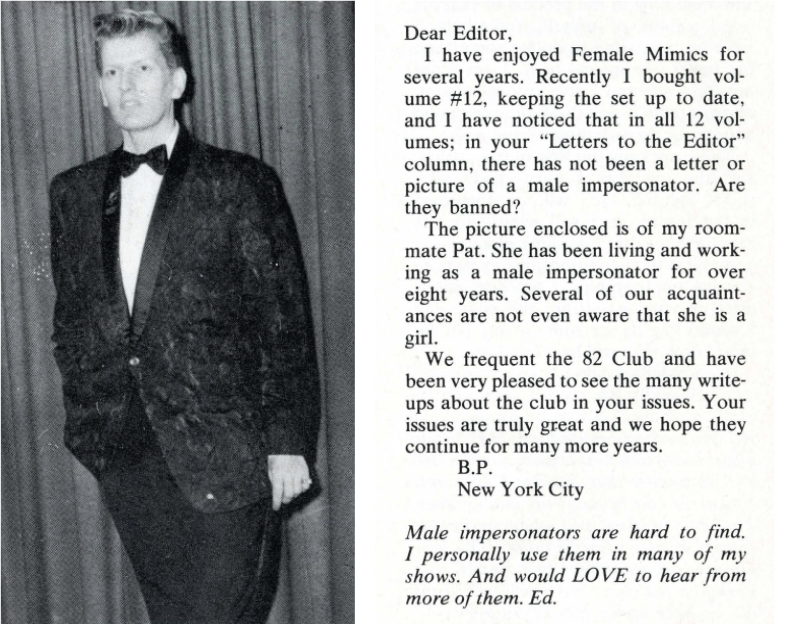
Figure 1
Letter from ‘B.P’ featured in the ‘Letters to the Editor’ section about their friend ‘Pat’ (in photograph).
Prompting critical examination from ethical and socioeconomic perspectives, this body of work highlights the historical and contemporary impacts of captive labour, specifically incarcerated shoemaking within North America. While the government’s intention for prison labour programs was to reform and educate incarcerated individuals, these programs have consistently benefited those already in positions of power, while simultaneously disempowering marginalized populations. The historical experiences of incarcerated individuals in North America mirror the continued exploitation of their contemporary counterparts. The current article explores the evolution of captive labour within the Canadian Penitentiary system, focusing on the evolution of the ideology and structure of labour programs in the Kingston Penitentiary, a federal facility in Ontario that operated between 1835 and 2012, revealing foundational cracks within the framework of 20th-century reform programs that persist in today's vocational training. Through exploring the historical evolution of captive labour within Canada, the article unveils parallels between the systemic inequalities, racism, and classism that continue to manifest within both incarcerated settings and broader Canadian society.
This article will explore the representations of cross-dressing and male impersonation in one specific New York-based magazine, Female Mimics, from its premiere issue in 1963 through to 1970, including the shift by publishers to the new title of Female Impersonators in 1969. Visual and text analysis of what is worn by gender non-conforming individuals featured in the magazine shine a light on members of the LGBTQ+ and cross-dressing community in the 1960s, and their subscription to, or refusal of, contemporary fashion trends and gender roles. The focus of this article will be a case study on how male impersonators, drag kings, and butch lesbians are represented, or not, within the magazine, highlighting Parisian cross-dressing bars and cabarets such figures frequented. Despite the magazine's near constant exclusion of such figures and spaces, the information provided in the handful of articles on the topic is invaluable in the historical consideration of butch masculinities and queer self-fashioning, and points to how historians can utilize queer periodicals as an essential source of LGBTQ+ dress histories.
Elizabeth Droubaugh, in her study on male impersonator DeLarverié in the book Crossing the Stage: Controversies on Cross-Dressing, notes that:
“The varieties of women in cross-dress–from male impersonators to butch lesbians to passing woman–have continued to provoke curiosity and even dread as they have tweaked (and sometimes wrenched) proprietary relations of sex, gender, and sexuality…research on men’s cross-dressing far exceeds that on women’s.”[5]
This article will seek to expand the research done on the topic of the female cross-dresser and male impersonator whilst highlighting the interconnections between such figures, butch lesbian presentations, and queer spaces during the decade. Although Female Mimics only briefly discusses such figures or spaces, the information provided is invaluable in the consideration of cross-dressing and gender-nonconforming histories which tend to privilege female impersonation over its counterpart.
[5] Elizabeth Droubaugh, “SLIDING SCALES: Notes on Stormé DeLarverie and the Jewel Box Revue, the Cross-Dressed Woman on the Contemporary Stage, and the Invert” in Crossing the Stage: Controversies on Cross-Dressing, ed. Lesley Farris (London: Routledge, 1993), 121.
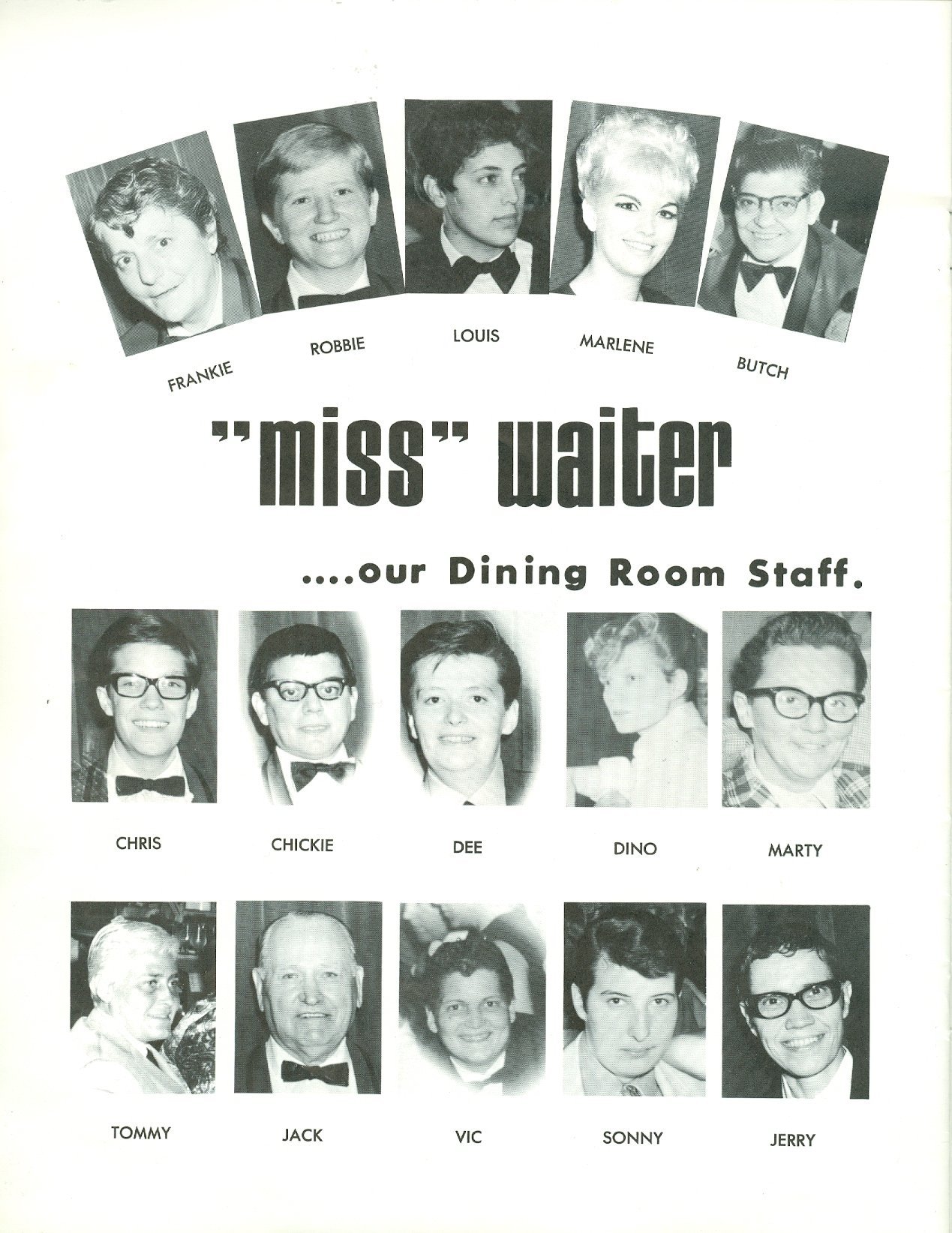
Figure 2
Dining room staff page in the 82 Club 1969 Souvenir Program dedicated to the male impersonator waiters the club became known for. Club 82 Souvenir Program, 1969, 15. Digital Transgender Archive.
By analyzing and critiquing text alongside photographs, the constructed reality of dress for the individuals mentioned can be explored. The notion of DIY (Do It Yourself) as characterized in Isabelle Held’s analysis of the history of falsies and padded foundation wear as essential elements in trans-feminine, self-fashioning is particularly relevant here.[6] The same DIY approach applies to the performance costume and dress discussed in Female Mimics, and how impersonators or other cross-dressing individuals made or collected garments themselves or worked with other creatives “to affirm their gender identities and transform their bodies.”[7] As a case study, the representations of lesbians, gender non-conforming individuals, and male impersonators or drag kings in 1960s Paris will serve as an introduction to the invaluable queer, and trans historical record present in publications such as Female Mimics.
[6] Isabelle Held, “Shaping Foundations: Trans Feminine Self-Fashioning, DIY and Community Building in the Postwar United States,” Critical Studies in Fashion & Beauty 15, no. 1 (June 1, 2024): 49-74. https://doi.org/10.1386/csfb_00069_1.
[7] Held, “Shaping Foundations,” 53.
Female Mimics: History and Editorial Content
The same article notes that Female Mimics was published for sixteen years, starting in 1963, and is an important resource in the study of LGBTQ+, specifically transgender, history.[9] Although the magazine was not always produced by members of the community, it contains valuable information regarding the lives of trans and otherwise gender non-conforming people at the time and “any researcher would be justified in saying that [the] community supported this publication and, therefore, it reflects much about [them].”[10] Queer people contributed to the publication even if they weren’t employed as editors or publishers. Articles were occasionally written by performers or members of the profession and the Letters to the Editor feature, which became an essential element of the publication, included both photographs and letters contributed by readers.
Female Mimics provides information on female, and some male, impersonators in New York and Paris, primarily, but also venues in cities across Canada, Germany, Mexico, and more. Articles range from profiles of specific performers to those focused on balls, events, and venues, as well as “how to’s” and histories of cross-dressing going back to antiquity. A typical publication would feature a colour front and back cover with two to three pages of coloured inserts, usually of the cover star or related to the cover story, and the rest presented in black and white. The overwhelming presence of photographs in the magazine offers a crucial, and mostly under-researched, image source for the study of cross-dressing. The images range from staged photographs in apartments, on sets, those taken at specific venues, publicity shots, and those sent in by readers.
[8] Bob Davis and Carol Kleinmaier, “The History and Significance of Female Mimics Magazine 1963-1979,” Ssshhh! 2, No. 1 (1995): 1-12.
[9] Davis and Kleinmaier, “Female Mimics Magazine,” 2.
[10] Ibid.
Sources and Methodology
As this article focuses on the publication Female Mimics itself, the most important primary source for this study are the issues produced in 1963 and 1970, which are available on both the Digital Transgender Archive and Internet Archive. For this article, digital versions of the magazine and other supporting primary documentation were viewed online at the Digital Transgender Archive in combination with physical versions of the periodical and other contemporaneous cross-dressing magazines in the collection of the LGBT Community Center National History Archive, located in New York, as well as in the collection of the New York Public Library archives. Many, if not all, of these periodicals focus on female cross-dressing during the period under consideration. Dedicated male impersonation periodicals either did not exist or have not been valued, collected, or digitized for ease of access.
This article follows in the footsteps of numerous recent studies on cross-dressing and its history. Seminal sources on the history and theory behind cross-dressing, such as author Marjorie Garber’s Vested Interests: Cross-Dressing and Cultural Anxiety (1992) and sexologists Vern and Bonnie Bullough’s Cross Dressing, Sex, and Gender (1993), are starting points for understanding the meaning behind cross-dressing, its reception in society, and its varied practice not only geographically, but also aesthetically. Theories on gender and performativity, such as gender studies scholar Judith Butler’s Gender Trouble: Feminism and the Subversion of Identity (1990) and Bodies That Matter: On the Discursive Limits of Sex (1993), are used to analyze the meaning of gender and the revolutionary act of drag in critiquing and highlighting societal expectations of gender roles, expressions, and identities. Clare Sears’ Arresting Dress: Cross-Dressing, Law, and Fascination in Nineteenth-Century San Francisco (2014), Gillian M. Rodger’s Just One of the Boys: Female-to-Male Cross-Dressing on the American Variety Stage (2018), Meredith Heller’s Queering Drag: Redefining the Discourse of Gender-Bending (2020) and Elyssa Maxx Goodman’s Glitter and Concrete: A Cultural History of Drag in New York City (2023) are more recent examples that make use of developments in gender, queer, and transgender studies. Qualifying papers by Fashion Institute of Technology (FIT) alumni Deirdre M. Morgan and Donald J. Jackson are also relevant in their discussion of cross-dressing from a dress historical perspective.[11]
As this paper's focus is on male impersonators, I draw from Elizabeth Droubaugh’s chapter on the Jewel Box Revue in the previously mentioned book Crossing the Stage: Controversies on Cross-Dressing, edited by Lesley Ferris.[12] Understanding cross-dressing in relation to women, drag kings, and male impersonators is an integral part of this article, that is informed by gender studies scholar Jack Halberstam’s Female Masculinity (1998), and drag king Diane Torr, and performance historian Stephen Bottoms’ Sex, Drag, and Male Roles: Investigating Gender as Performance (2010).
[11] Deirdre M. Morgan, “Pants, Performance, and Perception: The Impact of New York’s Disguise Law (1845) on Gendered Dress” (MA thesis., Fashion Institute of Technology, New York, 2023), ProQuest Dissertations & Theses; Donald J. Jackson, “Fashion, Freedom, and Acculturation in New York’s Catskill Mountains, 1900-1969” (MA thesis., Fashion Institute of Technology, New York, 2024), ProQuest Dissertations & Theses Global.
[12] Elizabeth Droubaugh, “SLIDING SCALES: Notes on Stormé DeLarverie and the Jewel Box Revue, the Cross-Dressed Woman on the Contemporary Stage, and the Invert” in Crossing the Stage: Controversies on Cross-Dressing, ed. Lesley Farris (London: Routledge, 1993), 121.
Definition and Explanation of Terms
Cross-dressing and impersonation are utilized in the title and throughout this article which is in keeping with the language used at the time under investigation. To use the term “drag” would be a partly inaccurate descriptor for the period since, as journalist Elyssa Maxx Goodman notes in Glitter and Concrete, the term drag queen in the 1960s, and before, implied a level of “amateurness” whereas the term impersonator was used to describe cross-dressing done professionally.[13] Similar to Goodman’s approach, the terminology used to refer to specific performers best reflects how they themselves described their profession or practice as, which could range from a female/male impersonator, drag queen/king, drag artist, drag performer, and more.[14]
In their analysis of cross-dressing and law in nineteenth century San Francisco, Clare Sears similarly follows the “historical subjects’ lead and uses pronouns and names (when known) that correspond to their self-identifications.”[15] When such information is unavailable, Sears utilizes ‘s/he’ and ‘his/her’ as an alternative.[16] For the sake of readability and to avoid the “presumption of gender” or the limitation of gender possibilities, this paper will follow a method utilized by the trans historian Kit Heyam of using they for figures who haven’t explicitly stated their desired pronouns.[17] For instance, Stormé DeLarverié, mentioned briefly in the introduction to this article, has often been referred to using she/her and they/them pronouns, and some friends and contemporaries also used he/him. For the purposes of this study, “they” will be used for the sake of consistency and to honour their gender nonconformity.[18]
[13] Goodman, Glitter and Concrete, 130.; Drag queens were those who cross-dressed at events like a drag ball and on the street without the pretense of performing at a venue as a female impersonator, in contrast, would.
[14] Ibid.
[15] Clare Sears, Arresting Dress: Cross-Dressing, Law, and Fascination in Nineteenth-Century San Francisco (Durham: Duke University Press, 2015), 20.
[16] Sears, Arresting Dress, 20.
[17] Kit Heyam, Before We Were Trans: A New History of Gender (New York: Seal Press, 2022), 29; A similar method was used in Deirdre M. Morgan’s qualifying paper “Pants, Performance, and Perception: The Impact of New York’s Disguise Law (1845) on Gendered Dress” from 2023.
[18] In keeping with the style guide for the Bulletin of Applied Transgender Studies, when “referring to people who do not conform to conventional gender norms” the adjectival phrase “gender-nonconforming” is used throughout this paper. The ATS also recommends a method similar to Heyam of using ‘they,’ for figures when their gender identity or pronouns are unknown. “Style Guide for the Bulletin of Applied Transgender Studies,” ATS, last modified December 15, 2021, https://bulletin.appliedtransstudies.org/docs/Style-Guide_2021_12_15.pdf.
Cross-dressing, though, is not a term without its problems. Sears notes that the term is perhaps too broad, obscuring the variations of the very practice it attempts to describe.[19] Importantly, “the term cross-dressing erroneously assumes that the type of clothing that “belongs” to each sex is easily agreed upon, when in fact such determinations are subject to fierce social debate as well as to change over time.”[20] Finally, the ‘cross’ in cross-dressing implies that people are jumping between two modes, reinforcing the idea that gender is binary and nothing more.[21] However, Sears notes the problems with the term cross-dressing do not mean that it is not a useful descriptor, but that it should be interrogated and understood as something “politically loaded” rather than neutral.[22]
Writing about gender-nonconforming people presents difficulties for the researcher attempting to bring their history to light. As Eleanor Medhurst notes in Unsuitable: A History of Lesbian Fashion, these subjects are real people who “are ultimately not ours to label, but only to try and understand.”[23] Yet, at the same time, a pervasive cis and heteronormative bias among historians is present. Heyam notes that “historians tend to interpret people from the past as, effectively, cis until proven otherwise.”[24] A trans gaze is effectively “no less objective than any other kinds of history: in fact, in many cases it might be more so.”[25] Although there have been many studies on the history of cross-dressing, few have analyzed the topic through the lens of dress history and even fewer shine a light on male impersonators.
Save for a few examples, such as the recent work by Eleanor Medhurst and Isabelle Held, there is a lack of scholarship within the discipline of dress history exploring this area.[26] Although the period of the 1960s has been studied extensively, both within the field and beyond, how impersonators and other cross-dressing individuals interacted with different trends and changing aesthetics of the time has yet to be thoroughly analyzed. Additionally, erotica and magazines of a similar vein to Female Mimics are often neglected in academic research due to their ‘taboo’ themes or pornographic content. This article serves only as an introduction to the benefit of looking into, and critiquing, these periodicals and the insights they can provide not only to dress historians, but also those in the fields of cultural studies, queer studies, gender studies, and beyond.
[19] Sears, Arresting Dress, 21.
[20] Ibid.
[21] Ibid.
[22] Ibid., 22.
[23] Eleanor Medhurst, Unsuitable: A History of Lesbian Fashion (London: Hurst and Company, 2024), 4.
[24] Heyam, Before We Were Trans, 19.
[25] Ibid., 20.
[26] Held, “Shaping Foundations,” 49–74.
The Cross-dressed Woman and the Male Impersonator in 1960S Paris
As mentioned previously, the majority of venues highlighted within the magazine are located in either New York or Paris. Le Carrousel, a famous Parisian venue for female impersonators, is highlighted as early as the first issue of Female Mimics pointing to the vibrant cross-dressing community that flourished within the European city.[27] As a New York-based magazine, the editorial descriptions of Paris come with a sense of fantastical otherworldliness.[28] Although certain articles highlighted the fact that performers often would work across European cities, it also was not unusual for American performers to appear in European venues, or vice versa.[29] Such a discussion, though, is often limited to that of female impersonators as opposed to their male impersonator counterparts. Overwhelmingly, the discussion of male impersonation is limited to venues located in Paris, despite performers working in New York in many of the spaces frequently highlighted in the magazine. As such, the remainder of the article will focus on male impersonation, butch presentations, and gender nonconformity within these Parisian spaces.
[27] “Merry Madhouse…le Carrousel,” Female Mimics Vol. 1 No. 1, 1963, 19-24;
[28] “Merry Madhouse…Le Carrousel,” 20.
[29] The magazine's article on Madame Arthur’s Amsterdam club notes that performers were ‘exchanged’ from Amsterdam to Paris, and vice versa; “Dutch Treat,” Female Mimics Vol. 1 No. 2, 1963, 52.
When male impersonators are mentioned, their highlights are fleeting, as in the case of the famed Jewel Box Revue and their one male impersonator starting with Micky Mercer, mentioned in the second issue of the magazine, and Stormé DeLarverié mentioned in the fifth.[30] Certain clubs, such as Club 82, did at some points have male impersonators as part of their program, such as Jo Vaughn who was featured in one from the early 1960s (fig. 3) and the male impersonator waiters also discussed earlier (fig. 2).
[30] “The Jewel Box Revue,” Female Mimics Vol. 1 No. 2, 1963, 52; “The Jewel Box Revue,” Female Mimics Vol. 1 No. 5, 1965, 22.
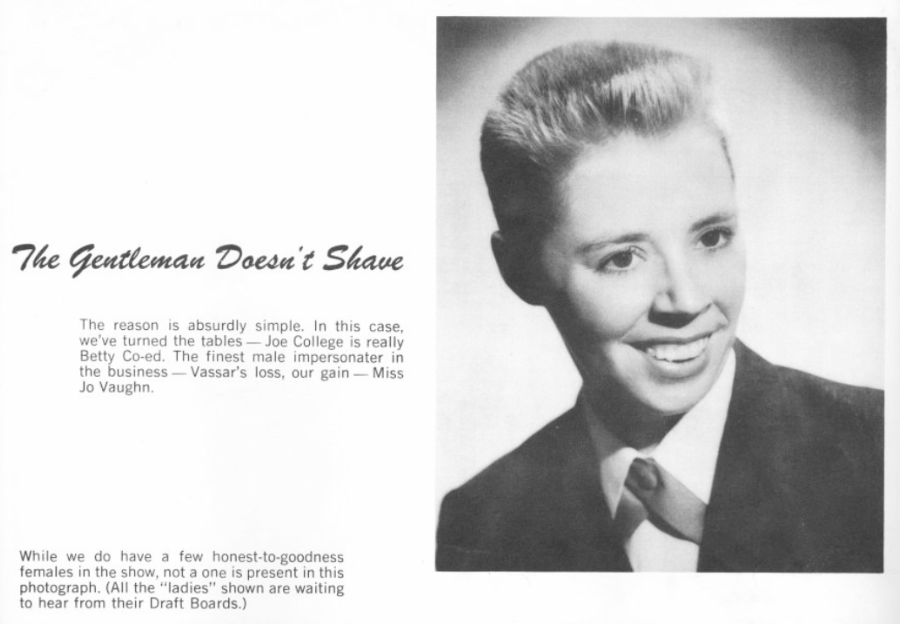
Figure 3
Male impersonator Jo Vaughn who performed at Club 82 in the early 1960s. Club 82 Program, c. 1961-1965, 10. Digital Transgender Archive.
From 1963-1968 there are two articles and one advertisement in Female Mimics dedicated to French bars and cabarets that served as both meeting places and venues for female cross-dressers, gender-nonconforming individuals, and male impersonators. There are, unfortunately, no articles within the publication explicitly dedicated to male impersonation in New York City-based venues. Often, articles dedicated to NYC venues tend to highlight the female impersonator performers that frequent such spaces with their male impersonator counterparts either only briefly mentioned or neglected entirely. As such, the focus on Parisian spaces provides an avenue for exploring how male impersonators, drag kings, and butch lesbians are represented within the magazine and the dress and/or performance costume they display.
The first article, “Torrid Three from Gay Paree,” in the third issue of the magazine from 1963, discusses Le Monocle, Frede's Carroll's Club, identified as Frede’s Cabaret, and Chez Moune along with photos of customers at the establishment (fig. 4).[31] Although Chez Moune is highlighted again in a 1968 feature, both Le Monocle and Frede’s Carroll’s Club are not discussed again in the publication.[32] Similarly, the venue Elle et Lui is featured only twice in the same 1968 feature as Chez Moune and in a three-page advertising spread in the eighth issue. Of these “sapphic cabarets,” Tamara Chaplin notes in her recent book Becoming Lesbian: A Queer History of Modern France that,
“(M)any of the sapphic cabarets that opened in Paris in the 1930s outlasted World War II and endured as sites of nonnormative communal and cultural continuity well into the postwar period. Their survival into the 1960s reveals a previously overlooked world of sapphic sociability that remained surprisingly active during years legendary for their heteronormativity and homophobia.”[33]
Alongside photos of the exteriors of Le Monocle and Chez Moune, the title page of “Torrid Three from Gay Paree” introduces these “clubs where women do the man bit.”[34] Located in Paris’ Left Bank, Le Monocle “was known for the eccentricities of its characters,” and was hosted by Jo.[35] Photographs of the venue mostly feature women dancing (fig. 5), supported by the text which notes that “there’s hardly a man to be seen on the dance floor.”36 Much like Club 82’s male impersonator waiters, Le Monocle similarly had female waiters whom the magazine describes as being “dressed and groomed as men.”[37]
[31] “Torrid Three from Gay Paree,” Female Mimics Vol. 1 No. 3, 1963, 54-62.; Tamara Chaplin, Becoming Lesbian: A Queer History of Modern France (Chicago: University of Chicago Press, 2024), 99.
[32] “From Gay Paree: An Exclusive Visit to Chez Moune and Elle et Lui Where Gals Play at Being Guys,” Female Mimics Vol. 1 No. 11, 1968, 19-24.
[33] Chaplin, Becoming Lesbian, 52-53.
[34] “Torrid Three From Gay Paree,” 54.
[35] Ibid,. 55.
[36] Ibid., 54.
[37] Ibid.
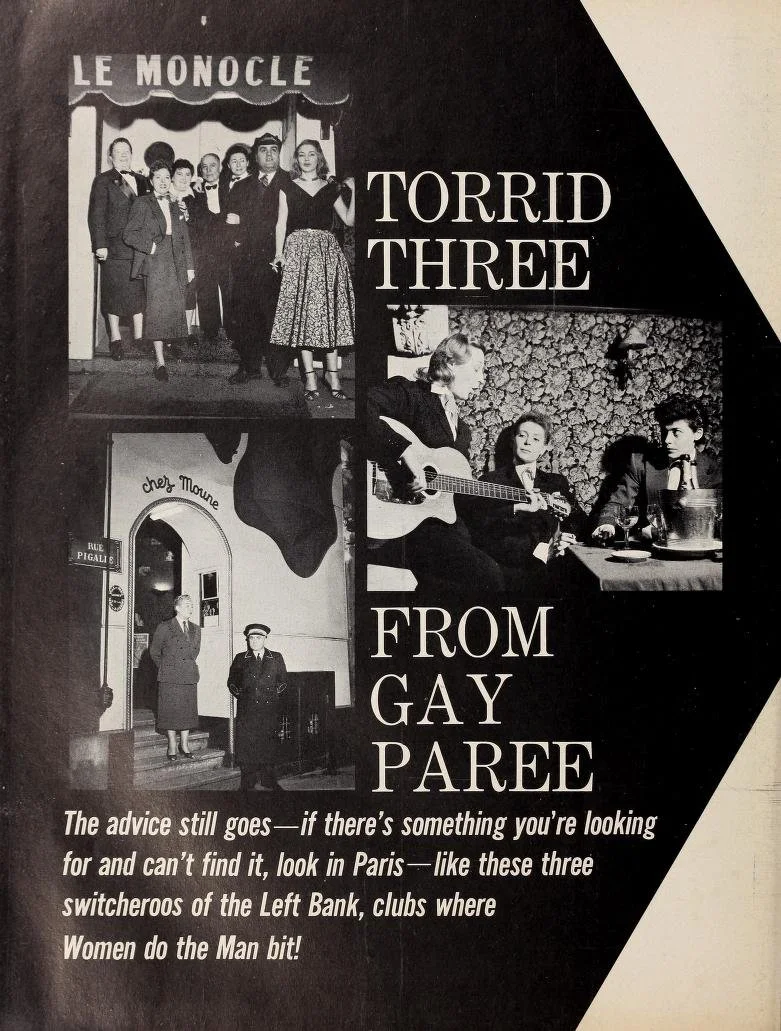
figure 4
Cover page for the “Torrid Three from Gay Paree” article focused on Le Monocle, Frede’s Cabaret, Chez Moune, and the cross-dressing women who frequented or worked at the establishment. Female Mimics Vol. 1 No. 3, 1963, 54. Digital Transgender Archive.
They may embellish their look with various pieces of jewelry or neckwear such as a small bowtie, a cravat, or a more traditional long tie, pointing to a level of individuality rather than uniformity when it comes to how patrons dressed within such spaces.
Le Monocle is perhaps best known as a club that flourished in Paris in the 1930s. Australian-American actor Errol Flynn in his autobiography described the attendees when he visited in the late 1930s as “masculine females, ready to please,” and all “dressed in tuxedos, like men.”[38] The French-Hungarian photographer Brassaï, known for his provocative images of the bar, wrote in 1976 that it was “one of the first temples of Sapphic love.”[39] Much like how Female Mimics discusses the club and others like it he noted, “the women were dressed as men, and so totally masculine in appearance that at first glance one thought they were,” a sentiment similar to that featured in Female Mimics where gender presentations of club attendees are often thought of as poor impersonations of ‘real’ masculinity seen as inherent in cis, heterosexual, male bodies.[40]
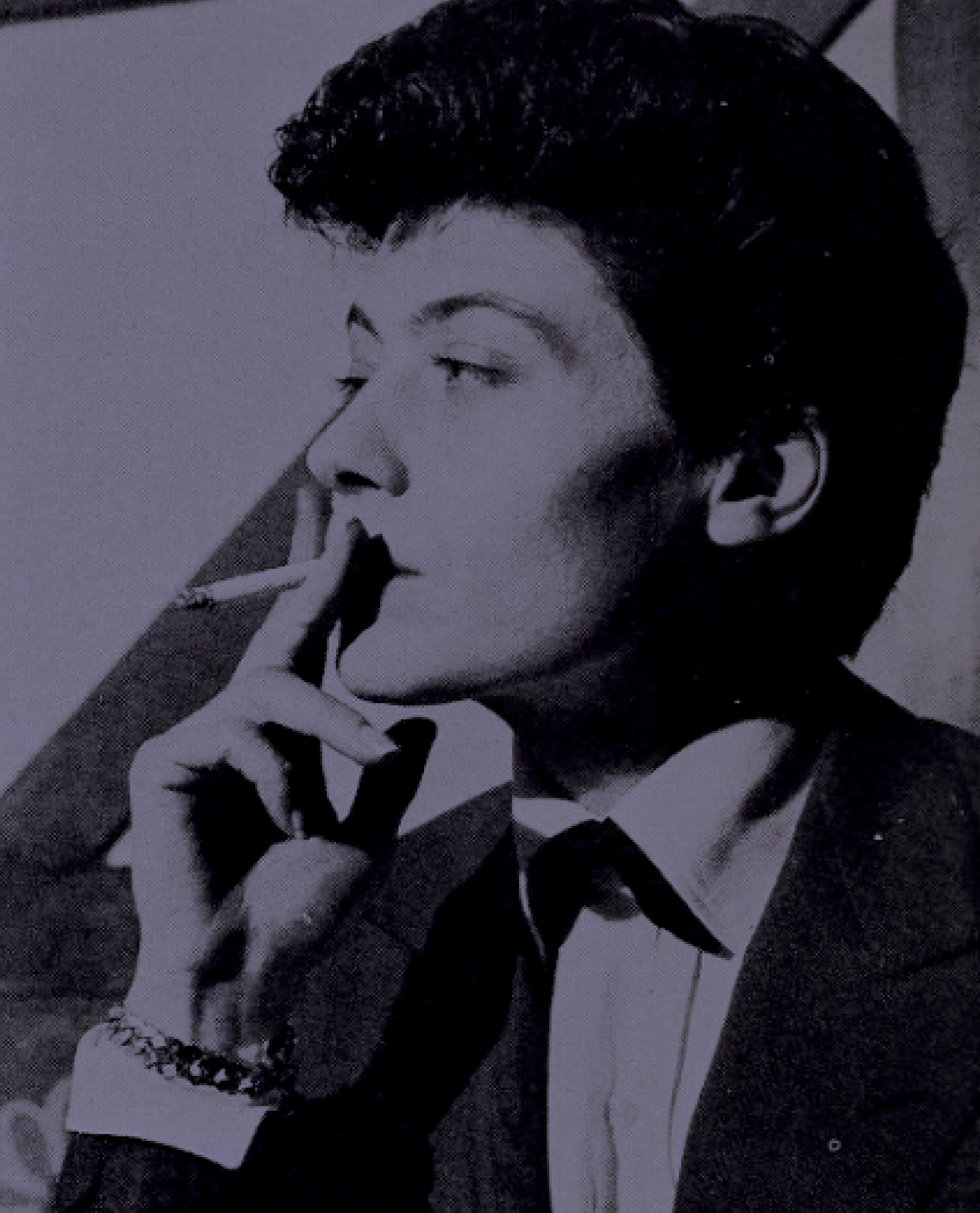
The second establishment discussed in the 1963 article is Frede's Carroll's Club, presided over by Frede Baulé, seen smoking a cigarette and “smartly dressed” in a suit in the first page highlighting the club.[41] Much like Le Monocle, Frede's Carroll's Club is described as less an establishment for tourists and more a location frequented by artists, writers, and other creatives.[42] Similar to Le Monocle, despite the many pictures of attendees, few are named other than the owner Frede and the club's secretary Michele Berger, who can be seen in conversation in various photos, both dressed in skirt suits (fig. 6). Both Frede and Berger are depicted with short hair, cigarettes in hand. Frede wears a double-breasted herringbone style suit with a white pocket square tucked into their breast pocket, whereas Berger opts for an all-black ensemble with smaller lapels on the jacket finished with what looks like a pin on her lapel and a white pocket square. Compared to the images from Le Monocle, neither woman wears a tie underneath their slim suits. A photo on the top right corner introducing the club shows Frede with short, cropped hair, cigarette at their lips, and wearing a men’s shirt and blazer with a thick chain bracelet at their wrist (fig. 7). Underneath the photo the magazine notes that “her clothes are made specifically for her by a Paris couturier.”[43] Their coiffed style of hair is almost Elvis-like and the contrast of the photo emphasizes their cheekbones as they draw on the cigarette at their lips.
[38] Errol Flynn and Earl Conrad, My Wicked, Wicked Ways (New York: G. P. Putnam’s Sons, 1956), 221.
[39] Brassaï, The Secret Paris of the 30s (New York: Pantheon Books, 1976), 161.
[40] Ibid., 166.
[41] “Torrid Three From Gay Paree,” 58; Chaplin, 99.
[42] “Torrid Three From Gay Paree,” 55-58.
[43] Ibid., 58.
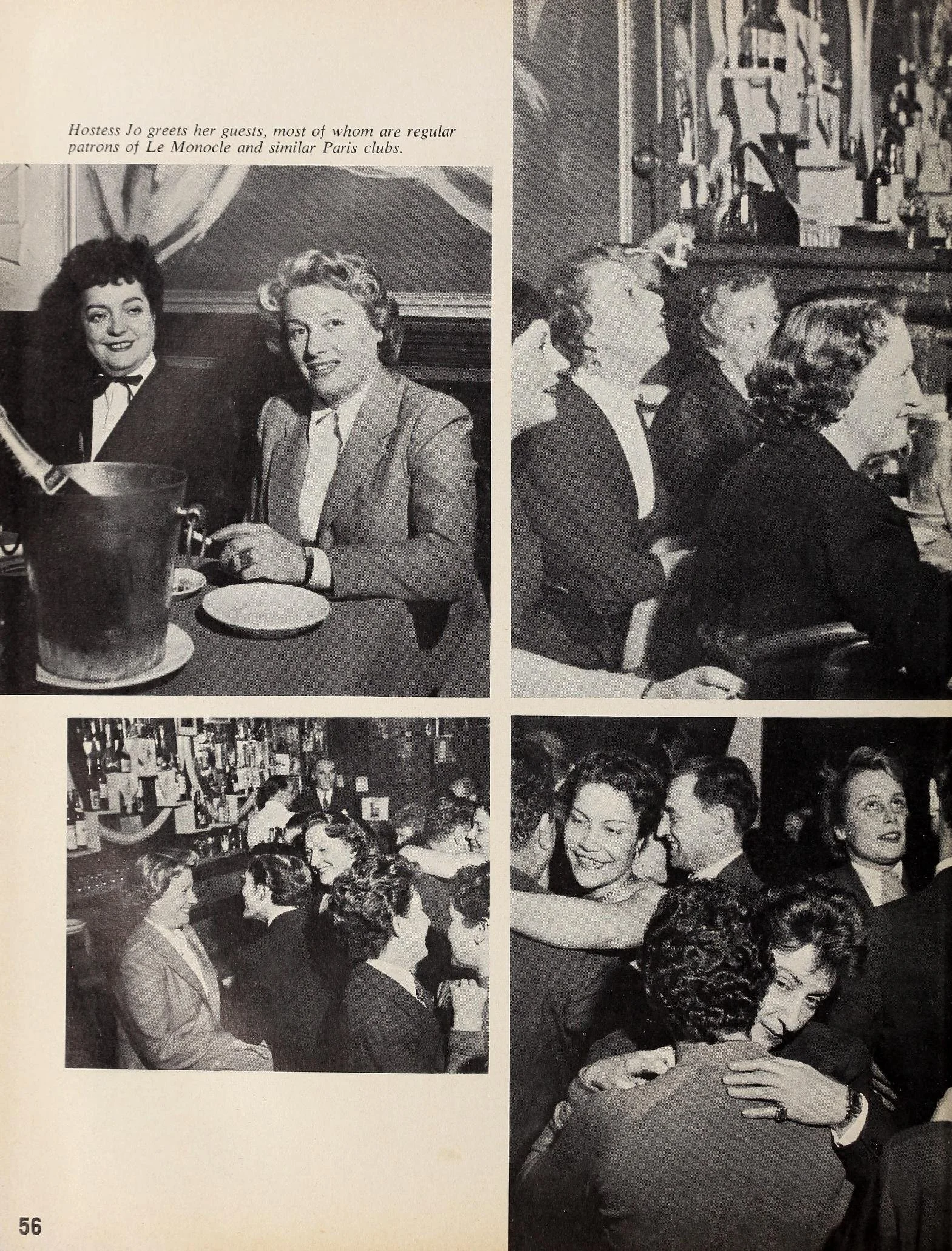
figure 5
Photographs from the French venue Le Monocle show few men and women dressed in tailored ensembles and sporting cropped hair. “Torrid Three from Gay Paree,” Female Mimics Vol. 1 No. 3, 1963, 54-62. Digital Transgender Archive.
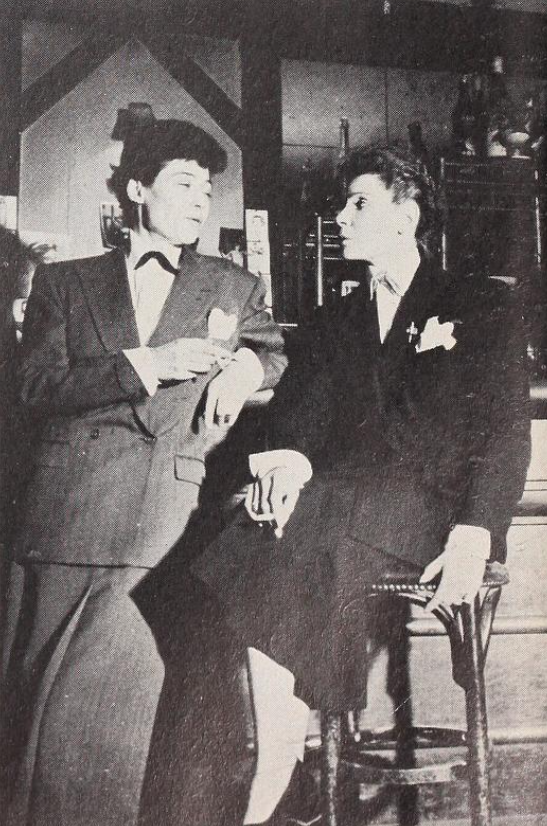
Figure 6
Secretary of Frede’s Cabaret Michele Berger (right) and owner Frede (left) within the club. “Torrid Three from Gay Paree,” Female Mimics Vol. 1 No. 3, 1963, 59. Digital Transgender Archive.
In describing mid-century lesbian bars Eleanor Medhurst discusses the butch and the skirt:
“Butch lesbians continued to be butch lesbians when dressed in skirts. There were certain ways of dressing that, while appropriately feminine for the eyes of the law, had butch connotations when seen by other lesbians. In the bars, butch and femme identities often came with strict dress codes. This was specifically butch fashion, not general masculine fashion, and it drew on a thread stitched and tugged by previous generations whose lesbian masculinity was not diluted by a lack of two-legged garments…”[44]
Alix Genter, in her analysis of queer legibility in post-war New York, describes the butch favorite of the pencil skirt.[45] Considered “more tailored and less feminine,” the pencil skirt allowed for butches to finish their outfits with masculine garments like a collared shirt and suit jacket, as shown in images from bars like Le Monocle, whereas if they wore a dress such expressions of identity would be harder to portray.[46]
To Medhurst’s earlier point, butch figures in history wearing skirts that were understood by other queer people as masculine was certainly nothing new. Images of the writer Radclyffe Hall and their partner Una Troubridge, understood as both representing a sort of lesbian dandyism in the earlier twentieth century, depicted Hall, more often than not, wearing a slim skirt with a shirt, tie, and jacket, whereas Troubridge would wear a dress (fig. 8). The contrast between their two gender presentations is understood as representing a sort of continuum of lesbian fashion where Hall can be read as more butch whilst wearing a skirt because Troubridge presents more femme in a dress.
[44] Medhurst, Unsuitable, 105.
[45] Alix Genter, “Appearances Can Be Deceiving: Butch-Femme Fashion and Queer Legibility in New York City, 1945–1969,” Feminist Studies 42, no. 3 (2016): 609.
[46] Genter, “Appearances Can Be Deceiving,” 610.
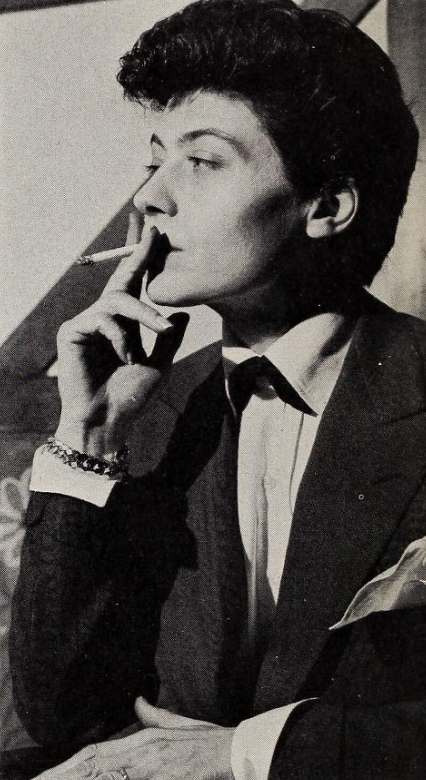
figure 7
Photograph of Frede in a button up and suit jacket with coiffed hair and a cigarette in hand. “Torrid Three from Gay Paree,” Female Mimics Vol. 1 No. 3, 1963, 58. Digital Transgender Archive.
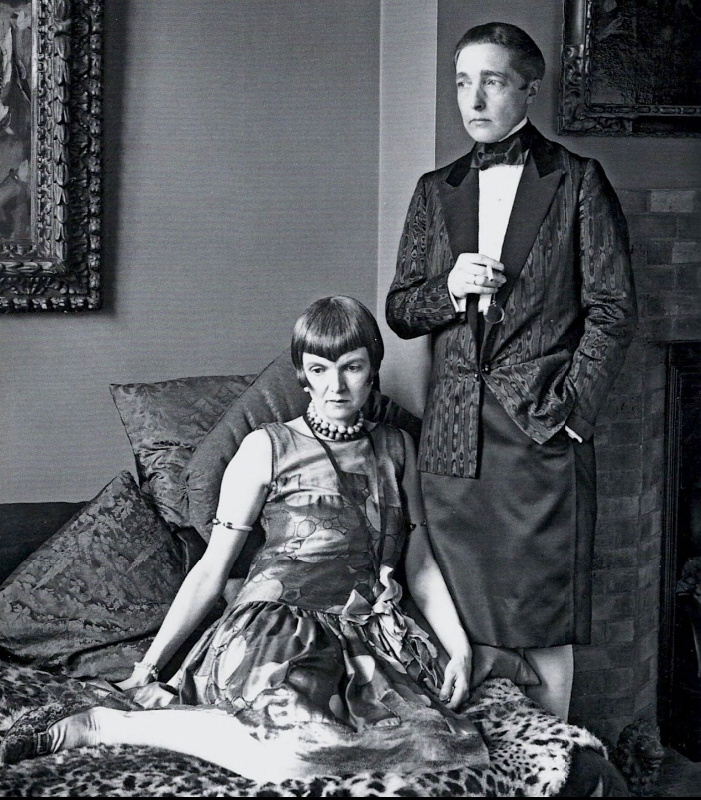
Figure 8
Una Troubridge (left) and Radclyffe Hall (right) representing an earlier version of the butch-femme lesbian dynamic where Hall wears a skirt and more masculine upper garments compared to the dress Troubridge wears. Radclyffe Hall and Una Vincenzo, Lady Troubridge, August 1, 1927, Hulton Archive, Harry Ransom Center, The University of Texas at Austin. HRC Digital Collection.
The final club mentioned in the article, Chez Moune, appears again in a later issue, unlike the aforementioned Le Monocle and Frede’s Carroll’s Club that are both only highlighted once over the total run of the periodical. Chez Moune was owned and operated by Moune “who dresses and acts like a man.”[47] The first photograph (fig. 9) introducing the club shows Moune sitting at a bar with waiters and customers in their finest menswear.[48] Moune’s light hair is slicked back and they wear a black suit jacket with a white shirt underneath and a geometric patterned tie that pops against the stark light of the shirt. The figures standing slightly behind those at the bar are likely the waiters, all wearing some semblance of a uniform which, in the case of Chez Moune, appears to be a white shirt with a black overcoat and small black tie at the neck.
It’s important to note how much the magazine harps on the masculine-presenting waiters at French clubs like Le Monocle and Chez Moune but completely negates their presence at venues such as Club 82; spaces where female impersonators are more recognized at least in the magazine's context. Alix Genter notes that “the dominant symbol of postwar lesbianism resided in legible butch bodies.”[49] In comparison to femmes, butches were more visibly queer, especially if they wore their hair short and favored more traditional menswear garments like a suit jacket and tie. Much like Frede and Berger from the previous profile on Frede’s Carroll’s Club, Moune is also shown in a skirt suit, seen in full in a photo on the following page (fig. 10) of the owner dancing with a woman who is “one of the rare ones dressed like one,” in attendance at the French club.[50]
[47] “Torrid Three From Gay Paree,” 60.
[48] Ibid.
[49] Genter, “Appearances Can Be Deceiving,” 604-607.
[50] “Torrid Three From Gay Paree,” 61.
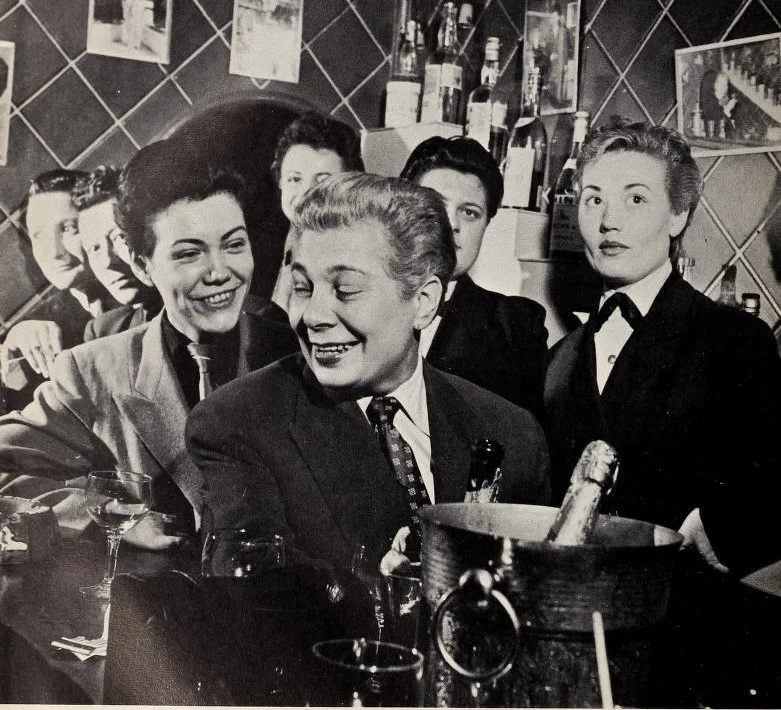
figure 9
Moune (center, front) with waiters and guests sitting at the bar of the French venue Chez Moune. “Torrid Three from Gay Paree,” Female Mimics Vol. 1 No. 3, 1963, 60. Digital Transgender Archive.
Chez Moune is mentioned again in the eleventh issue of Female Mimics in an article titled “From Gay Paree” where “gals play at being guys.”[51] Moune appears much as they did in the previous article; with short, cropped hair and wearing a dark suit jacket with a patterned tie (fig. 11). Other figures around the table show some variance; many opt against a tie, preferring to sport their shirts buttoned up underneath their jackets without anything at their neck. Others wear small-scale patterned ties or bowties. Bracelets, as well as rings, present on patrons' ring fingers, are also seen. The photo, much like the others from the article and ones like it, point to a generally accepted uniform within such spaces that allowed for slight variations and personal touches. In the previously mentioned image (fig. 10), where Moune is shown hand in hand with another woman, the figure displays a more feminine presentation with long hair, lipstick, a turtleneck sweater, and a long skirt.
Elle et Lui, although not highlighted in the first article on French clubs, three years later in 1966 is featured in an advertising spread in the eighth issue of the magazine. French for “She and Him,” it's noted the club is right next to Le Carrousel, the Parisian female impersonator venue, and that the two “co-exist by giving mutual aid.”[52] The style of the advertisement is modelled after an earlier one for Le Carrousel featuring the French female impersonator, Bambi, in a series of process photos to represent the fantastical magic of cross-dressing (fig. 12). On the left, she appears suave from head to toe in menswear, wearing a suit and tie with a fedora and cane in hand. In the transition shot Bambi appears mostly nude followed by the final image of her in a full-length fitted shift dress covered in a pattern of birds and flowers. Her hair, as opposed to being tucked underneath the hat, falls against her shoulder in a simple cut.
[51] “From Gay Paree,” 19.
[52] Elle et Lui Advertisement, Female Mimics Vol. 1 No. 8, 1966, 45.
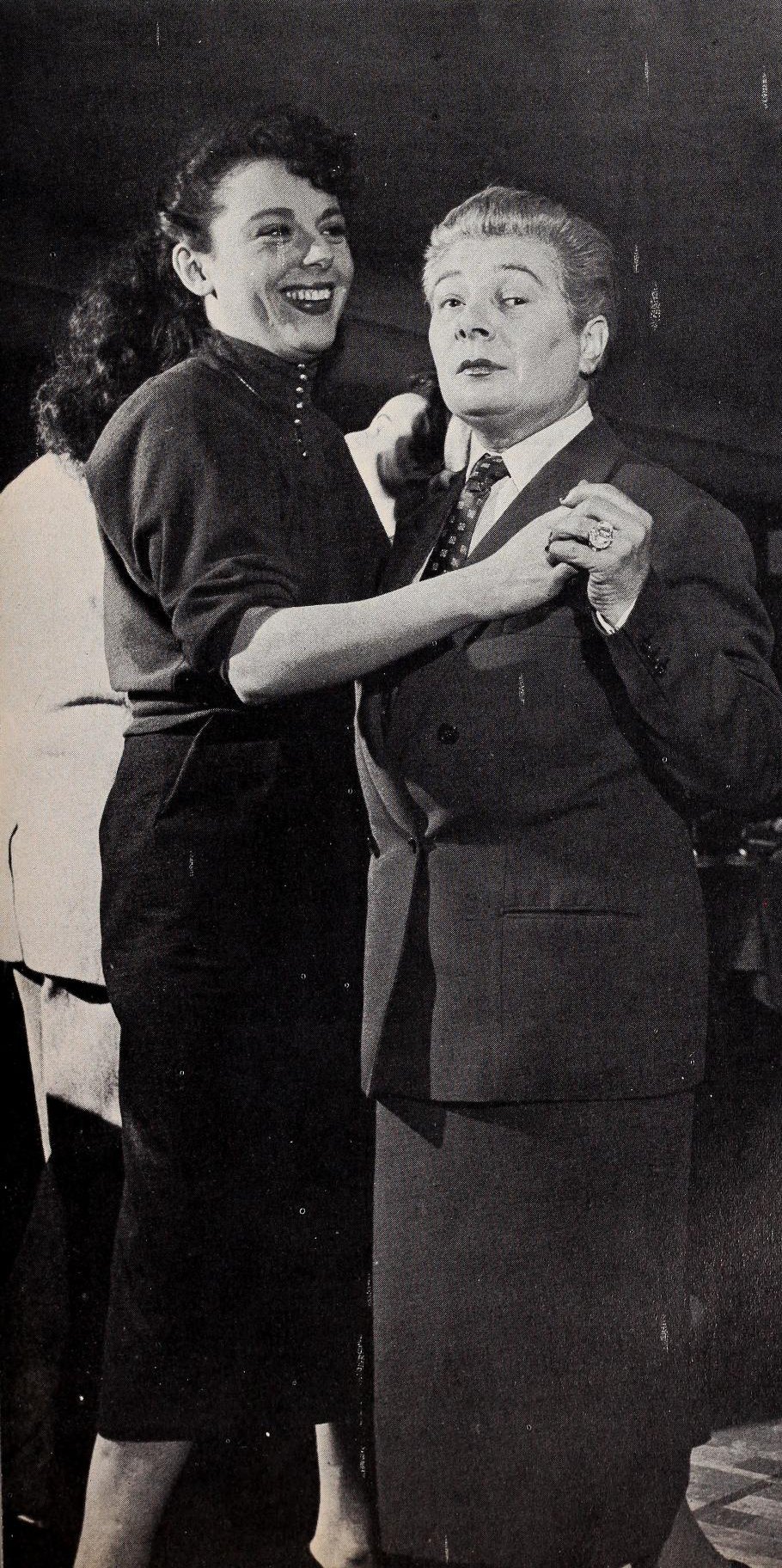
Figure 10
Moune (right) dancing with a guest at Chez Moune. “Torrid Three from Gay Paree,” Female Mimics Vol. 1 No. 3, 1963, 61. Digital Transgender Archive.
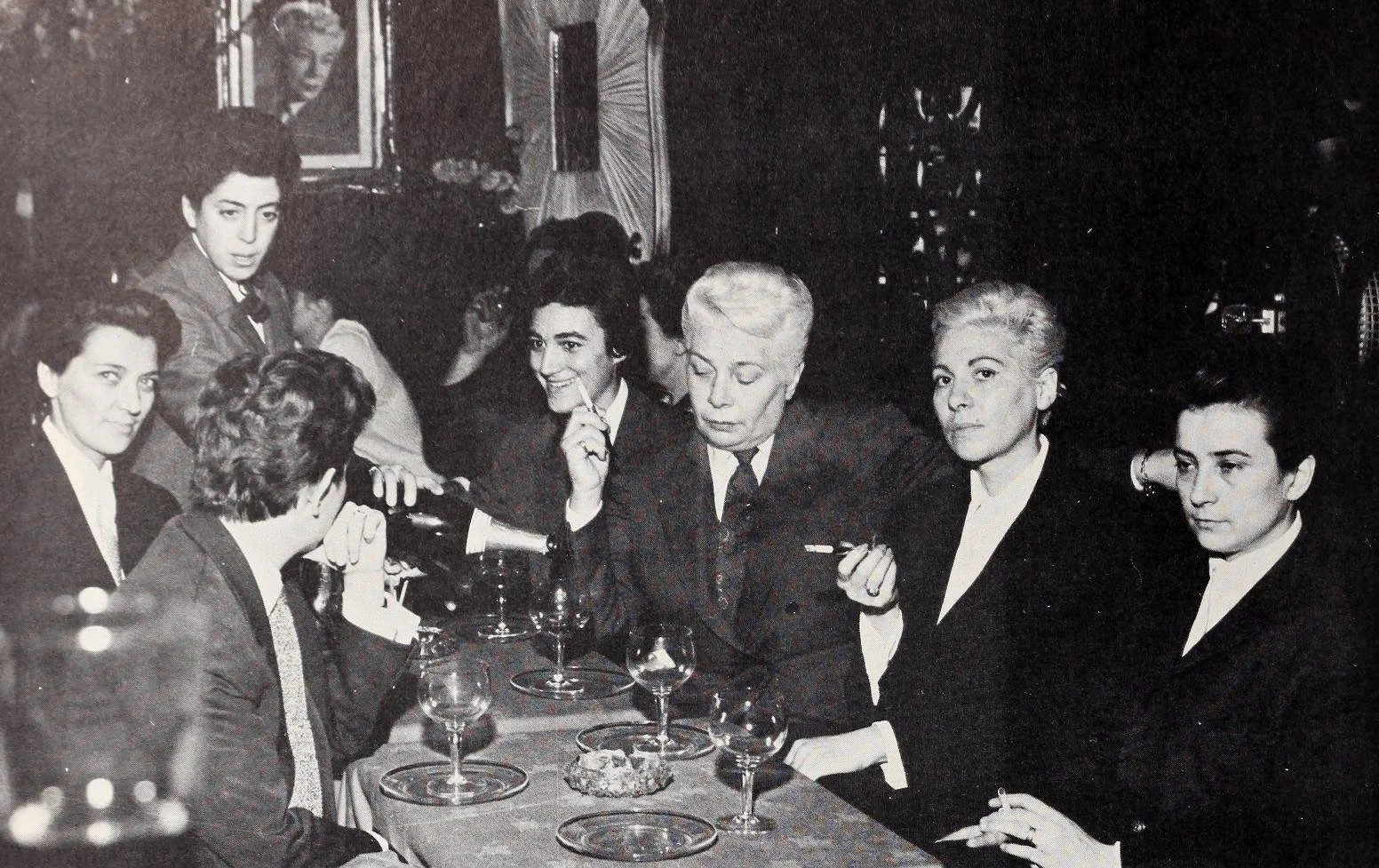
Figure 11
Moune (center with blonde hair) at Chez Moune, surrounded by customers. At the far left is a headshot of Moune, much like those of male impersonators at Elle et Lui, hung on the wall. “From Gay Paree,” Female Mimics Vol. 1 No. 11, 1968, 20. Digital Transgender Archive.
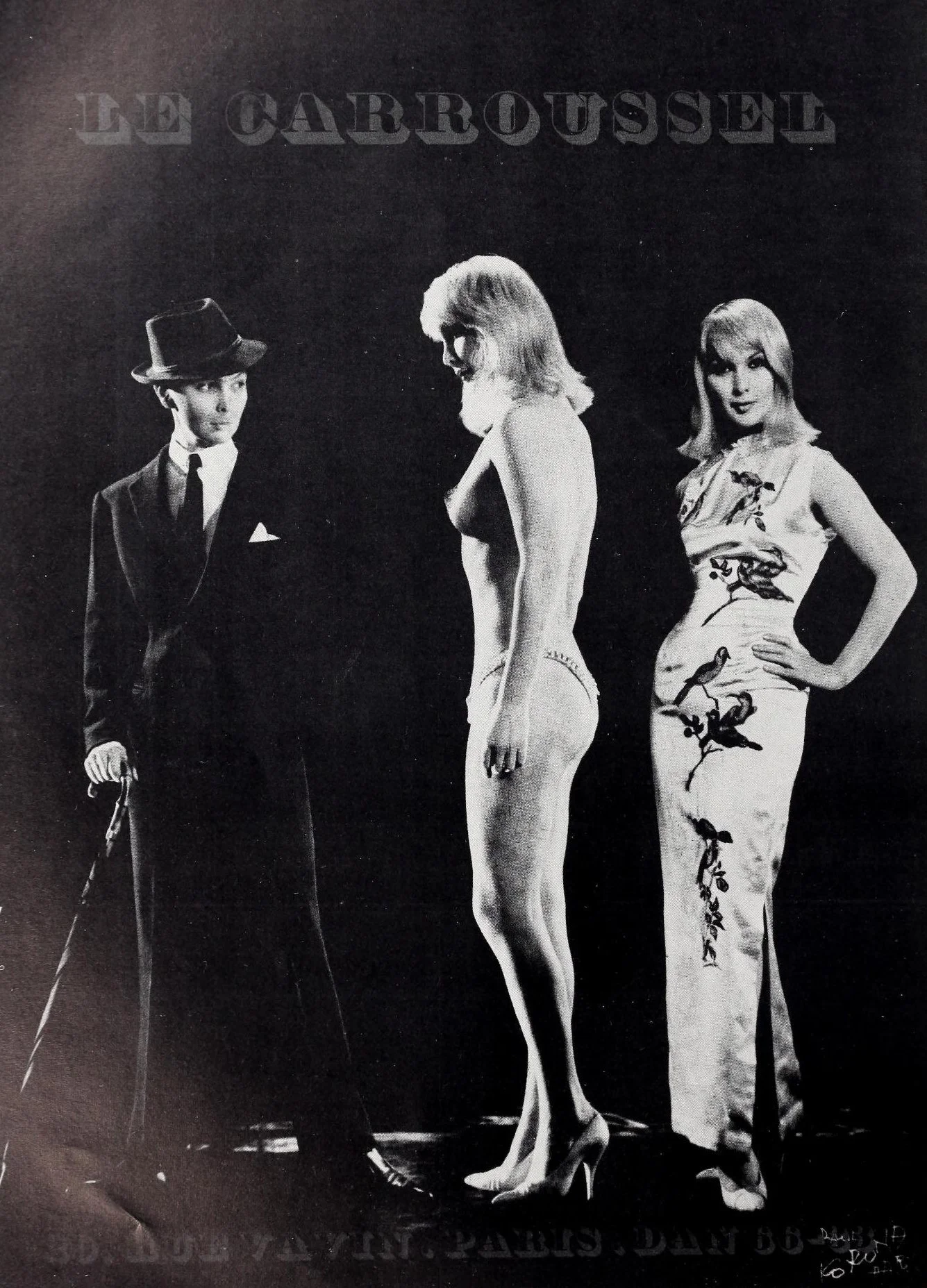
Figure 12
Advertisement for Le Carroussel, the French club known for its female impersonator acts, featuring the star performer Bambi in a ‘transition’ style of cross-dressing. Le Carroussel advertisement, Female Mimics Vol. 1 No. 8, 1966, 38. Digital Transgender Archive.
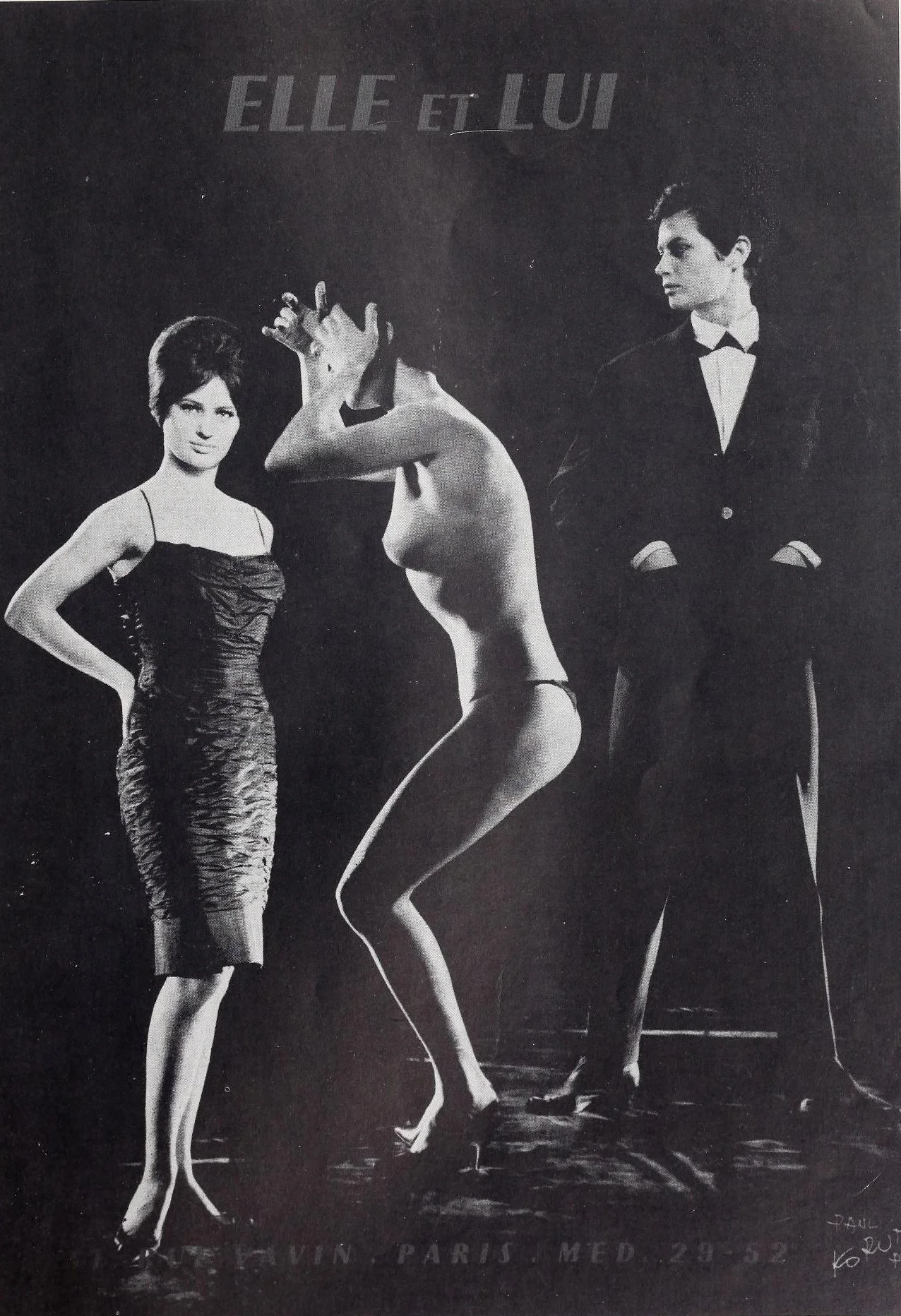
Figure 13
Advertisement for the French lesbian club Elle et Lui (She and Him) modelled off of the earlier Le Carroussel advertisement from the same issue. Elle et Lui advertisement, Female Mimics Vol. 1 No. 8, 1966, 43. Digital Transgender Archive.
As Judith Butler famously noted, “what we take to be an internal essence of gender is manufactured through a sustained set of acts, positioned through the gendered stylization of the body.”[53] Similarly, Katie Horowitz describes the gendering of gestures and their essentialness to the act of cross-dressing where “drag is a constellation of gestures that evokes legibly gendered states of embodiment only to dismiss them as absurd…or exaggerate them to abstraction.”[54] Wearing traditional menswear, Bambi places her hand in her pant pocket and looks mysteriously into the distance. Pose and gesture differ in Bambi’s final form wearing womenswear, her hands on her hips, leg outstretched to reveal her heeled shoe and staring seductively at the viewer and through the page of the magazine. The advertisement for Elle and Lui describes the club as “the other side of the coin,” of Le Carrousel where “women play at being men,” a consistently mentioned almost patronizing phrase that actively denies the gender-nonconforming identities of such figures.[55] The advertisement is presented in the same way as Bambi’s; showing a before, transition, and after to represent visually the process of cross-dressing, similar to the split screen style covers that feature on many of the magazine's issues (fig. 13). On the right, the figure wears a suit with a small tie peeking out from their collar. Their hands are placed in their pockets, legs outstretched wide, looking to the distance, much like Bambi did whilst wearing menswear.
On the following page are headshots of a series of performers identified as Domino, Franky, Frederique-Paule, and Marie-Pierre (fig. 14). Although the format of dress appears relatively similar, a shirt, suit jacket, and cropped hair, there are slight variations among the four male impersonators, a theme throughout the images depicted in the magazine. Domino is the only figure wearing a white suit, Frederique-Paule the only one with a large signet on their finger and a cigarette in hand. Much like the headshots of female impersonators featured in the publication, the male impersonator counterparts are styled, lit, and photographed in the manner of Old Hollywood studio portraits of prominent stars of the period. The only one of the four figures that also appears on the following page is Marie-Pierre, seen holding onto a woman and staring into her eyes (fig. 15). The photo, as well as one of two figures identified as Maxine and Jacky also featured, replicates typical mid-century lesbian butch-femme dynamics (fig. 16).[56] The image of Maxine and Jacky is interesting in that both figures wear white shirts, ties, and tailored jackets. Small changes, such as the length, cut, and material make the garments slightly more “masculine” or “feminine,” especially when placed in contrast to one another, similar to the earlier discussion of Hall and Troubridge. Considering that many of the figures in photographs from the clubs wear skirts with suit jackets, it’s interesting that in promotional imagery such as this one, a more full suit is chosen.
[53] Judith Butler, Gender Trouble: Feminism and the Subversion of Identity (New York and London: Routledge, 1999), xv.
[54] Katie Horowitz, Drag, Interperformance, and the Trouble with Queerness (Oxford: Routledge, 2020), 63.
[55] Elle at Lui advertisement, Female Mimics Vol. 1 No. 8, 1966, 43.
[56] Genter, “Appearances Can Be Deceiving,” 604.
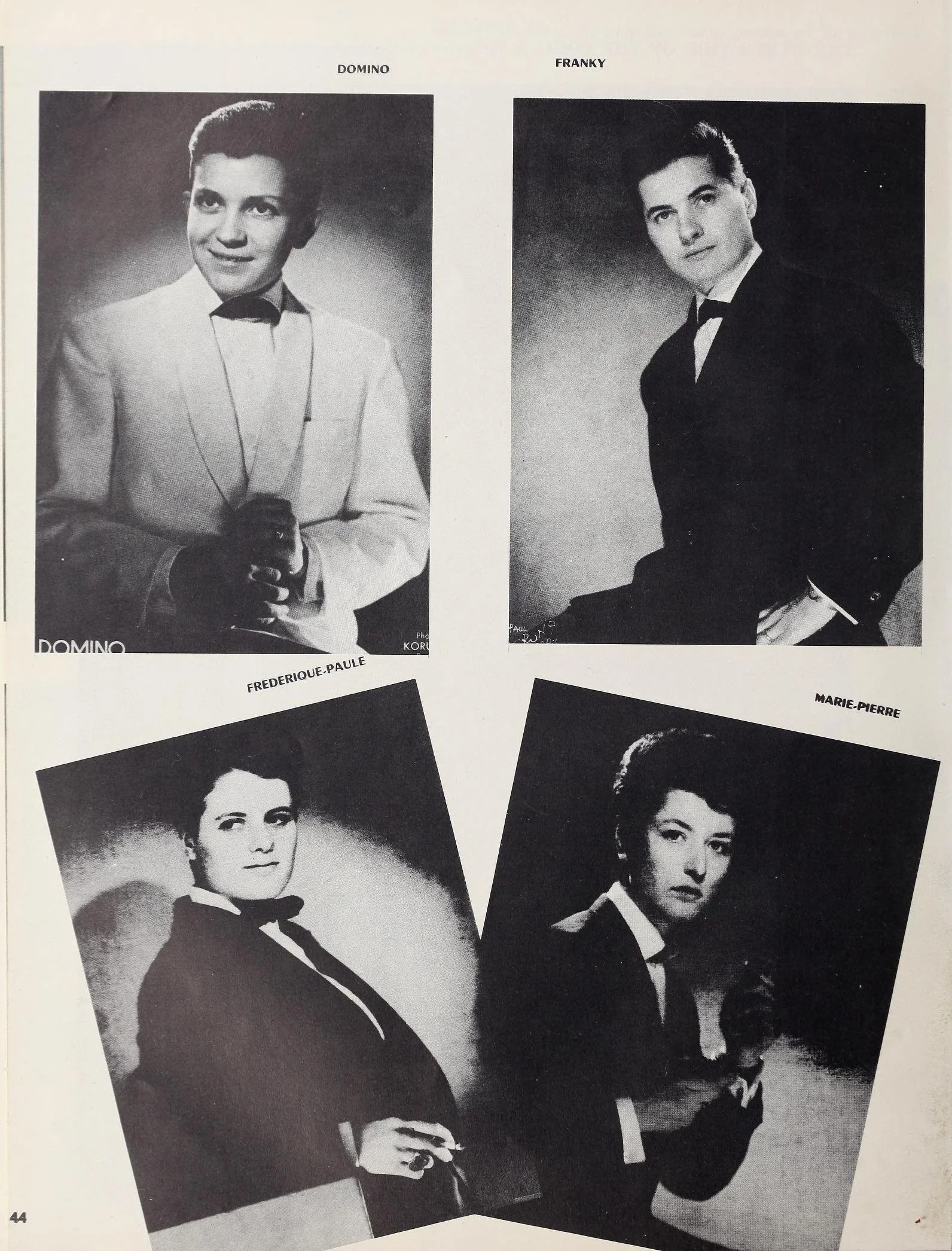
Figure 14
Male impersonators Domino, Franky, Frederique-Paule, and Marie-Pierre in an advertisement for the French venue Elle et Lui. Female Mimics Vol. 1 No. 8, 1966, 44. Digital Transgender Archive.
Maxine and Jacky appear again in the eleventh issue of the magazine where Elle et Lui is highlighted in conjunction with Chez Moune. Placed next to a series of images from both of the clubs, we see a photo of a figure on the top right wearing a tailored ensemble, cigarette in hand, with the promotional photograph of Maxine and Jacky (fig. 16) hung on the wall behind them (fig. 17). This same unnamed figure appears in numerous photos representing the bar, three total times on the one page either alone or side by side with other guests. Additionally, the figure who first appeared in the Elle et Lui advertisement modelled off of Le Carrousel from issue eight (fig. 13) of the magazine is also shown at the club.
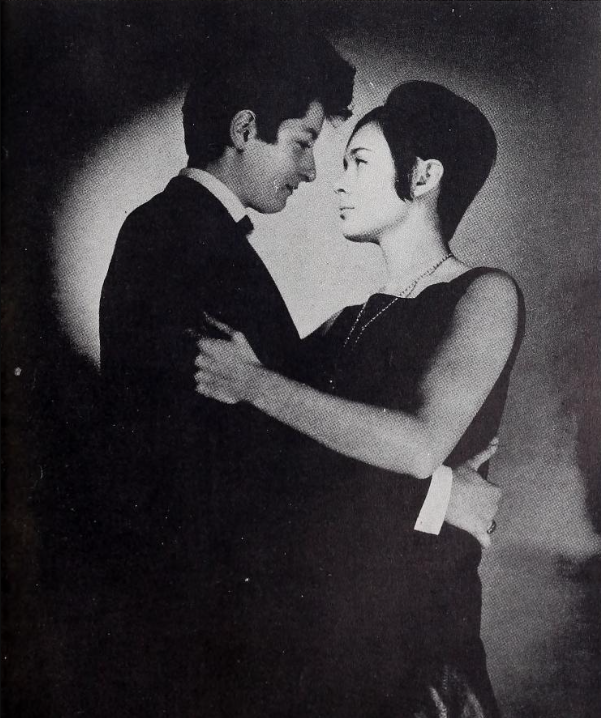
Figure 15
Photograph of Marie-Pierre (left) and Martine (right) from Elle et Lui. Female Mimics Vol. 1 No. 8, 1966, 45. Digital Transgender Archive.
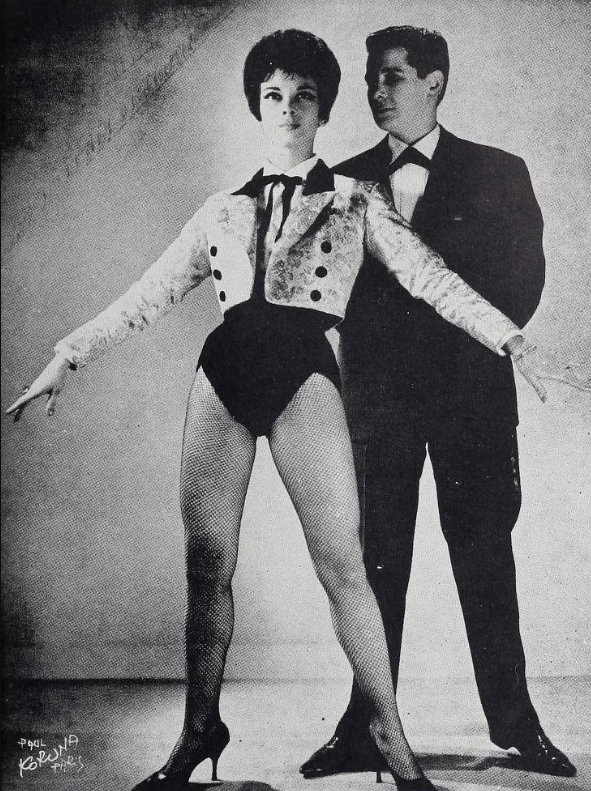
Figure 16
Photograph of Maxine (left) and Jacky (right) from Elle et Lui. Female Mimics Vol. 1 No. 8, 1966, 45. Digital Transgender Archive.
The final page of the article shows a photo of a group of attendees at the queer establishments, contrasted with one of men at an unnamed location (fig. 18). Text notes, “top businessmen having a meeting? College men on a spree? No! Here are some of the most beautiful French gals dressed the way they like best in male attire designed by top Parisienne couturiers…”[57] In this case, all figures from Elle et Lui wear ties; one white, two striped, and one patterned. Compared to the photograph of the men below them, the ensembles are more varied. The three men at the unnamed location wear bow ties paired with a white shirt and black suit jacket.
The images in the last page of the article highlight a bias of the editorial team where the identity and gender presentation of the attendees at the French bar Elle et Lui, and its counterparts Chez Moune, Frede's Carroll's Club and Le Monocle, were not seen as valid, only a lesser version of “real” masculinity supposedly inherent in cisgender, heterosexual male bodies. Although often the case when female impersonators are discussed in the magazine, the same holds true for when lesbians, male impersonators, and cross-dressing women are portrayed, although much less frequently.
Despite the major focus on female impersonation within Female Mimics, male impersonators, drag kings, and butch lesbians are occasionally discussed. Articles dedicated to spaces such as Le Monocle, Elle et Lui, and Chez Moune offer a candid glimpse into the world of 1960s cross-dressing and male impersonation and are an invaluable resource into the study of gender nonconformity, butch lesbian representations, and female masculinity. Queer periodicals such as Female Mimics are essential sources in recovering histories of LGBTQ+ dress often forgotten or entirely undiscussed in more mainstream fashion magazines. Their multitude of photographs, staged or not, provide both gender studies scholars and dress historians with direct photographic evidence of queer community, cross-dressing histories, and shared dress practices. Although these periodicals could be viewed as nothing more than conceited erotica, they represent an unmatched, and little explored, primary source of dress history. The analysis of dress practices in spaces such as Le Monocle, Chez Moune, Frede's Carroll's Club, and Elle et Lui only scratches the surface of what future historians and academics can uncover through investigations of queer periodicals like Female Mimics.
As Heyam notes in Before We Were Trans, “talking about [trans] history is politically important….helping to undermine arguments that…present trans people as newfangled inventions, simultaneously suggesting that we’re a trend that shouldn’t be taken seriously, and that we’re a potent new threat.”58 Despite the magazine’s attempt to negate the gender-nonconforming identities of the figures highlighted in this piece, the photographs analyzed within this article attest to individuals’ steadfast commitment to butch self-fashioning, cross-dressing expressions, and queer community.
[57] “From Gay Paree,” 24.
[58] Heyam, Before We Were Trans, 8.
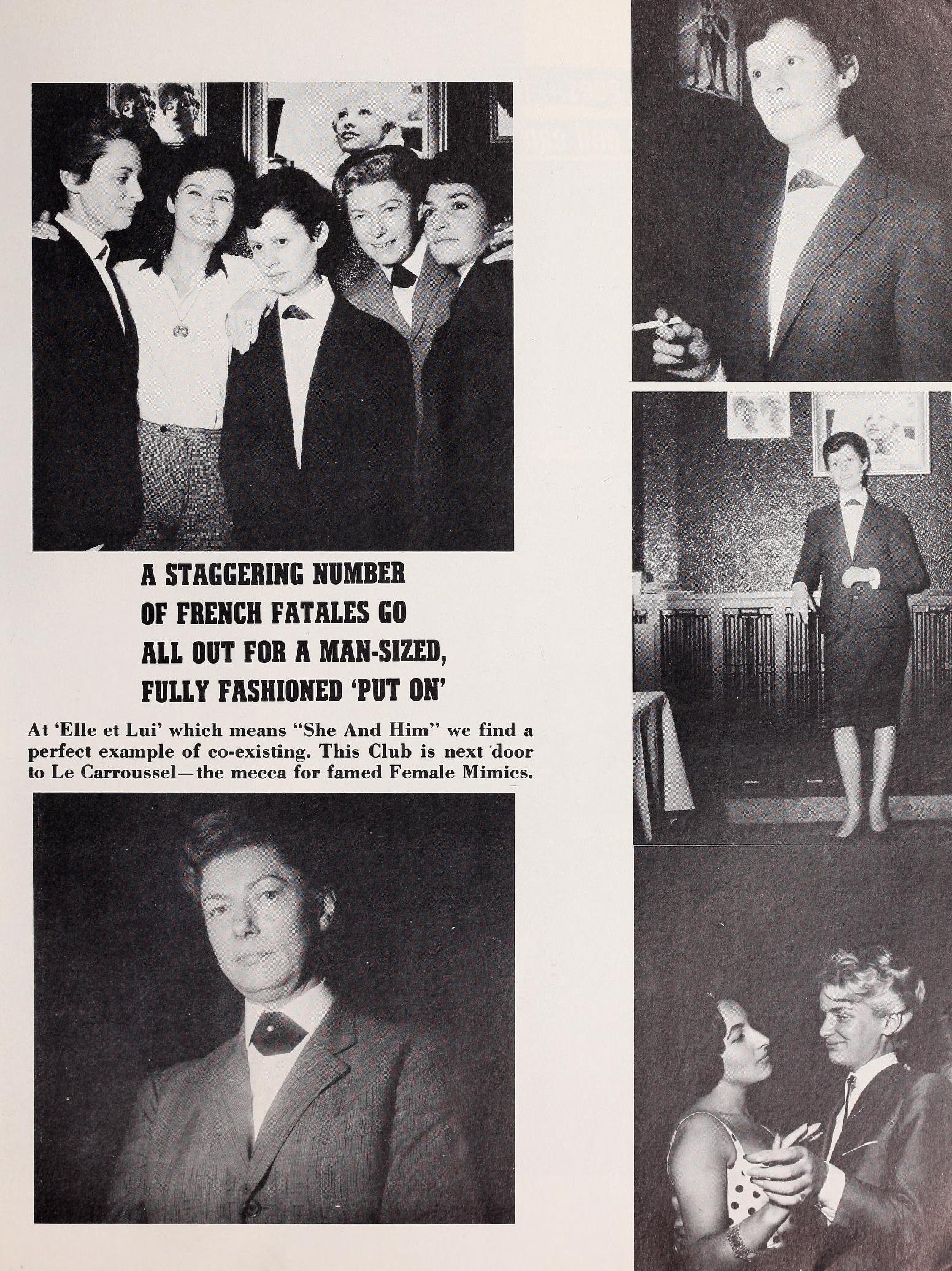
Figure 17
Images of patrons at Elle et Lui showing the figure who previously modelled for the club’s advertisement in the magazine (fig. 13) and the image of Maxine and Jacky (fig. 16) hung on the club’s wall. “From Gay Paree,” Female Mimics Vol. 1 No. 11, 1968, 21. Digital Transgender Archive.
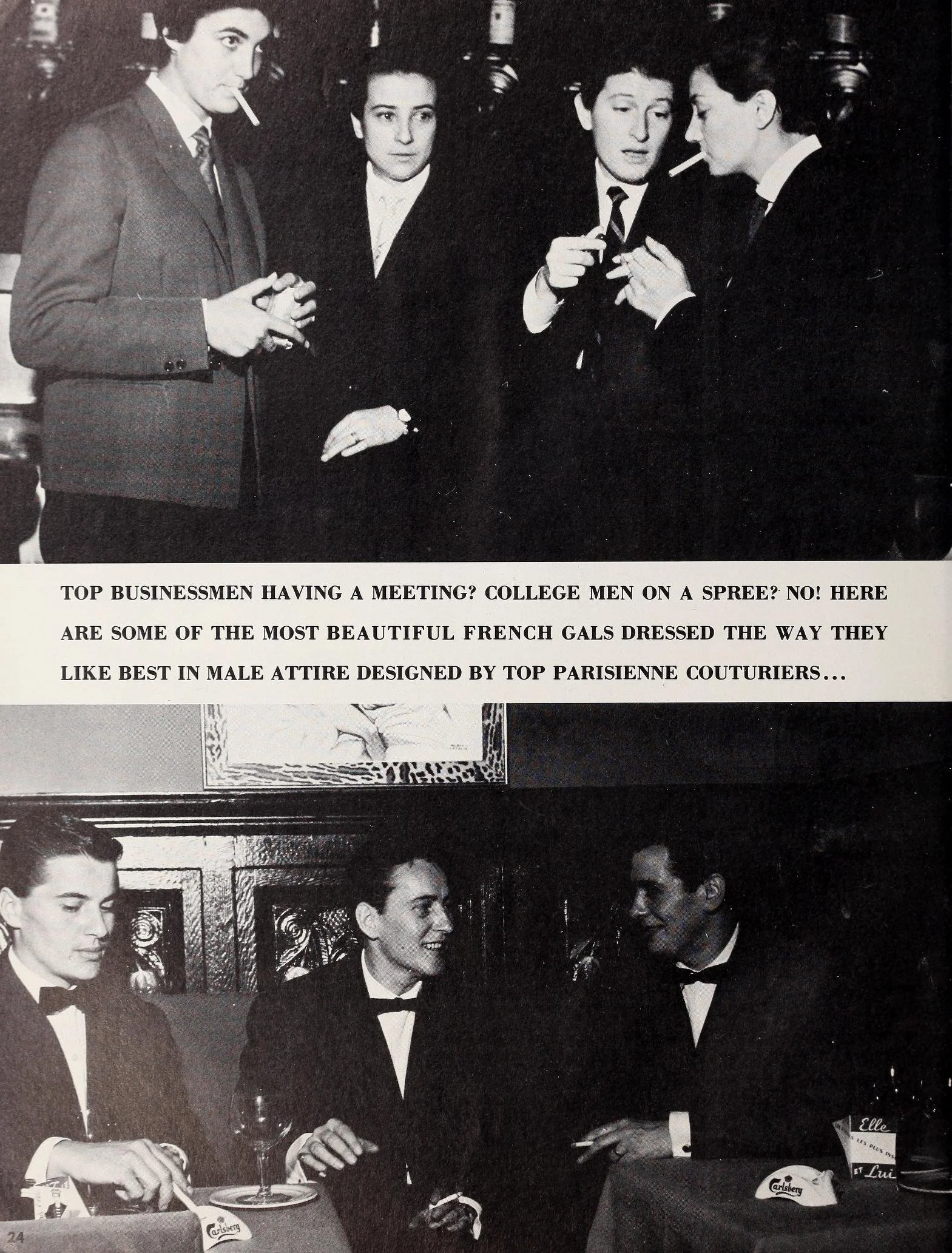
Figure 18
Attendees wearing “male attire” and smoking cigarettes, compared to a photo of men from the same period. “From Gay Paree,” Female Mimics Vol. 1 No. 11, 1968, 24. Digital Transgender Archive.
Works Cited
PRIMARY SOURCES
Brassaï. The Secret Paris of the 30s. New York: Pantheon Books, 1976.
Female Impersonators on Parade. Jersey City: Nutrix Co, 1960-1962.
Female Impersonators. New York: Health Knowledge Inc., 1969-1972.
Female Mimics. New York: Selbee Associates, Inc., 1963-1964.
—. New York: Health Knowledge Inc., 1965-1968, 1972-1979.
Flynn, Errol and Earl Conrad. My Wicked, Wicked Ways. New York: G. P. Putnam’s Sons, 1956.
Prince, Virginia Charles. The Transvestite and His Wife. Los Angeles: Argyle Books, 1967.
Transvestia. Los Angeles: Chevalier Publications, 1960-1986.
Transvestism Around the World. New York: S-K Press, 1964. https://archive.org/details/transvestismarou00unse/mode/1up.
Queer Music Heritage. “The 82 Club Program from 1969.” Accessed October 18, 2024. https://www.queermusicheritage.com/fem-cl82-1969.html.
sECONDARY sOURCES
ATS. “Style Guide for the Bulletin of Applied Transgender Studies.” Last modified December 15, 2021, https://bulletin.appliedtransstudies.org/docs/Style-Guide_2021_12_15.pdf.
Basiliere, Jae. “Staging Dissents: Drag Kings, Resistance, and Feminist Masculinities.” Signs: Journal of Women in Culture and Society 44, no. 4 (2019): 979–1001. https://doi.org/10.1086/702034.
Bullough, Vern L., and Bonnie Bullough. Cross Dressing, Sex, and Gender. Philadelphia: University of Pennsylvania Press, 1993.
Butler, Judith. Gender Trouble: Feminism and the Subversion of Identity. New York and London: Routledge, 1999.
Chaplin, Tamara. Becoming Lesbian: A Queer History of Modern France. Chicago: University of Chicago Press, 2024.
Davis, Bob, and Carol Kleinmaier. “The History and Significance of Female Mimics Magazine 1963-1970.” Ssshhh! 2, no. 1 (1995): 1-12.
Drag King History. “About.” Accessed April 14, 2025. https://dragkinghistory.com/about/.
Droubaugh, Elizabeth. “Sliding Scales: Notes on Stormé DeLarverie and the Jewel Box Revue, the Cross-Dressed Woman on the Contemporary Stage, and the Invert” in Crossing the Stage: Controversies on Cross-Dressing, edited by Lesley Farris. London: Routledge, 1993.
Ferris, Lesley. Crossing the Stage: Controversies on Cross-Dressing. London: Routledge, 1993.
Garber, Marjorie B. Vested Interests: Cross-Dressing & Cultural Anxiety. First HarperPerennial edition. New York: HarperPerennial, 1993.
Genter, Alix. “Appearances Can Be Deceiving: Butch-Femme Fashion and Queer Legibility in New York City, 1945–1969.” Feminist Studies 42, no. 3 (2016): 604–31. https://doi.org/10.15767/feministstudies.42.3.0604.
Goodman, Elyssa Maxx. Glitter and Concrete: A Cultural History of Drag in New York City. Toronto, Ontario: Hanover Square Press, 2023.
Halberstam, Jack. Female Masculinity. Durham: Duke University Press, 1998.
Held, Isabelle. “Shaping Foundations: Trans Feminine Self-Fashioning, DIY and Community Building in the Postwar United States.” Critical Studies in Fashion & Beauty 15, no. 1 (June 1, 2024): 49–74. https://doi.org/10.1386/csfb_00069_1.
Heller, Meredith. Queering Drag: Redefining the Discourse of Gender-Bending. Bloomington, Indiana: Indiana University Press, 2020.
Heyam, Kit. Before We Were Trans: A New History of Gender. First US edition. New York: Seal Press, 2022.
Hollander, Anne. Sex and Suits. First edition. New York: Alfred A. Knopf, 1994.
Jackson, Donald J. “Fashion, Freedom, and Acculturation in New York’s Catskill Mountains, 1900-1969.” MA thesis., Fashion Institute of Technology, New York, 2024. ProQuest Dissertations & Theses Global.
Jenss, Heike. “Icons of Modernity: Sixties Fashion and Youth Culture.” In Fashioning Memory: Vintage Style and Youth Culture, 37-64. London: Bloomsbury Academic, 2015.
Medhurst, Eleanor. Unsuitable: A History of Lesbian Fashion. London: Hurst and Company, 2024.
Milford-Cottam, Daniel. Fashion in the 1960s. Oxford, UK ; Shire Publications, 2020.
Morgan, Deirdre M. “Pants, Performance, and Perception: The Impact of New York’s Disguise Law (1845) on Gendered Dress.” MA thesis., Fashion Institute of Technology, New York, 2023. ProQuest Dissertations & Theses.
Redburn, Kate. “Before Equal Protection: The Fall of Cross-Dressing Bans and the Transgender Legal Movement, 1963–86,” Law & History Review 40, no. 4 (November 2022): 679–723.
Rifkin, Lori. “The Suit Suits Whom? Lesbian Gender, Female Masculinity, and Women-in-Suits.” Journal of Lesbian Studies 6, no. 2 (June 2002): 159-176. https://doi.org/10.1300/J155v06n02_20.
Sears, Clare. Arresting Dress: Cross-Dressing, Law, and Fascination in Nineteenth-Century San Francisco. Durham: Duke University Press, 2015.
Seneick, Laurence. The Changing Room: Sex, Drag and Theatre. United Kingdom: Taylor & Francis, 2002.
Stryker, Susan. Transgender History: The Roots of Today’s Revolution. Second edition. New York, NY: Seal Press, 2017.
Suthrell, Charlotte A. Unzipping Gender Sex, Cross-Dressing and Culture. Oxford: Berg, 2004.
Tompkins, Kyla Wazana, Aren Z. Aizura, Aimee Bahng, Karma R. Chávez, Mishuana Goeman, and Amber Jamilla Musser, eds. Keywords for Gender and Sexuality Studies. New York: New York University Press, 2021.
Torr, Diane, and Stephen J. (Stephen James) Bottoms. Sex, Drag, and Male Roles: Investigating Gender as Performance. Ann Arbor: University of Michigan Press, 2010.
Walford, Jonathan. Sixties Fashion: From Less Is More to Youthquake. London: Thames & Hudson, 2013.
Author Bio
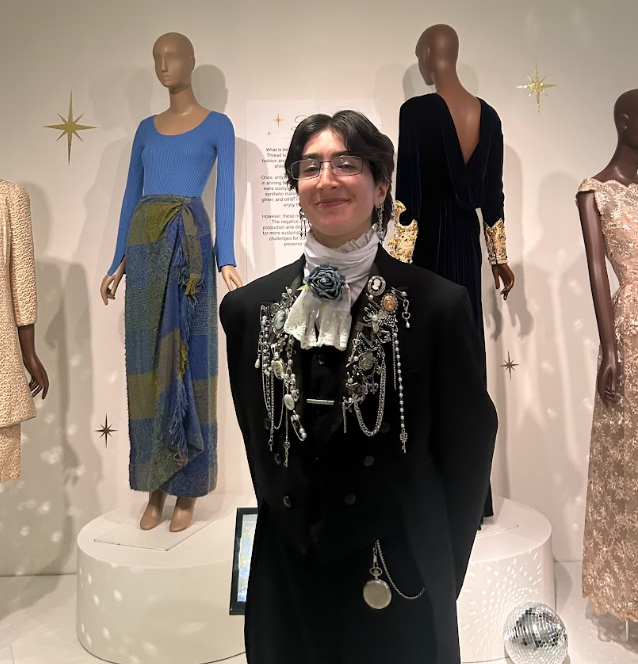
Nico Frederick (they/them) is an independent researcher and dress historian whose work explores the intersection between dress, gender, and identity. They have researched and spoken at numerous events and conferences highlighting lesbian fashion history, including their recent work on costuming the lesbian vampire in film. They are a recent graduate of the Fashion and Textile Studies MA program from the Fashion Institute of Technology in New York where their thesis explored representations of cross-dressing in the 1960s.

"Love Is Like a Cigarette" by k.d. lang
Article Citation
Frederick, Nico. “‘From Gay Paree’: Exploring Representations of Cross-Dressing and Male Impersonation in the Pages of Female Mimics, 1963-1970.” Unravelling Fashion Narratives, special issue of Fashion Studies, vol. 5, no. 2, 2026, pp. 1-31. https://doi.org/10.38055/UFN050203
Copyright © 2026 Fashion Studies - All Rights Reserved
Creative Commons Attribution-NonCommercial-NoDerivatives 4.0 International (CC BY-NC-ND 4.0) license (see: https://creativecommons.org/licenses/by-nc-nd/4.0/)