
La Segunda Piel: The Fight for Maya Textiles in Post-genocide Guatemala
By Regan Loggans

DOI: https://doi.org/10.38055/UFN050208
MLA: Loggans, Regan. “La Segunda Piel: The Fight for Maya Textiles in Post-Genocide Guatemala.” Unravelling Fashion Narratives, special issue of Fashion Studies, vol. 5, no. 2, 2026, pp. 1-37. https://doi.org/10.38055/UFN050208
APA: Loggans. R. (2026). La Segunda Piel: The Fight for Maya Textiles in Post-Genocide Guatemala. Unravelling Fashion Narratives, special issue of Fashion Studies, 5(2), 1-37. https://doi.org/10.38055/UFN050208
Chicago: Loggans, Regan. “La Segunda Piel: The Fight for Maya Textiles in Post-Genocide Guatemala.” Unravelling Fashion Narratives, special issue of Fashion Studies 5, no. 2 (2026): 1-37. https://doi.org/10.38055/UFN050208
Volume 5, Issue 2, Article 8
Keywords
Cultural appropriation
Fashion/textile history
Mayan textiles
Tourist economies
Genocide studies
Abstract
For years, there has been a legacy of the appropriation of Mayan textiles by Western designers, stylists, and tourists. Since the CIA-backed coup in 1954, which resulted in civil war and genocide of Maya peoples, scholars, academics, tourists, and missionaries have participated in continued resource extraction of Mayan traditional textiles.[1] As a result, in 2016 the Movimiento Nacional de Tejedoras: Ruchajixik ri qana’ojbäl introduced a new bill in Guatemala’s Constitutional Court to have their collective intellectual property rights recognized under Guatemalan law in order to battle the constant co-option of their works for profit.[2] And though the decision to rectify these wrongdoings by the Guatemalan government is now bound by congressional law, that has not stopped the continued disenfranchisement and cultural theft of Mayan textiles.[3] With the growth of tourism in Guatemala, it is time to initiate conversations that illuminate the parallels between traditional resource extraction and state-sponsored tourist initiatives that tokenize Maya people. This paper will examine how the misuse of Mayan textiles informs ongoing anti-Indigenous sentiment and how cultural appropriation, spurred by neoliberal tourism, are connected to the genocidal continuum.
Introduction
When first published in 1973, The Visible Self introduced a generation of anthropologists and sociologists to the cultural importance of dress. The publication explains how mass society, which is defined as the confluence of mass-industrialism, urbanism, bureaucracy, and media, familiarizes people to products, consumption trends, and reflects the values and ideologies of the mass-society, thus creating a mass-culture. Roach and Eichner asserted that mass-marketing, mass-communications, and mass-systems penetrate every aspect of the larger society, including the dress habits of a nation.[4] What about mass-violence? If mass-society is the culmination of a number of mass-societal appendages including media, value, and social ideologies, what role does mass-violence play in mass-society, and consequently what role does mass-violence play in the politics of dress?
[1] Juhn, Sunna, and Emily Ratté, “Intellectual extractivism: the dispossession of Maya weaving.” Intercontinental Cry Magazine, July 11, 2018.
[2] Picq, Manuela. “Maya Weavers Propose a Collective Intellectual Property Law.” Intercontinental Cry Magazine, March 14, 2017.
[3] Ibid.
[4] Roach, Mary Ellen, and Joanne Bubolz Eicher. The Visible Self: Perspectives on Dress. Prentice-Hall, 1973.
Guatemala’s Indigenous communities, specifically the Maya, have been the targets of mass violence since colonial contact. Anthropologist Giovanni Batz, in collaboration with the B’o’q’ol Q’esal Tenam K’usal, introduces the chronological genealogy of what he and the community refers to as the four invasions. These four invasions are histories of mass violence that have compounded against the Maya people; The first is “direct, violent, physical, and spiritual colonization, displacement, and forced settlement” by Spanish colonial contact.[5] The second invasion is the creation of plantation systems and growing liberalization through dictatorship and militarization. The third is the civil war and subsequent genocide. Operation PBSuccess was the 1954 U.S. backed coup that destabilized Guatemala’s democracy and installed a dictatorship to maintain U.S. land interest in the country;[6] The coup led to a 35-year-long civil war and genocide in which more than 200,000 people were murdered by the state, 88 percent being Maya.[7] And the fourth invasion is characterized by the combination of continued militarization and neoliberal megaprojects.[8] Megaprojects based in extractive industries, like the building of hydro dam and mining, are only possible due to the expansion of neoliberal policies, inviting foreign investors into Guatemala via decreased royalty rates.[9] The continuation of the fourth invasion is the expansion of neoliberal agendas beyond extractive industry into extractive tourist economies, and Maya peoples’ material culture are its commodity. But what is the connection between the histories of state violence in Guatemala and dress? The state that has oppressed Maya peoples since colonial contact, now mines their likeness, culture, and imagery for the tourist economy. One such example is the misuse of Indigenous Maya textiles for tourist consumption as a banner of a consumable, homogeneous nationhood. Traje is Maya dress made from woven textiles, commonly referred to as traje or traje tipico, loosely translating to outfit, suit, or even costume.[10] Traje is a racialized dress; traje is worn strictly by the Maya people and “carr(ies) a history of racial, cultural, social, and economic exclusion”.[11] Traje is also site-specific, in which different Maya peoples wear differing styles in differing regions. Prior to the state’s adoption of the Agreement on the Identity and the Rights of Indigenous People in 1995, wearing traje was prohibited in schools, government buildings, and Maya people faced discrimination when wearing traje.[12] However, even with state oppression and national anti-Indigenous sentiment, traje endures. And though traje is often a marker of exclusion for Indigenous people, it is also a symbol of resilience against ongoing colonialism and disenfranchisement. Maya women wear traje every day, signaling their commitment to material culture, no matter the cost. The bright, intricately woven and embroidered skirts, tops, and belts are unmistakable, and as a result are the most common souvenir purchased by tourists. Thus, traje has ‘inspired’ designers, stylists, and fashion historians for decades and is globally recognizable.
[5] Foss, Sarah. On Our Own Terms: Development and Indigeneity in Cold War Guatemala. The University of North Carolina Press, 2022.
[6] Trefzger, Douglas W. “Guatemala’s 1952 Agrarian Reform Law: A Critical Reassessment." International Social Science Review 77, no. 1/2 (2002).
[7] “Guatemala-Memory of Silence: Report of the Commission for Historical Clarification: Conclusions and Recommendations,” 1999. Die Friedens-Warte 74, no. 4: 511–47.
[8] Batz, Giovanni, and B’o’q’ol Q’esal Tenam K’usal. The Fourth Invasion: Decolonizing Histories, Extractivism, and Maya Resistance in Guatemala. 1st ed. University of California Press, 2024.
[9] Ibid, 125.
[10] Hendrickson, Carol. Weaving Identities : Construction of Dress and Self in a Highland Guatemala Town. University of Texas Press, 1995.
[11] Sittig, Ann L., and Martha Florinda González. The Mayans among Us : Migrant Women and Meatpacking on the Great Plains. University of Nebraska Press, 2016.
[12] Ibid.
The recognizability has come at a great cultural cost. Since 2016, the Movimiento Nacional de Tejedoras: Ruchajixik ri qana’ojbäl, a collective composed of 30 Maya women and who led weaving cooperatives in Guatemala, have been embroiled in legal battle with the Guatemalan state and tourist board, advocating for legal protections against continued cultural appropriation and cultural theft of their material culture, including traje. The Movimiento Nacional de Tejedoras: Ruchajixik ri qana’ojbäl has linked the role of tourism to the commodification of their ancestral dress, claiming plagiarism, cultural theft, and extractivism. The cultural appropriation of Maya textiles is not simple or innocuous plagiarism. The misuse of textile imagery by fashion houses and fast-fashion brands is part of the lineage of extraction, largely bolstered by the accessibility of these textiles, via tourist consumerism.
When I consider the role of plagiarism within the genealogy of aesthetics, I consider anti-capitalist, anti-consumerist plagiarisms or plagios; plagiarisms that seek to usurp power to the people via knock-offs and remakes. However, examples of textile cultural appropriation are different pathways of plagiarism. These modes of reproduction without artistic permission are predatory rather than liberatory and recreate the injustices plagiarism originally sought to disrupt.
This article seeks to unpack the role that legacies of mass violence have on dress; My geographic focus is Guatemalan Maya traje because it exists as an uninterrupted, enduring cultural tradition since colonial contact and has been well studied by anthropologists and art historians. However, the field is lacking an update that situates traje and those who wear it within contemporary Guatemalan society, which has been heavily influenced by the neoliberal agenda born from state violence and expanding tourism initiatives. What is the role of dress in post-genocidal and post-war communities, and how does the state and tourism extract the material culture of the oppressed? And, perhaps more importantly, how do those targeted for state violence resist neoliberal violence? And where does cultural appropriation exist within the legacy of genocidal violence? These are the questions guiding this work.
Textiles as Cultural Embodiment: La Segunda Piel
Traje has traditionally been woven on a back-strap loom with natural materials and dyes gathered from local plant-life. Huipiles (an oversized blouse made up of 3 woven panels) are often used to display one's region and community affiliation.
Weavers also implement a variety of personal details to create an individual finished art. Each huipil is unique, and honours an ancient tradition rooted in Indigenous cultural sovereignty. Traje is a gendered dress, not just because of obvious gendered stylistic differences between men’s and women’s dress, but because the tradition of wearing and weaving traje is retained by Maya women.[14]
When studying traje of Tecpan in the late 1980s and early 1990s, art historian Carol Hendrickson states that community-specific traje is most common in Maya women and that site-specification is a marker of ethnic identity.[15] However, in post-genocide/post-war Guatemala, it is more common to see Maya women wearing traje that is not site-specific to their native regions. This change has been explained as a consequence of growth, specifically the expansion of mobility, connectivity, and accessibility within the country by Indigenous populations. Anthropologist J. Clair Odland explains this shift as a result of changing economic conditions; with the building of better roads and faster ways to communicate, differing Maya groups are exposed to and influenced by different styles of dress.[16] In contrast, Anthropologist Diane Nelson describes this change as the visible representations of the violence of the war and genocide; wearing non-localized traje can be explained by violent geographical displacement, as well as seeking safety in hiding regional identities to avoid being targeted by soldiers.[17] During the 1980s, at the rise of the modern neoliberal model and the height of the violence against Indigenous people, association to guerrilla movements was a death sentence.
[13] There is tremendous research on the stylistic differences between geographic regions and cultures. See: Arathoon, Barbara Knoke de, Nancie L. Solien González, John M. Willemsen Devlin, Linda Asturias de Barrios, Dina Fernández García, and Museo Ixchel del Traje Indígena de Guatemala. 1999. Mayan Clothing and Weaving through the Ages. Translated by Jennifer H. de Keller. [Guatemala]: Museo Ixchel
[14] Hendrickson, Carol. Weaving Identities : Construction of Dress and Self in a Highland Guatemala Town. University of Texas Press, 1995.
[15] Ibid, 26.
[16] Odland, J. Claire. “Fashioning Tradition: Maya Huipiles in the Field Museum Collections.” Fieldiana. Anthropology, no. 38 (2006): i–67. 21.
[17] Nelson, Diane M. A Finger in the Wound : Body Politics in Quincentennial Guatemala. University of California Press, 1999.
Civil patrollers were instructed by the military to detain people wearing certain trajes.[18] Nelson states that to survive, many Guatemalans “assumed another identity”.[19] Maya people began to wear western clothing to further their proximity from guerilla combatants. Maya men wearing traje were targeted for forced conscription into the Guatemalan army or disappeared during the civil war.
I am reminded of a comment made by my Guatemalan mother over a cup of coffee in her Texas apartment. We were discussing the civil war and subsequent genocides, and my mother absentmindedly said that traje was used to identify victims in clandestine mass graves during the exhumations in the early 2000s. That, as bodily remains were removed from mass graves, traje provided forensic anthropologists with geographic certainty of where individuals came from. If individuals could be identified and returned home by using the geographic-specific markers, was the changing custom of less site-specific traje contingent on security and precaution? In a post-genocidal community, what is the purpose of shying away from distinctive dress? In a post-genocidal community, what is the role of traje as a marker of resilience?
Often, traje is referred to within Indigenous communities as la segunda piel, the second skin.[20] Indigenous epistemologies, specifically Maya epistemologies, engage with traje as a continuation of embodiment, sovereignty, and ancestral connection. Weaving and wearing traje as a practice represents a place of ancestral memory and construction of a collective identity and intellectual property. Ancestral fabrics are used to store cultural information and act as literature. As stated by Angelina Aspuac, leader of the Movimiento Nacional de Tejedoras: Ruchajixik ri qana’ojbäl, “Textiles are the books that the colony was not able to burn”.[21]
[18] Ibid, 182.
[19] Nelson, Diane M. Reckoning : The Ends of War in Guatemala. Duke University Press, 2009.
[20] Eduardo Dávila, Sebastián. “Beneath the Second Skin. Mayan textiles and bodies in the art of Manuel Tzoc and Sandra Monterroso.” Special issue, Bodies/Fashions in the Américas 2, edited by Franziska Neff and Miriam Oesterreich. MIRADAS – Journal for the Arts and Culture of the Américas and the Iberian Peninsula 6. (2022).
[21] Crisafulli, Ariana. “After Years of Cultural Appropriation, Mayan Weavers Want Legal Protection of Their Heritage,” Global Voices. September 25, 2017.

Figure 1
Manuel Tzoc Bucup, Bula meets Mango, Queens, NY, May 31, 2024. Photo by Manuel Morillo Orozco. TheLatinxProject.com.
Art historian Sebastián Eduardo Dávila explores the embodying of la segunda piel through the works of Guatemalan artist, Manuel Tzoc. Tzoc, an artist of K'iche' descent, performed Piel (skin) on October 22, 2016 in the Plaza de la Constitución in Guatemala City, and again on May 30, 2024 in New York City (Figure 1). In the performance, Tzoc publicly undresses himself and redresses himself in a full-body suit made of woven textiles, the same fabrics used to make traje. Tzoc states that his transformation, in which his body “acts as a vehicle,” becomes a site of the inscription of his Maya-K’iché’ ancestry.[22] Social Scientist, Morna Macleod, further investigates the role of la segunda piel, stating that:
There is a growing tendency among the Maya women to positively embrace this responsibility, as part of the process of empowerment and as a position of political-cultural stance of struggle; That is to say, with an emancipatory sense of resistance. Re-signifying their identities, in which the dress of Maya women is assumed as a “second skin”, as a flag of struggle, raised day to day.[23]
Through this quote, we can surmise the cultural importance of wearing traje in the everyday. Macleod insists that the daily struggles, due to a legacy of colonialism, are combatted via the daily usage of traje as a symbol of resistance. The re-signifying of identity, through dress, is what fastens the traje to the skin, demarcating an additional skin. Dávila furthered Macleod's assessment describing la segunda piel as “the extension of an otherwise intimate identity: that of the wearer’s Mayan ancestry”.[24] By undressing from Western fashion and re-dressing in a suit of traje, Tzoc asserts identity, cultural belonging, and re-establishes his connection to la segunda piel.
[22] Tzoc, Manuel. 2016. “Proceso creativo e intelectual de la performance ‘Piel’.” Unpublished document cited in Eduardo Dávila, Sebastián. “Beneath the Second Skin. Mayan textiles and bodies in the art of Manuel Tzoc and Sandra Monterroso.” Special issue, Bodies/Fashions in the Américas 2, edited by Franziska Neff and Miriam Oesterreich. MIRADAS – Journal for the Arts and Culture of the Américas and the Iberian Peninsula 6. (2022): 106.
[23] Macleod, Morna. Nietas del Fuego. Creadoras del Alba. Luchas político-culturales de mujeres mayas. FLACSO Guatemala, 2011. NOTE: translation from Spanish to English is my own.
[24] Eduardo Dávila, Sebastián. “Beneath the Second Skin.”
Santo Domingo Xenacoj
Santo Domingo Xenacoj is about an hour west of Guatemala City in the same municipality of Sacatepéquez, and it is not known as a tourist hub, but it is part of a cultural resurgence surrounding community healing, cultural revitalization, and cultural heritage protection. One group is the Consejo de Tejedoras Ixkoj Ajkem, a collective of Kaqchikel Maya weavers who are also part of the Movimiento Nacional de Tejedoras: Ruchajixik ri qana’ojbäl and work in tandem with Asociación Feminina Para el Desarrollo de Sacatepéquez (AFEDES). I met with five members of the Consejo de Tejedoras Ixkoj Ajkem in front of the Church of Santo Domingo Xenacoj.
Gloria is in her late fifties, a member of the Consejo de Tejedoras Ixkoj Ajkem, and I immediately recognized her from photos of protests led by the Movimiento Nacional de Tejedoras: Ruchajixik ri qana’ojbäl over the years. Gloria has been on the frontline of this work for years, experiencing harassment and discrimination for her continued advocacy. We were in discussion about changing dress traditions and Gloria said:
We believe that our traditional dress represents women's resistance—that our clothing itself is an act of resistance, embodied in the colors and the evolving designs of our huipiles....It (traje) serves as a form of resistance, for we believe that our huipiles are everything to us; they are our second skin. They embody mathematical precision and spiritual energy, as we weave into them the full spectrum of our emotions—We do not wear our clothing haphazardly.[25]
[25] Gloria, interviewed by author (translated from Spanish by author), July 1, 2025.
Brooklyn
Ch’umilkaj is a Kaqchikel singer in her twenties from Comalapa. We met in 2024 in Brooklyn when she was on tour and participating in multiple film screenings of the documentary Nataxik-Memoria (2023). Nataxik follows the narrative memories and after-lives of the survivors of the genocide in Guatemala, focusing on the exhumations and memories of those murdered and disappeared by the state. When I asked Ch’umilkaj the significance of traje to her, she responded:
That our attire—despite the invasions and the genocides and everything else—has served as our second skin; it has been a book, or rather, books that the colonial regime could not burn. For the books that were written were burned for three months during the colonial era—countless codices were burned and everything else. But thanks to the stelae which have truly been preserved and can still be interpreted there are similar symbols that remain safeguarded to this very day. Therefore, for me, wearing this attire means a great deal; I do not do it merely for the sake of folklore….despite the genocide and years of attempts to colonize and eradicate the culture, the traje has become a second skin. The books were burned, but the history was not because it was able to endure within the dress.[26]
Gloria and Ch’umilkaj experience traje as a means of cultural preservation and resilience; their livelihoods are dependent on traje, not just economically, but as a signifier of the constant reconciliations Maya women must juggle between historical and contemporary marginalizations and discriminations.
However, no matter the consequence, the two continue to wear their traje every day. Through the testimonies of these Kaqchikel women, we understand that for them, traje cannot be divorced from the body, rather, they are conjoined like an additional skin. This is a difficult imagining in a global neoliberal sphere that seeks to depoliticize fashion, dress, and clothing. Fast fashion markets have readily sterilized and flattened dress identities through mass cultural hegemony; Traje is in direct contradiction to the flattening of dress politics.
[26] Ch’umilkaj, interviewed by author (translated from Spanish by author), March 8, 2024.
As explored in this analysis, there is a disruption between the politics of dress through global industrialization and Indigenous epistemologies (like segunda piel) as understood (or misunderstood) by non-Indigenous peoples. La segunda piel seeks to encompass the political, social, and spiritual practices of bodily belonging that traje provides for Maya peoples. Belonging is a learned practice, incorporating community, dress, historical, collective memories, and cultural affirmations; wearing traje is a practice of resistance and collective memory, demanding public visibility to all that is woven in the cloth.

figure 2
Image of tarmac at Aurora International Airport, taken by author, 8/13/2024
Tourism on Indigenous Lands
In 1996, the same year the peace accords were signed, Guatemala reported about 520,000 tourists. By 2004, that number was up to 1.2 million tourists.[27] The Guatemalan Tourism Institute (INGUAT) reported that in 2022, 1,844,739 tourists traveled to Guatemala, representing an increase of 64 percent when compared to the number of tourists in 2021.[28] A January 2024 report published by the United States Department of Agriculture in collaboration with the Global Agricultural Information Network, stated that tourism in Guatemala represents 10.2 percent of the country’s total GDP.[29] And as of 2023, international tourism in Guatemala reached record figures of 2.65 million visitors, generating 1.349 billion dollars in revenue, and exceeding pre-pandemic levels by 177 percent.[30]
[27] Weissert, Will. “Maya country: With brutal civil war long over, tourists return in droves.” The Associated Press, 2005.
[28] Vasquez, Edith. September 29, 2023. Guatemala: Food Service-Hotel and Restaurant institutional, RN: GT2023-0010.United States Department of Agriculture (USDA):Foreign Agriculture Service and Global Agricultural Information Network (GAIN).
[29] Vasquez, Edith. January 3, 2024. Guatemala: Exporter Guide, RN:GT2023-0012. United States Department of Agriculture (USDA):Foreign Agriculture Service and Global Agricultural Information Network (GAIN).
[30] Organización Mundial del Turismo. 2025, Tourism Doing Business – Invirtiendo en Guatemala, ONU Turismo, Madrid.
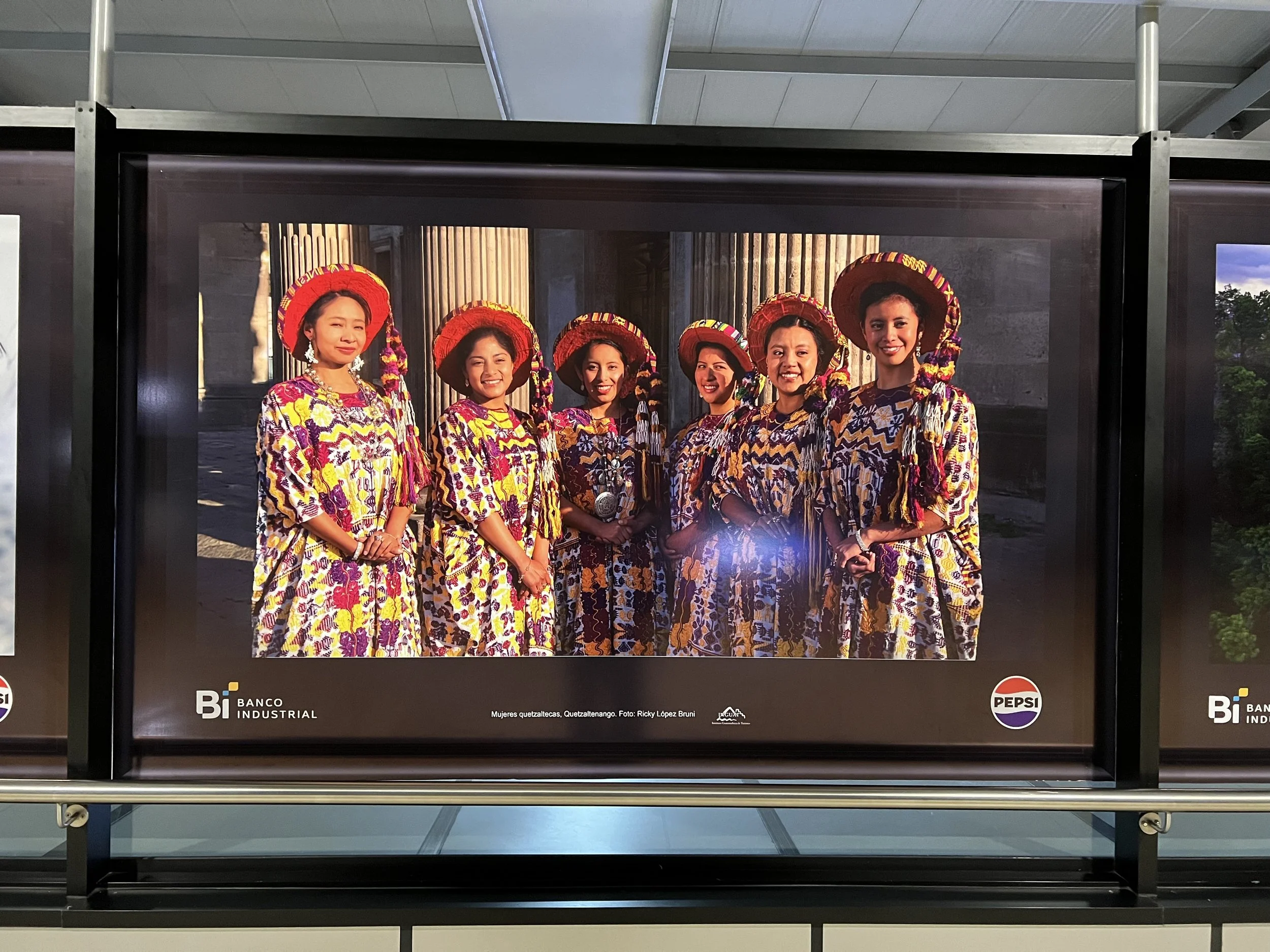
Figure 3
Lopez Buni, Ricky, “Mujeres Quetzaltecas”, Aurora International Airport, INGUAT poster. Image taken by author, 8/13/2024.
In the summer of 2024, I was struck by the immense volume of country-wide tourism propaganda (Figures 2 & 3). INGUAT (Guatemalan Institute of Tourism) posters were not limited to the airport, but ever present in all the major cities and tourist destinations. Posters read “the heart of the Maya world” or “Bienvenidos a mundo Maya” (welcome to the Maya world). Each INGUAT poster used images of Maya women, Maya textiles, and/or Maya cultural events in addition to the text (Figure 4).[31] And though Maya people are the focus of the marketing campaign, it should be noted that the revenues gained from tourism by INGUAT are not distributed to Maya communities.[32] No matter the geographic location, Maya artisans, mostly Maya women, were ever present, selling souvenirs like keychains, beaded bracelets, and textiles.
What is the role of tourism in Guatemala, especially in a post-war Guatemala? What is the role of Indigenous craft in the maintenance of tourist economies? How could one divorce, hide, or avoid a history of genocide when engaging with Indigenous tourist craft? When I think of these questions and the obvious growth in Guatemalan tourism over recent decades, I am reminded of tourism in Indigenous communities during the expansion of western territories in the United States. During the 1890s and again in the 1920s, during the height of uranium extraction in the territories, Southwestern tribal nations like the Dine (Navajo), Hopi, and Pueblo people engaged in selling craft work.[33] In fact, tourism in the Southwest was highly encouraged by Atchison, Topeka and Santa Fe Railway and the National Parks Service as a way for Indigenous people to make money autonomously.[34] Anthropologist Jill Sweet explained that the Pueblo people had developed creative and assertive tourist techniques, in which they embedded cultural and historical circumstances to assert autonomy.[35] What Sweet fails to address is class and race, capital and ownership. In Guatemala, though Indigenous people engage in tourist economies, it is not as the owners of hostels, ATV tour shops, or bus shuttles. They are the cleaners, drivers, laborers, tour guides, and vendors within tourist encounters.
[31] Figueroa, Paul. “When Imitation Is Not Flattery: Addressing Cultural Exploitation in Guatemala Through a Sui Generis Model.” Brigham Young University Law Review, 46. (2021): 985; “Somos,” INGUAT: Instituto Guatemalteco de Turismo,
http://www.inguat.gob.gt/.
[32] Montejo, Victor. “Indigenous Threatened Heritage in Guatemala.” In Cultural Heritage and Mass Atrocities, edited by Cuno, James, and Thomas G. Weiss. Getty Publications, 2022.
[33] Sweet, J. O. “Let 'em Loose”: Pueblo Indian Management of Tourism.” American Indian Culture and Research Journal 15, no. 4 (1991): 59-74.
[34] Jett, Stephen C. “Culture and Tourism in the Navajo Country.” Journal of Cultural Geography 11, no. 1 (1990): 85.
[35] Sweet, J. O. “Let 'em Loose”: 59.
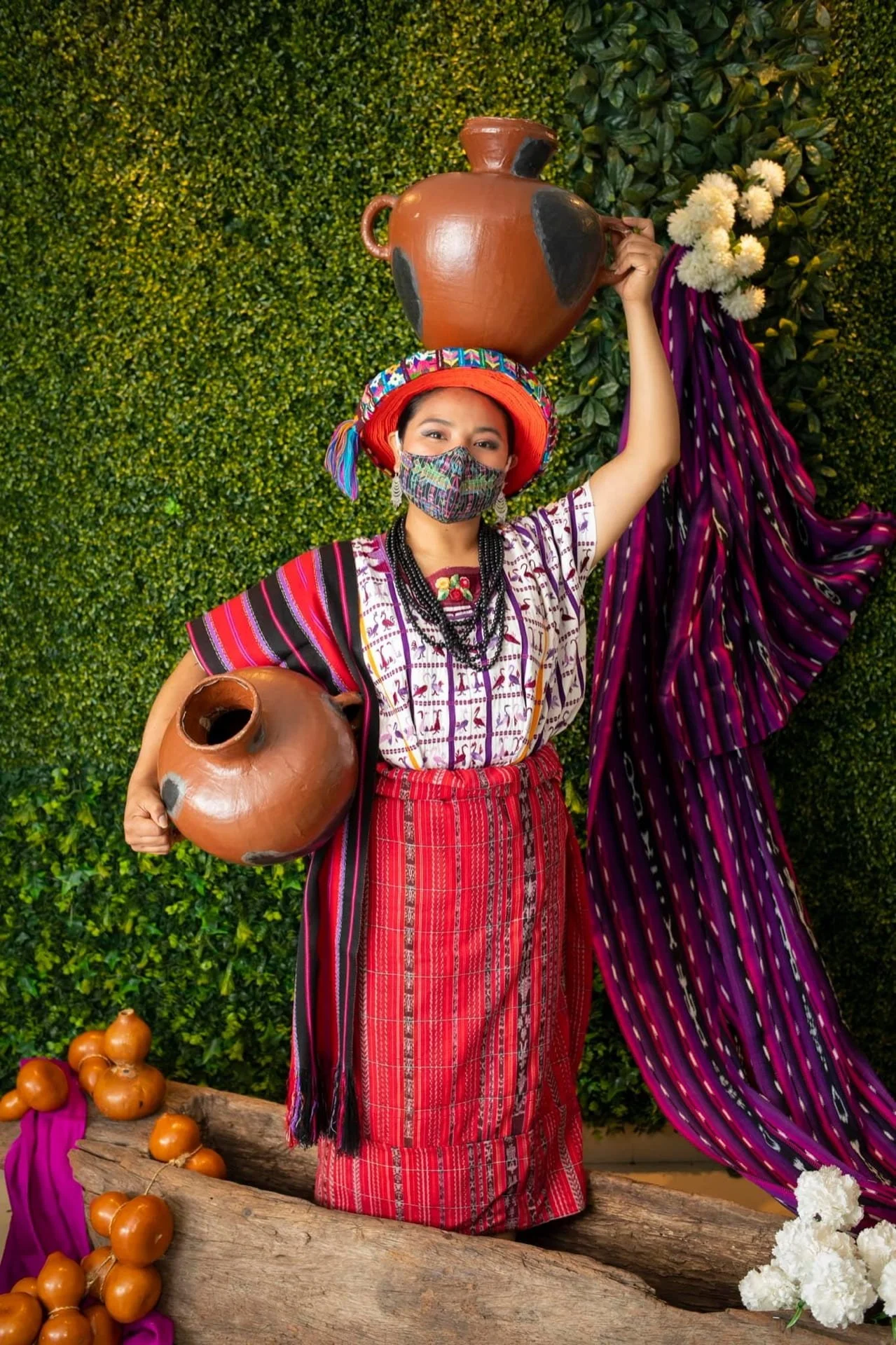
figure 4
Indigenous women in traditional Maya traje posted in the La Aurora International Airport in May 2022. Photo credit: INGUAT.
Anthropologist Diana Wilson grapples with this in her work on the effects of tourism in Latin America stating, “Tourism impacts can be felt at national, regional, and local levels and by different communities within any given locality. Different classes will be affected differently, with the national and local elites gaining more than others”.[36] Wilson further supports this argument by citing geographers Martin Mowforth and Ian Munt who stated that tourism exacerbated previous societal divisions, increasing the economic gaps between those marginalized by the system of tourism.[37]
[36] Wilson, Tamar Diana. “Introduction: The Impacts of Tourism in Latin America.” Latin American Perspectives 35, no. 3 (2008): 3–20.
[37] Mowforth, Martin, and Ian Munt. Tourism and Sustainability : Development, Globalisation and New Tourism in the Third World. Fourth edition. Routledge, 2016: 99.
Though historical tourism in the American Southwest is often viewed or marketed as a champion of Indigenous-led initiatives or success, there is a consequence to the unfiltered access to Southwestern tribal material culture. Dine tribal tourism and the access to cultural materials has led to rampant cultural appropriation of traditional aesthetics and designs. Famously the Navajo Nation of New Mexico successfully won a lawsuit against Urban Outfitters, Inc. for the misuse of Navajo artistic imagery in 2012. The lawsuit stated that Urban Outfitters, Inc. should be held accountable for the “sale of goods under the Navajo names and trademarks, as well as its sale of other goods falsely represented as authentic goods, when [Urban Outfitters, Inc.] knew that their goods were not made by, in connection, or in any way associated with the Navajo Nation, another Indian Tribe, nor any other Indian organization or person”.[38]
Geographer Alan Law stated that cultural tourism is "designed to be low impact and create self-sufficiency…and preserve and protect irreplaceable natural and cultural resources”.[39] What is a cultural resource in an era of resource extraction? Additionally, can cultural tourism be low impact or preserve natural and cultural resources in communities with lineages of colonialism or imperialism? In post-war and post-genocidal communities like Guatemala or the American Southwest, where Indigenous people are consistently disenfranchised by the state and larger society, where does self-sufficiency exist in cultural resource extraction? I ask these questions not to remove the agency of Indigenous people that engage in tourist economies, rather to question where tourism exists within the pattern of resource extraction? The INGUAT posters are a reminder of the pervasiveness of the post-war neoliberal multiculturalism, and its behaviour to celebrate cultural differences and acknowledge the rights of disenfranchised groups, while remaining inactive to change.
Anthropologist Victor Montejo, who is Jakaltek Maya from Guatemala, discusses how Maya people’s continued disenfranchisement is intrinsically tied to mismanagement of cultural heritage.[40] According to Montejo, due to the false representation of Indigenous people as “savages” and assimilationist programs and tactics, Maya people are not considered within the processes of protecting cultural rights and heritage. Montejo names a known contradiction, that the Guatemalan government glorifies past Mayan history for touristic consumption, while rejecting and discriminating against contemporary Maya people.[41] Montejo also notes that even though INGUAT consistently uses Maya aesthetics, peoples, and culture in their ads, revenues gained by INGUAT are not distributed to Maya communities.[42] When we perceive resource extraction, the resource is mined and sold, often through foreign and state investment and intervention, and local communities gain little to no fiscal runoff from the site of extraction. Indigenous communities are displaced and further marginalized by these processes. When considering these parallels, it is difficult not to view cultural heritage as a market of resource extraction.
[38] Navajo Nation v. Urban Outfitters, No. 12-195 BB/LAM, 2016 U.S. Dist. LEXIS 136563 (D.N.M. Sep. 2016)
[39] Lew, Alan A., and George A. Van Otten. Tourism and Gaming on American Indian Lands. Cognizant Communication Corp 1998: 88.
[40] Montejo, Victor. “Indigenous Threatened Heritage in Guatemala,” 267.
[41] Ibid.
[42] Ibid, 273.
Tourism in Guatemala has become pivotal to the economic survival and prosperity for the poor. However, tourism is contingent on the maintenance of a multicultural nationalistic identity, which continues to disenfranchise Indigenous people as relics of the past. Anthropologist Alberto Acosta defines extractivismo as “a concept that helps explain plundering, accumulation, concentration, and colonial and neocolonial devastation, as well as the evolution of modern capitalism and ideas of ‘development’ and ‘sub-development”.[43] Acosta affirms that extractivismo is not limited to mineral extraction, but can also include tourist extraction. He furthers this point by stating that colonization and extractivism are entwined and neither has ended. Rather, extractivism and colonization are present through neoliberal development initiatives, like tourism.[44] Anthropologist Christopher Loperena’s work explores the role of extractivismo within Honduras, in which he asserts that multicultural neoliberal ecotourism initiatives are extractive industries preying on Indigenous populations.[45] Both Acosta and Loperena view tourism as extractive, participating in the deterioration of both natural and social environments. I adopt that claim and assert that Guatemalan tourist initiatives are extractive industries that contribute to continued Indigenous disenfranchisement. I would further this assessment and argue that due to neoliberal appeasement allowing foreign investment into Guatemala, foreign elites have more to gain than Guatemalans’ themselves when engaging in tourist economies.
Environmental scholar Rob Nixon defines slow violence as "a violence that occurs gradually and out of sight, a violence of delayed destruction that is dispersed across time and space, an attritional violence that is typically not viewed as violence at all".[46] People who are lacking in resources, the globalized poor, are the casualties of environmental racism because slow violence is "built on the bedrock of social inequality".[47] Nixon uses the term to refer to slow, long-term processes of climate change, but the principle can be used here to depict the slow-moving yet equally destructive appropriation of Maya culture, including textiles.
[43] Acosta, Alberto. “Post-Extractivism: From Discourse to Practice—Reflections for Action.” In Alternative Pathways to Sustainable Development: Lessons from Latin America, edited by Gilles Carbonnier, Humberto Campodónico, and Sergio Tezanos Vázquez, 77–102. Brill, 2017. 81-82.
[44] Ibid, 81-82.
[45] Loperena, Christopher. 2023. The Ends of Paradise : Race, Extraction, and the Struggle for Black Life in Honduras. Stanford University Press, 2023, 68-69.
[46] Nixon, Rob. Slow Violence and the Environmentalism of the Poor. Harvard University Press, 2013, 2.
[47] Ibid, 4.
Cultural appropriation of material culture acts as slow violence, gradually devaluing the ancestral knowledge of the Maya as a source of worthwhile knowledge to be co-opted for profit.[48]
Consider Monterroso’s installation of El matador, 2011 (Figure 5). The installation was of a black huipil tied to a I♥NY shirt, the two connected by an umbilical cord. Monterroso chooses a black huipil to signify continued colonial violence, and the bipolar conflict of traje as tourist memorabilia.[49] Art Historian Kency Cornejo explains that the huipil alludes to the paradoxical view of traditional Maya clothing in Guatemala, which on the one hand is celebrated as a signifier of “authentic” Indigenous culture, and on the other is the target of defamation and degradation.[50] The iconic I♥NY t-shirt draws on notions of a world center, tourism, consumerism, and Western popular culture. Attaching the huipil to a symbol of ubiquitous imperialism, tourism, and consumerism, generates opposition. The opposition, the tension, is what wearers of traje willingly engage with in the everyday when dressing themselves in a pedagogy of being (la segunda piel). Cornejo states “The garments thus stand in opposition: the t-shirt’s symbolism of a world led by imperialism and consumption, and the huipil’s evocation of centuries of Indigenous resistance”. Though Cornejo states that the garments stand in opposition to each other, I would argue that in fact, they are connected. As an umbilical cord feeds parent to child, so has the I♥NY t-shirt fed the huipil, in which they are both specific geographical tourist objects, that are available for purchase. The global neoliberal model, which seeks to capitalize Indigenous aesthetics, has dribbled its way into Guatemala via tourist expansion. Monterroso illuminates tourist desire by combining the epicenter of global tourism (New York City) with the commodification of Indigenous culture through traje. It is not coincidental, rather these works illuminate the imagery of explicitly and overt tourism through a global signifier. By situating traje within the context of a New York imagination, Monterroso demands attention to the crisis of tourism and identity in Guatemala.
[48] Ibid.
[49] Cornejo, Kency. Visual Disobedience : Art and Decoloniality in Central America. Duke University Press, 2024, 68-69.
[50] Ibid.

figure 5
Sandra Monterroso, El matador, 2011, multimedia installation, Institutodevision.com.
La “Mujer Maya” y “Típica Fever
Traje is a material culture that embodies ethnicity/race (Indigenous vs non-Indigenous), gender, class, and belonging to a nation.[51] Its ability to engage with these intersections of cultural identity and society are what make it such a pervasive and vulnerable object. By administering and representing a milieu of intersections, traje is locally and globally visible, and therefore consumable. There is a tourist desire to purchase souvenirs that authentically capture the culture which has led to “tipica fever”, in which tourists, anthropologists, and other foreigners fervently purchase craft art, like traje, in Guatemala.[52] And the mujer Maya is at the crux of tipica fever. Nelson uses the term mujer Maya, to describe the fantasy, stereotypical portrayal of Maya women in larger mass-society in Guatemala and in the tourism industry.[53] The mujer Maya keeps with tradition, wears traje, therefore is a tourist attraction to those seeking entry into the “mundo de maya”. The mujer Maya is permitted to be a member of the public narrative though she is relegated to the tourist sector. La mujer Maya is a consumable trope of genuine Indigeneity that tourists seek to capture in their experience through the purchasing authenticity, codifying tipica fever. The trope that is mujer Maya has been employed by INGUAT tourist materials since the 1990’s, and remains ever present in tourist materials.[54]
La mujer Maya and tipica fever are interconnected through tourist textile consumption. Tourists are able to witness, engage, purchase, and then keep a part of authentic Indigeneity through the commodification of textiles. Similarly, art historian Chris Goetzen explored the role of authenticity in tourist textiles in Oaxaca. In Goertzen’s article about Oaxacan textiles and tourism, he states that Indigenous craft objects must insist on authenticity, while also balancing understandability and mysteriousness through attractiveness.[55] Tourists expect souvenirs to perpetuate ancient traditions and embody authenticity. Goertzen asserts that there is a negotiation of authenticity that happens between the tourist and the Indigenous maker, in which the object is reflective of shared expectations.[56] Goertzen questions if this kind of negotiation is inherently colonial, asking the reader if the “craftsperson must debase their work to earn a living?” or if this kind of market is a “natural and healthy outgrowth of tradition?”.[57] I would also further this line of questioning and ask, is there ethical consumption of Indigenous craft arts in a multicultural neoliberal economic system? Is there ethical consumption of Indigenous craft arts in a post-genocidal community?
[51] Nelson, Diane M. A Finger in the Wound, 182-183.
[52] Ibid, 182-183.
[53] Ibid, 360-361.
[54] Devine, Jennifer A. “Politics of Post-War Tourism in Guatemala: Contested Identities, Histories, and Futures.” L’Espace Politique 28. (2016): 18
[55] Goertzen, Chris. “Crafts, Tourism, and Traditional Life in Chiapas, Mexico: A Tale Related by a Pillowcase.” In Selling the Indian: Commercializing and Appropriating American Indian Cultures, edited by Carter Jones Meyer and Diana Royer, 236–70. University of Arizona Press, 2001, 242-243.
[56] Ibid, 242-243.
[57] Ibid, 242-243.
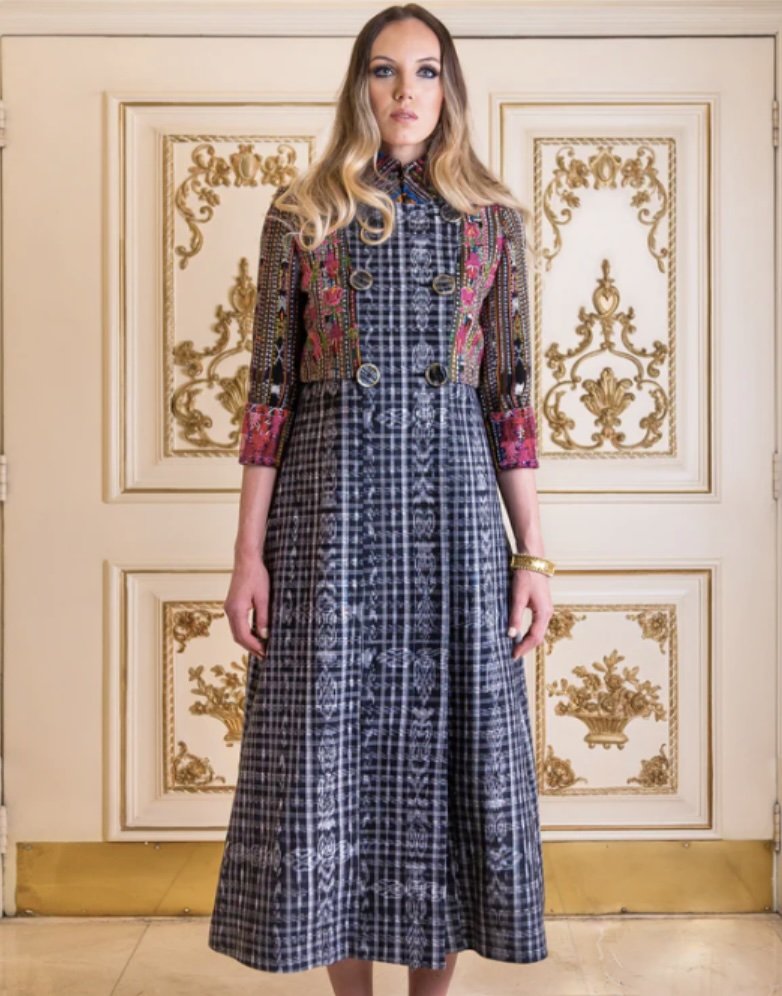
figure 6
Fmioat, $1,250. Anit Lara designs, Anitalara.com.
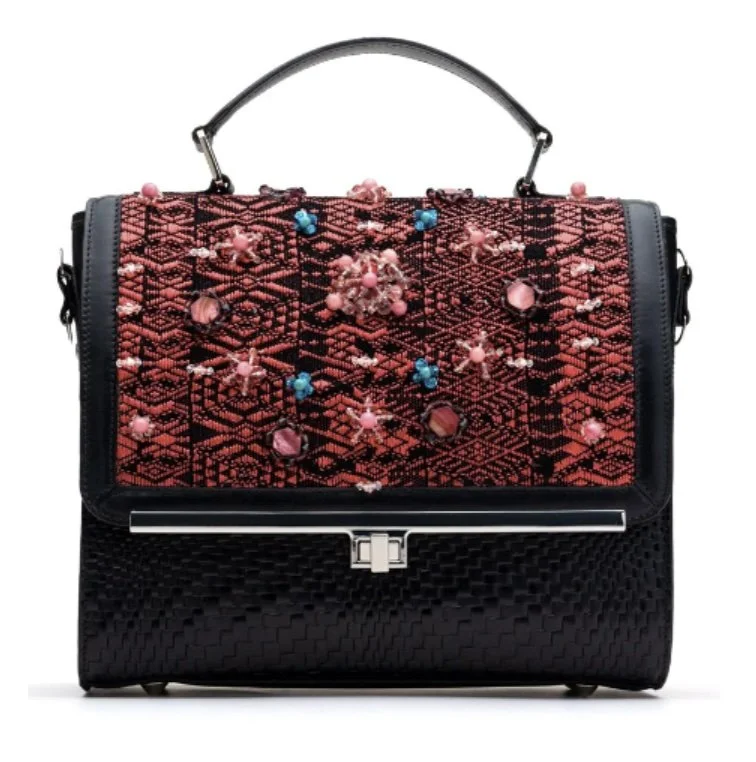
figure 7
Domina Zima, $1800.00, Marias Bags, Mariasbags.com.
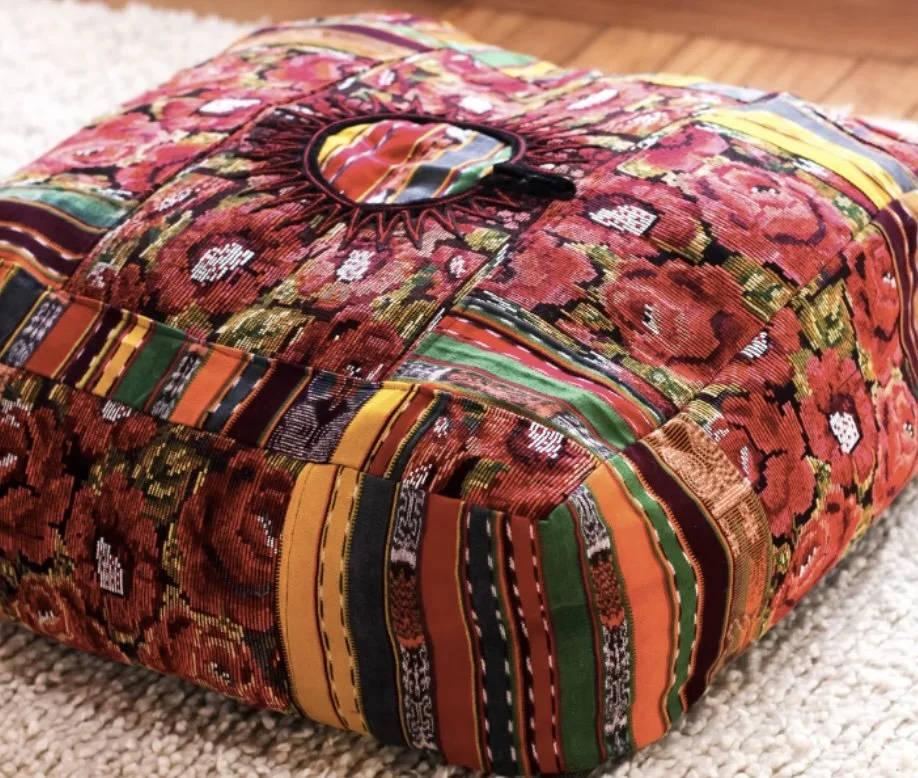
Figure 8
Casa Flour Pouf, $328, Hiptipico.com.
The phenomena of tipica fever, and the consumption of textiles by foreign researchers, tourists, archivists, and museums perfectly situates itself within discourse of cultural appreciation and appropriation.
A growing number of designers and international companies like: UNIK, María's Bags, and Hiptipico (with products for sale on ASOS, Forever 21, Urban Outfitters, and Free People platforms) have entire platforms based on the appropriation of Maya textiles (Figure 6-8).[58] Mara Hoffman, a New YorkCity-based designer, released a line of “Guatemalan Inspired” swimsuits at Miami Fashion Week: Swim Resort 2015 runway after her eight-day trip to Guatemala (Figure 9). She even went so far as providing Elle Magazine an exclusive interview entitled “Mara Hoffman’s Guide to Guatemala”. In this article she stated that she fell in love with the textiles, rainbow-blocked belts, and huipils. "It's packed with culture,” she said “and I'm so textile driven, so you can go nuts there… I would go back in a heartbeat”.[59] The following year, Valentino’s 2016 Summer Men's collection was also inspired by traje after Italian designers Maria Grazia Chiuri and Pierpaolo Piccioli visited Guatemala (Figure 10).[60] And when interviewed by Vogue and asked what inspired the collection, Chiuri responded, "At the end there is no real reference. We love to go around with our mind and our inspiration to create…Cultures become one culture—that's what we find exciting".[61] And the following year, Missoni released their Men’s Spring 2017 collection, also appropriated from a men’s traje jacket that Angela Missoni purchased on a trip to Guatemala (Figure 11 & 12).
[58] Walsh, Aisling. “How Mayan Women in Guatemala are Fighting to Protect Their Designs and Their Identity.” Open Democracy Magazine, August 8, 2018.
[59] Arellano, Jennifer. “Mara Hoffman’s Guide to Guatemala.” Elle, April 31, 2014.
[60] Leitch, Luke. “Valentino Spring 2016 Menswear Collection.” Vogue, June 24, 2015; Arévalo Rita. “Valentino Se Inspira En Guatemala.” Look Magazine, September 24, 2015.
[61] Ibid. Note: This same article misidentified the Maya appropriated fabric as “Native American (but not necessarily North American) weaving.”

Figure 9
Mara Hoffman, Resort 2015 collection at Mercedes-Benz Fashion Week in Miami, Vogue.com.
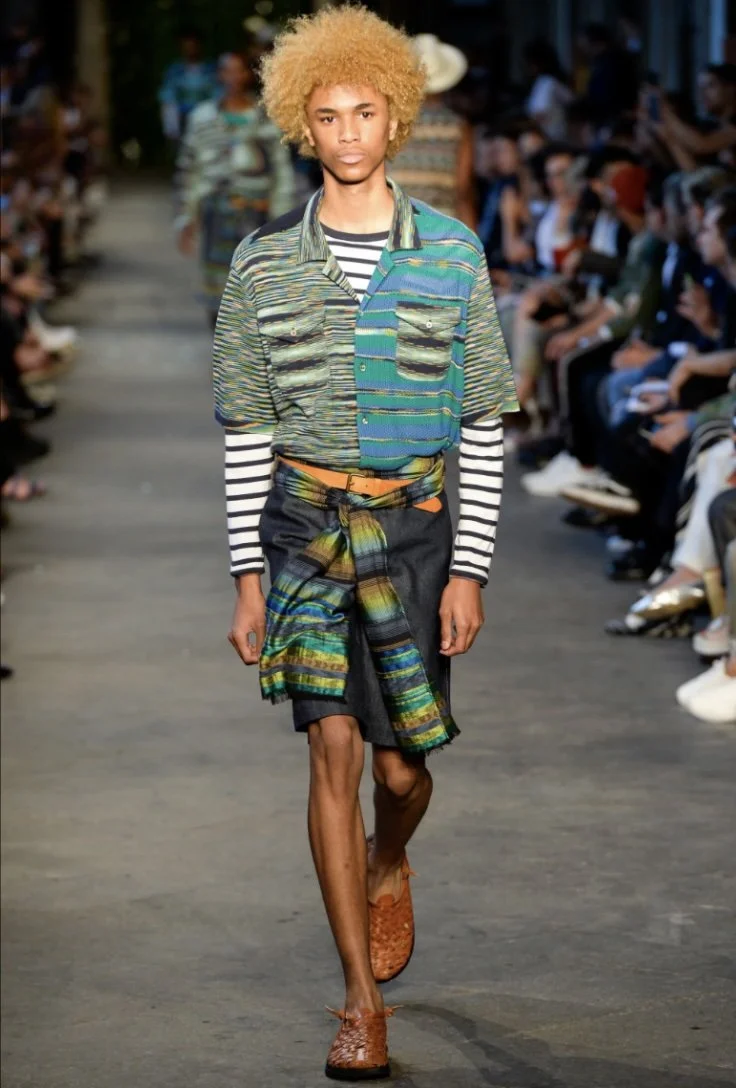
Figure 11
“Missoni Takes us to Guatemala this Spring”, spring 2017. Vogue.com.
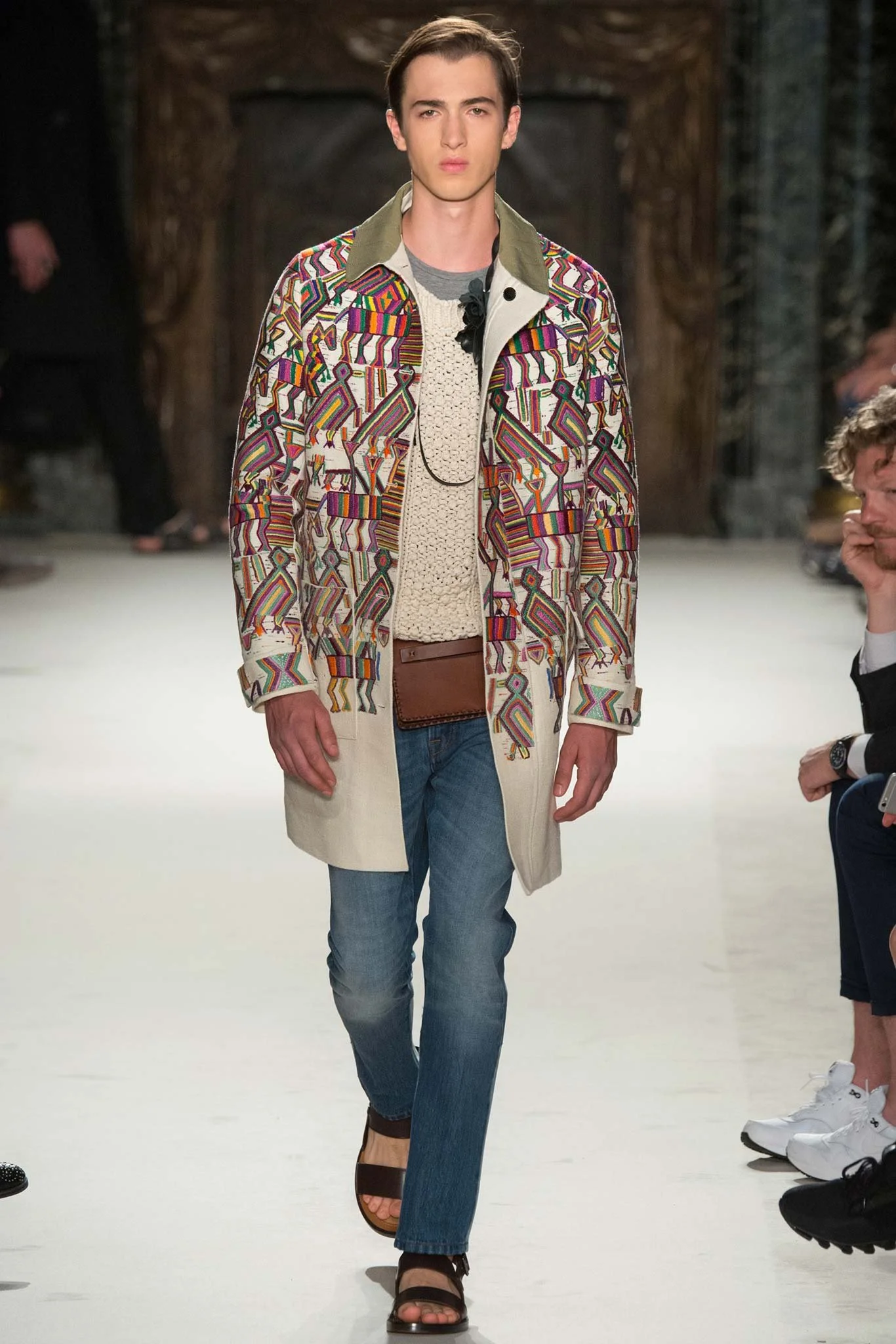
Figure 10
“Valentino se inspira en guatemala” Valentino, September 2015, Vogue.com.

Figure 12
“Missoni Takes us to Guatemala this Spring”, spring 2017, Vogue.com.
The jacket was ‘inspired’ by Maya ancestral designs. However, beyond the appropriated design, there was no connection between the jacket and the Indigenous communities the aesthetic is ‘inspired’ by. In fact, the cotton, machine-made jacquard jacket was made in China. This example of cultural appropriation is at the crux of the legal battles being led by the Movimiento Nacional de Tejedoras: Ruchajixik ri qana’ojbäl. And according to the leader and collective member Angelina Aspuac, the BCBG jacket is “an example of the parallels that exist between this phenomenon (cultural appropriation) and traditional forms of extractivism”.[62] The design on BCBG’s jacket is from the Nebaj region and an almost exact replica of a traditional sobrehuipil, worn exclusively by txux mertomas, Maya women spiritual leaders (Figure 15).[63] And without concern to the spiritual and cultural associations of the design, BCBG Max Azria misused the design on jackets, shoes, bags, and swimsuits.[64]
[62] Juhn, Sunna, and Emily Ratté, “Intellectual extractivism: the dispossession of Maya weaving.” Intercontinental Cry Magazine, July 11, 2018.
[63] Object label for Sobrehuipil de Cofradia at the Museo Ixchel de traje Indigena. Guatemala City, Guatemala, Seen on: August 16, 2024; Arathoon, Barbara Knoke de, and Rosario Miralbés de Polanco. Huipiles Mayas de Guatemala.
[64] Ibid.

Figure 13
BCBG, Runway Freddie Jacket, Spring 2018, Vogue.com.
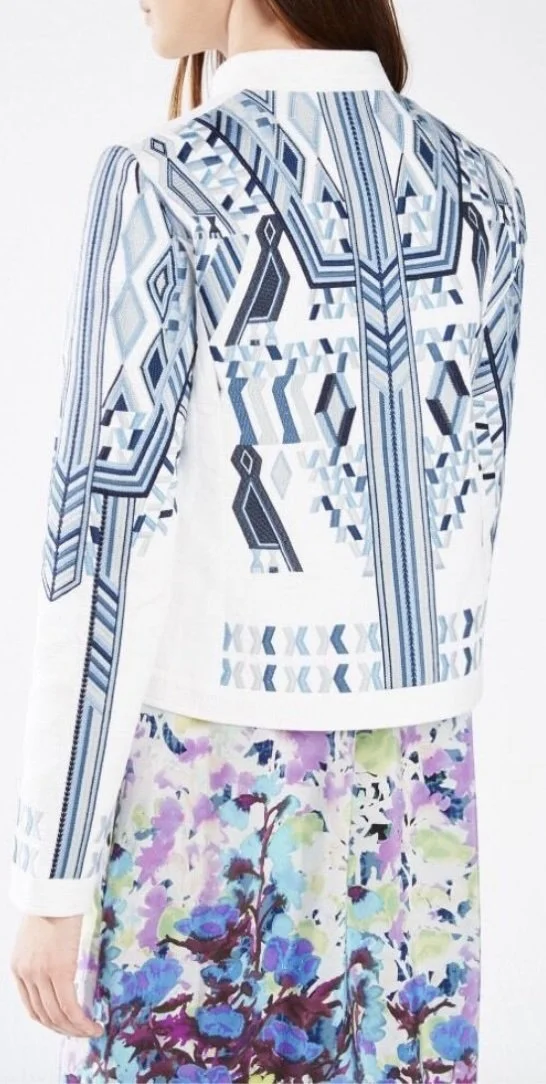
Figure 14
BCBG, Runway Freddie Jacket, Spring 2018, $1,817.00.
Art historian Deborah Root states that cultural appropriation, “signifies not only the taking up of something and making it one’s own but also the ability to do so”.[65] Root goes on to say that people have always shared and borrowed ideas from one another, but appropriation involves, “commodification of aesthetic, cultural and spiritual forms of a society” that is then “packaged for a consumer’s convenience”.[66] She defines the act of cultural theft as one inherently based on the outsider’s ability to do so without greater consequence, which then allows the perpetrators to continue in their commandeering. However, Root’s definition does not consider how colonialism and genocide have participated in cultural theft. Cultural appropriation is the commodification and consumer-ability of one oppressed cultures’ sacredness, aesthetic, imagery, clothing, and social wellness by the oppressor, as a means of continued actions of oppression and colonialism.[67] The power dynamic that exists between oppressed and oppressor is the most important variable to the formula.[68]
[65] Root, Deborah. Cannibal Culture: Art, Appropriation, and the Commodification of Difference. Westview Press, 1996.
[66] Ibid.
[67] Loggans, Regan De. "Selling Headdresses to Hipsters: A Discussion on the Cultural Appropriation of Native American Regalia." Master's thesis, Fashion Institute of Technology, State University of New York. 2017.
[68] Young, James O. Cultural Appropriation and the Arts. Wiley-Blackwell Pub, 2010.
Cultural Appropriation & the Law
In response to continued cultural extractivism via cultural appropriation and tourist exotification, Maya women have organized in defense of their cultural material. In 2016, Movimiento Nacional de Tejedoras: Ruchajixik ri qana’ojbäl filed a constitutional challenge for their collective intellectual property rights to be recognized under Guatemalan law in order to battle the constant co-option of their works for profit (Figures 16 & 17).[69] The group asserted that the Guatemalan state had failed to protect Indigenous people under the states’ constitutional responsibility.[70] Simultaneously, a bill was introduced proposing the usage of, sui generis, a specialized intellectual property law which would recognize Indigenous intellectual property as collective.[71] Sui generis are laws used in intellectual property law to “describe a regime designed to protect rights that fall outside the traditional patent, trademark, copyright, and trade-secret doctrines”.[72] The bill sought to reform five legal articles on the Law on Copyright and Related Rights, the Law on Industrial Property, the Law on Protection and Development of Crafts and the Criminal Code.[73] This recognition of collective authorship would force companies and corporations, including fashion labels, to pay royalties to the communities who are the “authors” of traje designs. In an interview, Angelina Aspuac stated, “We are artists-the people are the artists and authors. What we ask is that the Indigenous Peoples, not just individuals or associations, be recognized as a collective subject.”[74]
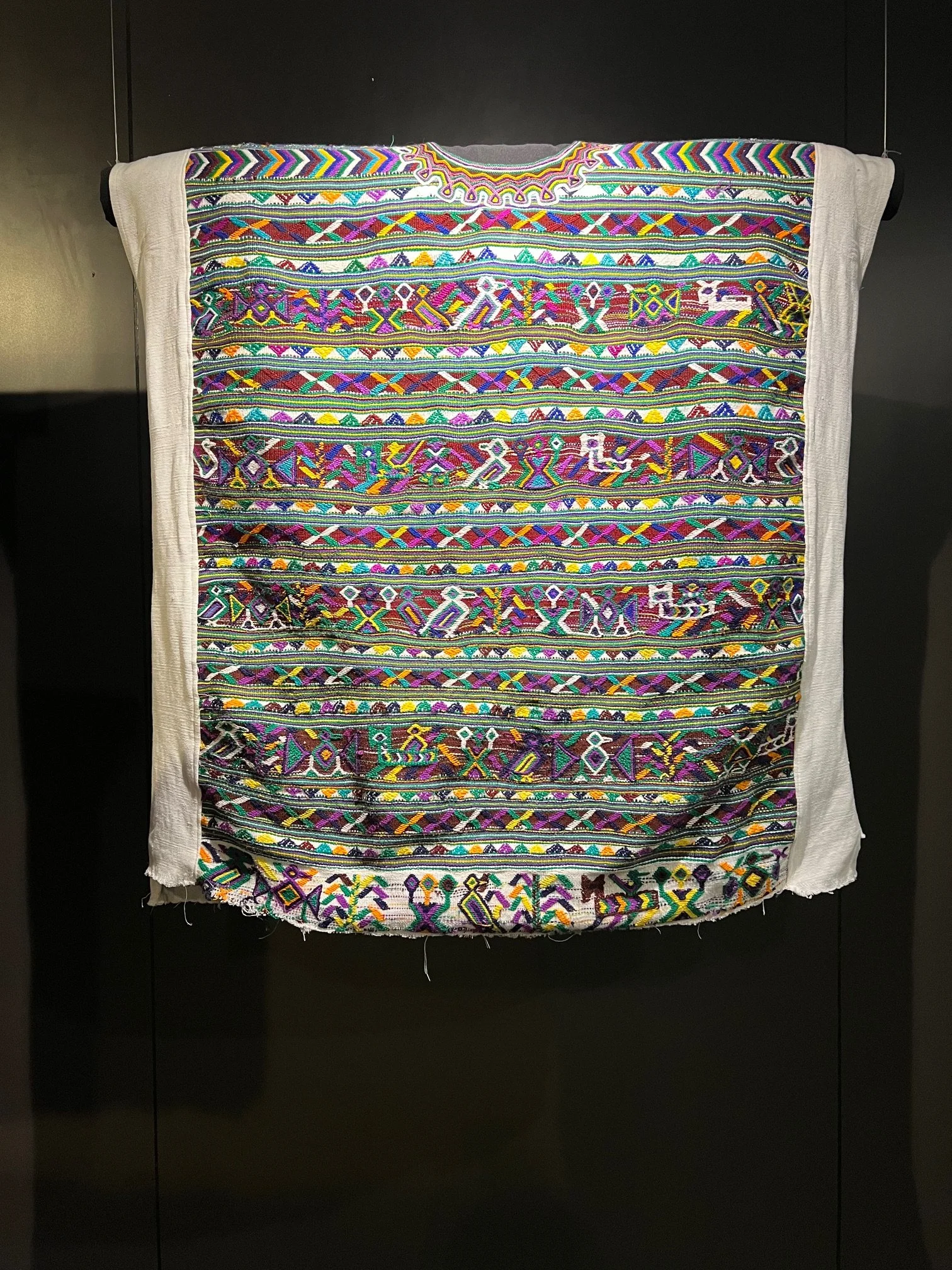
figure 15
Ixil Huipil with hummingbird design, Nebaj region, Ixchel Museo. Image by author.
[69] Picq, Manuela. “Maya Weavers Propose a Collective Intellectual Property Law.” Intercontinental Cry Magazine, March 14, 2017; Kearns, Rick. “Mayan Weavers Seek Legal Protection of Their Designs.” Indian Country Today, June 11, 2017; Abbott, Jeff. “Indigenous Weavers Organize for Collective Intellectual Property Rights.” Waging Nonviolence Magazine, July 17, 2017.
[70] Sosa, Lucie Couillard. Where in the World: Protecting Indigenous Textiles in Guatemala Through Geographical Indications, Brooklyn Journal of Internal Law, 47 (2022): 601; Figueroa, Paul. “When Imitation Is Not Flattery: Addressing Cultural Exploitation in Guatemala Through a Sui Generis Model.” Brigham Young University Law Review, 46. (2021): 989
[71] Note: Sui Generis laws in Guatemala are loosely modeled after Panama’s Law No. 20.4. See, De Obaldia, Irma. “Western Intellectual Property and Indigenous Cultures: The Case of the Panamanian Indigenous Intellectual Property Law.” Boston University Internal Law Journal, 23 (2005): 337-338.
[72] Schuler, Lindsey. “Modern Age Protection: Protecting Indigenous Knowledge Through Intellectual Property Law.” Michigan State International Law Review 21, no. 3 (2013): 609.
[73] Chacón, Gloria Elizabeth. “Material Culture, Indigeneity, and Temporality: The Textile as Legal Subject.” Textual Cultures 13, no. 2. (2020).
[74] Picq, Manuela. “Maya Weavers Propose a Collective Intellectual Property Law.”
[75] Propiedad intelectual colectiva indígena: Sentencia de la Corte de Constitucionalidad de Octubre 24 de 2017, No. 2112-2016.

Figure 16
During a protest, Maya Weavers carry a sign that says “The textile created by Indigenous Peoples are patrimony of Indigenous Peoples.” Photo: AFEDES

Figure 17
The National Weavers Movement at the Guatemalan court after suing the state, 2016 Photo: AFEDES
Though the unconstitutional practice was recognized, the bill coupled with the constitutional complaint, has been stalled in the court.[76] In 2019, a technical commission was created to draft the sui generis law needed to support the bill, but no congressional deadline was made, leaving the legal framework necessary to support the congressional ruling defunct.[77] In 2021, the Movimiento Nacional de Tejedoras: Ruchajixik ri qana’ojbäl once again brought a constitutional complaint forward and filed legal action against the Guatemalan Institute of Tourism (INGUAT). The movement illuminated two points of harm to address: (1) the folklorization and commodification of Indigenous women and textiles in INGUAT tourism policy, photos, and campaigns, and (2) the withholding of state tourism revenues to these same women.[78] Surprisingly, the Constitutional Court ruled in their favor of the weavers and INGUAT must refrain from tokenization of Indigenous people for marketing, as well as “'implement adequate mechanisms for Indigenous peoples’ real and effective participation in formulating and designing public policies on the matter, specifically those that could affect their rights, through legitimate representatives elected according to their own forms of organization”.[79] However, little has been done to rectify this. Here is an undeniable example of state-sanctioned tourism and Indigenous tokenization. INGUAT has used Maya women, and their textiles, to bolster tourism in Guatemala, while continuing and purposefully disenfranchising them. Once again, we witness the state acknowledging the value of Indigenous culture, acknowledging the harm caused by lack of legal protection, but a lack of engagement in rectifying the wrongdoings.
[76] Sosa, Lucie Couillard. Where in the World: Protecting Indigenous Textiles in Guatemala Through Geographical Indications, Brooklyn Journal of Internal Law, 47 (2022): 47.
[77] Figueroa, Paul. “When Imitation Is Not Flattery”: 989-990.
[78] Lopez, Kimberly. “Women Weavers: To Outsiders We’re Exotic; In Guatemala We’re the ‘Marías.’” Elfaro Magazine, February 14, 2021.
[79] Ibid.
Conclusion: Cultural Heritage as Commodification
The INGUAT posters are a reminder of the pervasiveness of the post-war neoliberal multiculturalism, and its behaviour to celebrate cultural differences and acknowledge the rights of disenfranchised groups, while remaining inactive in change. Neoliberal economic reforms, that award individualism and market-based policies, also seek to control cultural rights claims made by disenfranchised groups.[80] Additionally, neoliberal multiculturalism thrives on recognition of cultural differences, while also determining what deserves recognition and what does not.[81] The adoption of multiculturalism permits the state to acknowledge the cultural value of the Maya, while continuing to marginalize them via land-theft, economic reform, and cultural disenfranchisement. Indigenous rights are not denied, rather selectively recognized and reorganized to the state’s advantage.[82] A successful use of neoliberal multiculturalism in post-war Guatemala is through the expansion of tourism and the usage of Indigenous imagery and culture for marketing. Tourism in Guatemala has become pivotal to the economic survival and prosperity of the poor. However, tourism is contingent on the maintenance of a multicultural nationalistic identity, which continues to disenfranchise Indigenous people as relics of the past.
Since the Peace Accords, state officials have used a multicultural discourse to promote Maya culture as “Guatemala’s comparative advantage in the global tourism industry”.[83] While Indigenous people are continuously and systematically under-served, their imagery is used for state-run tourist initiatives. The expanded tourist economy was built, non-consensually, on the backs of Indigenous tropes (mujer maya) and the exotification of crafts arts, specifically textiles (tipica fever). Examples have been provided of fashion brands and design labels witnessing the marketability of Maya designs and profiting from cultural theft.
[80] Hale, Charles R. MáS Que Un Indio More than an Indian : Racial Ambivalence and Neoliberal Multiculturalism in Guatemala. School for Advanced Research Press, 2009, 35.
[81] Ibid.
[82] Ibid.
[83] Devine, Jennifer A. “Politics of Post-War Tourism in Guatemala: Contested Identities, Histories, and Futures.” L’Espace Politique 28. (2016).
Consider the Freddie jacket once again, an obvious and gross example of cultural appropriation of Maya textiles (Figures 13 & 14). This single jacket acts as an example of the lineage of current global conditions. The Freddie jacket was available for purchase beyond the borders of Guatemala, and I would reckon few Guatemalans (Indigenous or not) purchased the $1400 jacket. I believe the global phenomena of Maya textile theft cannot also be divorced from the global phenomena that is fast-fashion production, including all the race and class-based issues that are tied to it. The commodification of Maya textiles, due to tourist access, is similar in traditional extraction processes, like mining or hydroelectric extraction, which is contingent on land displacement and dispossession of Indigenous communities. It is dissimilar in its ability to engage in luxury economies, like fashion, which globalizes displacement and dispossession to other marginalized communities beyond the border of the original, site-specific act of theft. Cultural appropriation is also a consumerist endeavour, and we cannot divorce the role of the global consumer in textile cultural appropriation. The cultural degradation of Maya communities in Guatemala has taken a global stage, but are lacking an audience seeking to empower Indigenous strategies. As seen with the Movimiento Nacional de Tejedoras: Ruchajixik ri qana’ojbäl, even with legal wins against the Guatemalan government and INGUAT, there is little change in the day-to-day lives of those most impacted by cultural theft. Weaving practices are elevated as sites of touristic gain but then lack the protection from extraction. Increased tourism into Guatemala has been a resource to be extracted for an ever-growing tourist market. The continued allowance of such disenfranchisement is contingent on an already prepped nation, with deep roots of desensitizing violence against Indigenous people via genocide and the transformation of historicized racism into a multicultural neoliberal state.
When identifying or defining genocide, a criterion of the identification of validity is “intent to destroy, in whole or in part, a national, ethnical, racial or religious group, as such causing serious bodily or mental harm to members of the group”.[84] I consider this definition deeply when I grapple with this research. Maya epistemologies identify traje as a second skin, la segunda piel. Ongoing harm to the appendage that is a secondary skin is the causation of serious bodily harm. How can we then divorce the violence against traje from a continuum of genocide?[85] As traje is so innately tied to Maya people, continued governmental and cultural inaction is the continuation of the long duree of multicultural neoliberal violence. We cannot untangle the role of traje from the continuum of genocide; They are woven together so neatly and cruelly mirroring the mathematical and cultural epistemologies of the textiles themselves.
[84] UN General Assembly, 9 December 1948, Convention on the Prevention and Punishment of the Crime of Genocide, United Nations, Treaty Series, vol. 78.
[85] Scheper-Hughes, N., 2003. "A Genealogy of Genocide". Modern Psychoanalysis 28(2): 178.
Bibliography
Abbott, Jeff. “Indigenous Weavers Organize for Collective Intellectual Property Rights.” Waging Nonviolence Magazine, July 17, 2017.
Acosta, Alberto. “Post-Extractivism: From Discourse to Practice—Reflections for Action.” In Alternative Pathways to Sustainable Development: Lessons from Latin America, edited by Gilles Carbonnier, Humberto Campodónico, and Sergio Tezanos Vázquez, 77–102. Brill, 2017.
Arathoon, Barbara Knoke de, and Rosario Miralbés de Polanco. Huipiles Mayas de Guatemala : Expresiones Tradicionales de Identidad = Maya Huipiles of Guatemala Traditional Expressions of Identity, edited by William H. Hempstead. Primera edición. Museo Ixchel del Traje Indígena de Guatemala, 2011.
Arellano, Jennifer. “Mara Hoffman’s Guide to Guatemala.” Elle, April 31, 2014.
Arévalo Rita. “Valentino Se Inspira En Guatemala.” Look Magazine, September 24, 2015.
Bastos, Santiago, and Manuela Camus. “Difficult Complementarity: Relations between the Mayan and Revolutionary Movements.” In War by Other Means: Aftermath in Post-Genocide Guatemala, edited by Carlota McAllister and Diane M. Nelson, 71–92. Duke University Press, 2013.
Batz, Giovanni, and B’o’q’ol Q’esal Tenam K’usal. The Fourth Invasion: Decolonizing Histories, Extractivism, and Maya Resistance in Guatemala. 1st ed. University of California Press, 2024.
Chacón, Gloria Elizabeth. “Material Culture, Indigeneity, and Temporality: The Textile as Legal Subject.” Textual Cultures 13, no. 2. (2020).
Cornejo, Kency. Visual Disobedience : Art and Decoloniality in Central America. Duke University Press, 2024.
Crisafulli, Ariana. “After Years of Cultural Appropriation, Mayan Weavers Want Legal Protection of Their Heritage,” Global Voices. September 25, 2017.
De Obaldia, Irma. “Western Intellectual Property and Indigenous Cultures: The Case of the Panamanian Indigenous Intellectual Property Law.” Boston University Internal Law Journal, 23 (2005): 337-338.
Devine, Jennifer A. “Politics of Post-War Tourism in Guatemala: Contested Identities, Histories, and Futures.” L’Espace Politique 28. (2016).
Eduardo Dávila, Sebastián. “Beneath the Second Skin. Mayan textiles and bodies in the art of Manuel Tzoc and Sandra Monterroso.” Special issue, Bodies/Fashions in the Américas 2, edited by Franziska Neff and Miriam Oesterreich. MIRADAS – Journal for the Arts and Culture of the Américas and the Iberian Peninsula 6. (2022).
Figueroa, Paul. “When Imitation Is Not Flattery: Addressing Cultural Exploitation in Guatemala Through a Sui Generis Model.” Brigham Young University Law Review, 46. (2021)
Foss, Sarah. On Our Own Terms : Development and Indigeneity in Cold War Guatemala. The University of North Carolina Press, 2022.
Goertzen, Chris. “Crafts, Tourism, and Traditional Life in Chiapas, Mexico: A Tale Related by a Pillowcase.” In Selling the Indian: Commercializing and Appropriating American Indian Cultures, edited by Carter Jones Meyer and Diana Royer, 236–70. University of Arizona Press, 2001.
Hale, Charles R. MáS Que Un Indio More than an Indian : Racial Ambivalence and Neoliberal Multiculturalism in Guatemala. School for Advanced Research Press, 2009.
Handy, Jim. “‘The Most Precious Fruit of the Revolution’: The Guatemalan Agrarian Reform, 1952-54.” The Hispanic American Historical Review 68, no. 4 (1988): 675–705.
Hendrickson, Carol. Weaving Identities : Construction of Dress and Self in a Highland Guatemala Town. University of Texas Press, 1995.
Higonnet, Etelle. Quiet Genocide: Guatemala 1981-1983. First edition. Taylor and Francis, 2017.
Jett, Stephen C. “Culture and Tourism in the Navajo Country.” Journal of Cultural Geography 11, no. 1 (1990).
Juhn, Sunna, and Emily Ratté, “Intellectual extractivism: the dispossession of Maya weaving.” Intercontinental Cry Magazine, July 11, 2018.
Kearns, Rick. “Mayan Weavers Seek Legal Protection of Their Designs.” Indian Country Today, June 11, 2017.
Lew, Alan A., and George A. Van Otten. Tourism and Gaming on American Indian Lands. Cognizant Communication Corp 1998.
Leitch, Luke. “Valentino Spring 2016 Menswear Collection.” Vogue, June 24, 2015.
Loggans, Regan De. "Selling Headdresses to Hipsters: A Discussion on the Cultural Appropriation of Native American Regalia." Master's thesis, Fashion Institute of Technology, State University of New York. 2017.
Loperena, Christopher. 2023. The Ends of Paradise : Race, Extraction, and the Struggle for Black Life in Honduras. Stanford University Press, 2023
Lopez, Kimberly. “Women Weavers: To Outsiders We’re Exotic; In Guatemala We’re the ‘Marías.’” Elfaro Magazine, February 14, 2021.
Lyon, Sarah. “A Market of Our Own: Women’s Livelihoods and Fair Trade Markets.” In Fair Trade and Social Justice: Global Ethnographies, edited by Sarah Lyon and Mark Moberg, 125–46. NYU Press, 2010.
Macleod, Morna. Nietas del Fuego. Creadoras del Alba. Luchas político-culturales de mujeres mayas. FLACSO Guatemala, 2011.
Mejia, Robin. “Digging Guatemala: Anthropologists Look for Clues to Past Political Killings,” Scientific American (2009).
Montejo, Victor. “Indigenous Threatened Heritage in Guatemala.” In Cultural Heritage and Mass Atrocities, edited by Cuno, James, and Thomas G. Weiss. Getty Publications, 2022.
Mowforth, Martin, and Ian Munt. Tourism and Sustainability : Development, Globalisation and New Tourism in the Third World. Fourth edition. Routledge, 2016.
Nelson, Diane M. Reckoning : The Ends of War in Guatemala. Duke University Press, 2009.
Nelson, Diane M. A Finger in the Wound : Body Politics in Quincentennial Guatemala. University of California Press, 1999.
Nixon, Rob. Slow Violence and the Environmentalism of the Poor. Harvard University Press, 2013.
Odland, J. Claire. “Fashioning Tradition: Maya Huipiles in the Field Museum Collections.” Fieldiana. Anthropology, no. 38 (2006): i–67. 21.
O’Neill, Kevin Lewis, and Kedron Thomas. Securing the City : Neoliberalism, Space, and Insecurity in Postwar Guatemala. Duke University Press, 2011.
Picq, Manuela. “Maya Weavers Propose a Collective Intellectual Property Law.” Intercontinental Cry Magazine, March 14, 2017.
Roach, Mary Ellen, and Joanne Bubolz Eicher. The Visible Self: Perspectives on Dress. Prentice-Hall, 1973.
Root, Deborah. Cannibal Culture: Art, Appropriation, and the Commodification of Difference. Westview Press, 1996.
Scheper-Hughes, N. "A Genealogy of Genocide". Modern Psychoanalysis 28, no. 2 (2003): 178.
Schuler, Lindsey. “Modern Age Protection: Protecting Indigenous Knowledge Through Intellectual Property Law.” Michigan State International Law Review 21, no. 3 (2013).
Sittig, Ann L., and Martha Florinda González. The Mayans among Us : Migrant Women and Meatpacking on the Great Plains. University of Nebraska Press, 2016.
“Somos,” INGUAT: Instituto Guatemalteco de Turismo, http://www.inguat.gob.gt/.
Sosa, Lucie Couillard. Where in the World: Protecting Indigenous Textiles in Guatemala Through Geographical Indications, Brooklyn Journal of Internal Law, 47 (2022).
Sweet, J. O. “Let 'em Loose”: Pueblo Indian Management of Tourism.” American Indian Culture and Research Journal 15, no. 4 (1991): 59-74.
Trefzger, Douglas W. “Guatemala’s 1952 Agrarian Reform Law: A Critical Reassessment." International Social Science Review 77, no. 1/2 (2002).
Walsh, Aisling. “How Mayan Women in Guatemala are Fighting to Protect Their Designs and Their Identity.” Open Democracy Magazine, August 8, 2018.
Weissert, Will. “Maya country: With brutal civil war long over, tourists return in droves.” The Associated Press, 2005.
Wilson, Tamar Diana. “Introduction: The Impacts of Tourism in Latin America.” Latin American Perspectives 35, no. 3 (2008): 3–20.
Young, James O. Cultural Appropriation and the Arts. Wiley-Blackwell Pub, 2010.
reports
Amnesty International. Amnesty International Briefing: Guatemala. Index no. AMR 34/001/1976.December 1, 1976.
Amnesty International. “AI Publishes Briefing on Guatemala” Amnesty International Newsletter 2, no. 1 (January 1977): 1, continued on 4.
Amnesty International. Guatemala: The Guatemalan Peace Process Agreements: Elements Most Relevant to Amnesty International Concerns. Index no. AMR 34/024/1997. August 17, 1997.
Defense Intelligence Agency. Guatemalan Antiterrorist Campaign. Secret Intelligence Bulletin. 1971.
Guatemala—Memory of Silence: Report of the Commission for Historical Clarification: Conclusions and Recommendations. Die Friedens-Warte 74, no. 4 (1999): 511–547.
International Labour Organization. Indigenous and Tribal Peoples Convention, 1989 (No. 169). Convention C169. June 27, 1989.
International Work Group for Indigenous Affairs. “Indigenous People in Guatemala.” In The Indigenous World 2024. 38th ed. Copenhagen: International Work Group for Indigenous Affairs, 2024.
Navajo Nation v. Urban Outfitters, No. 12-195 BB/LAM, 2016 U.S. Dist. LEXIS 136563 (D.N.M. Sept. 19, 2016).
Organización Mundial del Turismo. Tourism Doing Business: Invirtiendo en Guatemala. Madrid: ONU Turismo, 2025.
Propiedad intelectual colectiva indígena: Sentencia de la Corte de Constitucionalidad de octubre 24 de 2017, No. 2112-2016.
United Nations General Assembly. Convention on the Prevention and Punishment of the Crime of Genocide. Treaty Series, vol. 78. December 9, 1948.
UN Women. “Guatemala.” Where We Are: Americas and the Caribbean. United Nations, 2024.
Vasquez, Edith. Guatemala: Exporter Guide. RN: GT2023-0012. Foreign Agricultural Service and Global Agricultural Information Network (GAIN), U.S. Department of Agriculture. January 3, 2024.
Vasquez, Edith. Guatemala: Food Service—Hotel, Restaurant, and Institutional. RN: GT2023-0010. Foreign Agricultural Service and Global Agricultural Information Network (GAIN), U.S. Department of Agriculture. September 29, 2023.
World Bank. Gender-Based Violence Country Profile: Guatemala. GBV Country Profile. Washington, DC: World Bank, 2023.
Somos INGUAT. Instituto Guatemalteco de Turismo. Accessed [Month Day, Year]. http://www.inguat.gob.gt/.
Author Bio
Regan (they/themme/theirs/elle) is an anthropologist and fashion scholar interested in the intersections of mass violence, politics of dress, and Indigenous resistance. They have a Master’s in Fashion and Textile History from SUNY: Fashion Institute of Technology, a Master’s in Genocide Studies from the CUNY: Graduate Center, and will be pursuing a Doctorate in Anthropology at Tulane University. They have been conducting fieldwork in Guatemala for three years; Regan resides in Lenapehoking.

“Kixampe” by Rebecca lane, Primobeatz, and Sarah Curruchich
Article Citation
Loggans, Regan. “La Segunda Piel: The Fight for Maya Textiles in Post-Genocide Guatemala.” Unravelling Fashion Narratives, special issue of Fashion Studies, vol. 5, no. 2, 2026, pp. 1-37. https://doi.org/10.38055/UFN050208
Copyright © 2026 Fashion Studies - All Rights Reserved
Creative Commons Attribution-NonCommercial-NoDerivatives 4.0 International (CC BY-NC-ND 4.0) license (see: https://creativecommons.org/licenses/by-nc-nd/4.0/)