
Summoning Ghosts in the Fashion Archive: Reparative Case Studies of 1870s-1920s Menswear
By Lex Flavelle
DOI: https://doi.org/10.38055/UFN050201
MLA: Flavelle, Lex. “Summoning Ghosts in the Fashion Archive: Reparative Case Studies of 1870s-1920s Menswear.” Unravelling Fashion Narratives, special issue of Fashion Studies, vol. 5, no. 2, 2026, pp. 1-30. https://doi.org/10.38055/UFN050201
APA: Flavelle, L. (2026). Summoning Ghosts in the Fashion Archive: Reparative Case Studies of 1870s-1920s Menswear. Unravelling Fashion Narratives, special issue of Fashion Studies, 5(2), 1-30. https://doi.org/10.38055/UFN050201
Chicago: Flavelle, Lex. “Summoning Ghosts in the Fashion Archive: Reparative Case Studies of 1870s-1920s Menswear.” Unravelling Fashion Narratives, special issue of Fashion Studies 5, no. 2 (2026): 1-30. https://doi.org/10.38055/UFN050201
Volume 5, Issue 2, Article 1
Keywords
Shapewear
Menswear
19th century
20th century
Queer fashion history
Abstract
In conjuring the image of a gentleman at the turn-of-the-20th-century, a few memorable garments spring to mind: trousers, vest, coat, perhaps a top hat. While seldom discussed, shapewear was an essential component to crafting the distinctive silhouettes of this period. Scholars like Peter Farrer, Valerie Steele, and Alanna McKnight have discussed the controversial use of corsets in men in the late-19th and early-20th centuries as an exceptional practice for health, sexual gratification, or gender realization. However, this analysis of two extant garments from the 1870s-1920s, a cotton pinstripe vest and a black wool tailcoat from Toronto-area collections, proves that even everyday masculine dress employed varied techniques of patterning, cinching, and tailoring to shape the body. I study these techniques, juxtaposing them with similar examples, to argue for an expansive definition of shapewear. In doing so, I examine how the abstracted masculine ideal was navigated—and deconstructed—through one’s clothing. Moreover, I take the scant provenance records of these garments as an opportunity to adapt Marisa J. Fuentes’ bias grain reading of unknown histories, darning over the holes in their histories to imagine potential wearers from a queer perspective. This project asks readers to consider how storytelling possibilities live in clothing’s memory—and how we can summon ghosts of the past and present to better understand the somatic elements of queer fashion history.
In conjuring the image of a gentleman at the turn of the 20th century, a few memorable garments spring to mind: trousers, vest, coat, perhaps a top hat. While seldom discussed, shapewear was an essential component to crafting the distinct silhouettes of this period. This analysis of two surviving garments of the 1870s-1920s—a cotton pinstripe vest and a black wool tailcoat—adopts a broad definition of male shapewear to examine how everyday clothing items could augment the body, signal masculinity, and express or reject social mores. These garments, and others like them, prove that menswear of this period subscribed to fashion trends and employed a diversity of techniques to achieve desired forms. By adapting reparative storytelling frameworks pioneered in the field of Black social history, I interpret these shapewear items through a queer lens as modes of alternative masculinity.
Fashion historians Ingrid Mida and Alexandra Kim note the comparative lack of men’s clothing in museum collections and displays, stymying efforts to assess periodicity, track trends, or perform any meaningful quantitative analysis. [1] This lack of material exacerbates well-acknowledged issues with fashion study, including the privileging of fashionable elite over common people. [2] Furthermore, as Alanna McKnight notes, the feminized reputation of corsetry and shapewear frustrates attempts to gauge their adoption by men.[3] Early works on 19th century male shapewear, like Peter Farrer’s edited volumes of men’s letters to English periodicals, focus on the written discourse of male corsetry as an exceptional practice for health, sexual gratification, or gender realization.[4] This is a useful lens, but fails to address diverse tailoring and assembly techniques employed in other garments—techniques which show shapewear of this period meant more than corsetry.
These case studies revolve around two outerwear items, a cotton vest from the Fashion Research Collection (FRC) at Toronto Metropolitan University, and a wool tailcoat held in the archives of the Village at Black Creek. A note on language: while “waistcoat” and “vest” are used interchangeably in Canada to refer to the same garment, I am describing the FRC article as a “vest” to differentiate it from the tailcoat. The vest, still a ubiquitous part of men’s formalwear in the present day, adjusts the waist with ties anchored in the side seams. The tailcoat uses skillfully applied pad stitching under the arms to shape the waist, affecting the conical silhouette in fashion among dandies of its period. In applying the descriptor “shapewear,” I consciously invert the feminine and often critical association with garments that alter the body’s appearance, demonstrating that this practice was (and is) employed by people of all genders.
[1] Ingrid Mida and Alexandra Kim, The Dress Detective: A Practical Guide to Object-Based Research in Fashion, Bloomsbury Academic edition., with Society of Antiquaries of London (Bloomsbury Visual Arts, 2018), 140.
[2] Mida and Kim, The Dress Detective, 137.
[3] Alanna McKnight, “Chapter 2: Hard and Straight: The Creation of Nineteenth-Century Masculinity Through Corsetry,” in Crossing Gender Boundaries: Fashion to Create, Disrupt and Transcend (Intellect, 2020), 38.
[4] Peter Farrer, ed., Men in Petticoats: A Selection of Letters from Victorian Newspapers (Karn Publications, 1987), The Kinsey Institute Library & Special Collections; Peter Farrer, ed., The Regime of the Stay-Lace: A Further Selection of Letters from Victorian Newspapers (Karn Publications, 1995), The Kinsey Institute Library & Special Collections.
As exterior garments, it is unlikely that people of the 1870s-1920s viewed them the same way as corsets. However, both items employ construction techniques that visibly reduce or redistribute soft tissue. Sophie Lamotte identifies “tells” of “whalebone” shapewear that might expose a man as a corset-wearer: the ultimate indiscretion.[5]
Such compromises show the impact of the “contradictory impulses” of masculinity at work in this period.[6]
[5] Sophie Lamotte, “Corsets, Stomach Belts, and Padded Calves: The Masculine Silhouette Reconfigured,” in Fashioning the Body: An Intimate History of the Silhouette (Bard Graduate Center, 2015), 200.
[6] Martin Francis, “The Domestication of the Male? Recent Research on Nineteenth- and Twentieth-Century British Masculinity,” The Historical Journal (Cambridge, UK) 45, no. 3 (2002): 643. While Francis relates these impulses to male domesticity, this observation fits within a broader analysis of how masculinity in the late 19th and early 20th centuries was a site of constant negotiation.
The accession history and biographical data of both garments are scant. To reckon with this, I have adapted Marisa J. Fuentes’ bias grain approach to invisible and unknown histories into a speculative method of object biography I compare to darning.[7] Fuentes describes her method, stretching archival fragments to bring light to invisible stories, as reading “along the bias grain” of history.[8] She refers to hanging fabric diagonally (on its bias) along the direction of greatest stretch, comparing it to her process of uncovering Black women’s histories in oppressive archives that otherwise fail to preserve their presence. Working from primarily written sources, Fuentes cautiously engages with what Saidiya Hartman calls “critical fabulation.”[9] Rather than building imagined histories, she uses archival fragments to illuminate the spaces between enslaved women’s intersections with the archive.[10]
Tiya Miles demonstrates how adapting this method to object history can open new avenues for speculative narration: working from a single sentence of embroidery on a surviving grain sack, she tells the story of a Black family’s separation through sale in evocative, despairing, and reverent vignettes.[11] She escapes the limits of the written archive—which features as a hostile agent to both Hartman and Fuentes’ reparative narration—by ruminating on the emotional and practical weight of a mother providing for her daughter. But Miles’ story still relies on the sack’s embroidery. What do we do with objects lacking a legible record?
In keeping with the apt textile metaphor, I propose a darning approach to presenting possible realities in objects without known provenance. Darning is a garment repair technique that involves replacing worn areas of knit fabric with fresh fibres. While these replacement stitches can be nigh undetectable, my version draws from the colourful and unapologetic world of visible mending practices. My repairs involve working from physical and contextual evidence to produce moments of vivid patchwork interspersed throughout the fabric of what is known. This method allows me to explore possible realities, anchored by the certainty of an object’s physical form. Rather than an abstracted form of museum mannequin design, where the body recedes from view behind the garment, I practice an imagined form of experiential historical dress.[12]
In adapting methods pioneered by Black women for Black women, I am conscious of the differences in our source material. I hope that working from a history that has “engendered” me (queerness in Toronto), itself fraught with policing and surveillance, lends my narration some of the fidelity and care shown by Hartman, Fuentes, and Miles to their subjects.[13]
[7] Marisa J. Fuentes, Dispossessed Lives: Enslaved Women, Violence, and the Archive (University of Pennsylvania Press, 2016), 7–8.
[8] Fuentes, Dispossessed Lives, 8.
[9] Saidiya Hartman, “Venus in Two Acts,” Small Axe: A Journal of Criticism (Bloomington) 12, no. 2 (2008): 11.
[10] Fuentes, Dispossessed Lives, 10.
[11] Fuentes, Dispossessed Lives, 7; Tiya Miles, All That She Carried: The Journey of Ashley’s Sack, a Black Family Keepsake (Random House Publishing Group, 2021).
[12] Dinah Eastop and Mary M. Brooks, “Interactions of Meaning and Matter,” in Refashioning and Redress: Conserving and Displaying Dress (Getty Conservation Institute, Getty Publications, 2016), 10–11.
[13] Hartman, “Venus in Two Acts,” 4.
The dearth of instructional material in the assessment of menswear for museum display is another example of menswear’s underrepresentation in public history. However, I have adapted an abridged version of Janet Wood’s womenswear assessment method to identify this vest and tailcoat as belonging to the 1870s-1920s period. As I am not preparing these garments for display, my truncated dating method focuses on their key design features, silhouette, and corroborating primary evidence. In place of Wood’s specifications for signature silhouettes in womenswear, I have consulted Graham Cottenden’s manual on men’s tailoring, capturing a hundred-year period beginning in 1850. [14] As both scholars are British, I account for regional differences by consulting American and Canadian primary sources.
This project contributes to the study of masculinities by examining how the hegemonic masculine body can inspire, or be deconstructed by, other masculinities that adopt its visual language.[15]
To borrow Simon Yarrow’s term, emulating the “iconic masculinity” of this period involved adopting shapewear to affect an ideal male silhouette–all while distancing oneself from the feminizing forces of fashion and corsetry.[17]
[14] Graham Cottenden, Men’s Tailoring: Bespoke, Theatrical and Historical Tailoring 1830-1950, 1st ed. (Taylor & Francis Group, 2019).
[15] R. W. Connell and James W. Messerschmidt, “Hegemonic Masculinity: Rethinking the Concept,” Gender & Society (Thousand Oaks, CA) 19, no. 6 (2005): 838–40.
[16] Connell and Messerschmidt, “Hegemonic Masculinity,” 838; Valerie Steele, The Corset: A Cultural History (Yale University Press, 2001), 39.
[17] Simon Yarrow, “Masculinity as a World Historical Category of Analysis,” in What Is Masculinity?, with John H. Arnold and Sean Brady, Genders and Sexualities in History (Palgrave Macmillan UK, 2011), 116-122.
In the negotiation between the ideal and the real, varied bodies of living people, alternate masculinities are realized. For those who did not meet the iconic masculine ideal, male shapewear remained a means of self-expression and social identification. Women who wore men’s clothing—from vaudeville performers and literary heroines to those who covertly “passed” as men—marked male hegemony as unstable and socially enforced.[18] Men who dramatically exaggerated their waists performed an alternate masculinity associated with effeminacy and homosexuality.[19] Grafting these lived experiences onto the vest and tailcoat accomplishes queer reading two ways: it introduces alternate object biographies that trouble the iconic masculine memory, and considers how even the most accessible and publicly accepted modes of male shapewear could be adopted into queer expressions.
I ask readers to reckon with how we tell object history by prioritizing the possibilities concealed in clothing’s memory. Moving away from the semiotics of literary study, this project approaches the somatic relationship between human and object by considering the shapes left behind in the things we wear.[20] It constructs emotional, subjective histories by lingering on the material.[21]
[18] Sharon Ullman, “The ‘Self-Made Man:’ Male Impersonation and the New Woman,” in Passing: Identity and Interpretation in Sexuality, Race, and Religion, ed. Maria C. Sanchez and Linda Schlossberg (New York University Press, 2001), 188; Draucker, Sounding Bodies, 79–98; Katie Hindmarch-Watson, “Lois Schwich, the Female Errand Boy: Narratives of Female Cross-Dressing in Late-Victorian London,” GLQ: A Journal of Lesbian and Gay Studies 14, no. 1 (2008): 81.
[19] Michael S. Kimmel, “Masculinity as Homophobia: Fear, Shame, and Silence in the Construction of Gender Identity,” in Feminism and Masculinities, ed. Peter F. Murphy (Oxford University Press, 2004), 181; Seth Koven, Slumming: Sexual and Social Politics in Victorian London (Princeton University Press, 2006), 104.
[20] Joanne Entwistle and Katherine Townsend, “On Fashioning Anatomy,” in Crafting Anatomies: Archives, Dialogues, Fabrications, ed. Katherine Townsend et al. (Bloomsbury Visual Arts, 2020), 292.
[21] Michael Roper, “Slipping Out of View: Subjectivity and Emotion in Gender History,” History Workshop Journal 59, no. 1 (2005): 62.
[22] Katherine Townsend et al., “The Electric Corset and Other Future Histories,” in Crafting Anatomies: Archives, Dialogues, Fabrications, ed. Katherine Townsend et al. (Bloomsbury Visual Arts, 2020), 94. Here, I borrow the phrasing about “ghosts” in the archive. Whereas Townsend et al. use this phrasing to describe “future histories,” the ghosts I invoke in this project are of the past and present.
Haunting or Hallucination? Notes on “Darning” Holes in Object History
My speculative darning is rooted in corroborative research, using the objects’ materiality as a base. We have virtually no provenance to draw from for this vest and tailcoat. Accordingly, I have textured my analyses of garment construction and historical context by introducing speculative stories of wear, in a smaller-scale—yet more imagined—rendition of Miles’ storytelling. In choosing to linger on queer modes of dress, I build on the reparative readings of Victorian media and somatics by Abigail Joseph and Shannon Draucker, who ask historians to consider the archive not just as a site for queer interpretation but as a repository for queer experiences to “reconstruct… lost history.”[23] By demonstrating two applications of this darning method, I hope to offer object biography frameworks that emphasize human experience and material impact on imagined wearers, even in instances of archival scarcity.
So, who are these imagined wearers, these (un)living mannequins? While I have sourced these objects from Toronto-area archives, it is possible that they were purchased by their former owners from other regions. These original owners are equally mysterious: the race, sexuality, and even gender of the people who wore these garments are lost to us. The challenge of interpreting these objects is to embrace a speculative history, rooted in corroborative research, without erasing possible realities.
For example, it is likely that these garments were sold to and owned by men, because we know that they are menswear—however, we cannot be certain.[24] The mail-order market allowed people to purchase goods without the scrutiny of a sales associate. Studies like Joseph’s analysis of queer Victorian fashion, and Katie Hindmarch-Watson’s review of passing women, focus on instances of exposure preserved in the archive: moments where people are discovered and the consequences thereof. Such instances point to a thriving, less visible queer experience that evades the archive—can we pick up these threads to repair holes in objects’ provenance?
[23] Abigail Joseph, Exquisite Materials: Episodes in the Queer History of Victorian Style (University of Delaware Press, 2019), 85; Shannon Draucker, Sounding Bodies: Acoustical Science and Musical Erotics in Victorian Literature (State University of New York Press, 2024).
[24] Farrer, Men in Petticoats; Joseph, Exquisite Materials, 80.
Pinstripes and Pearl: A Black & White Wardrobe Staple
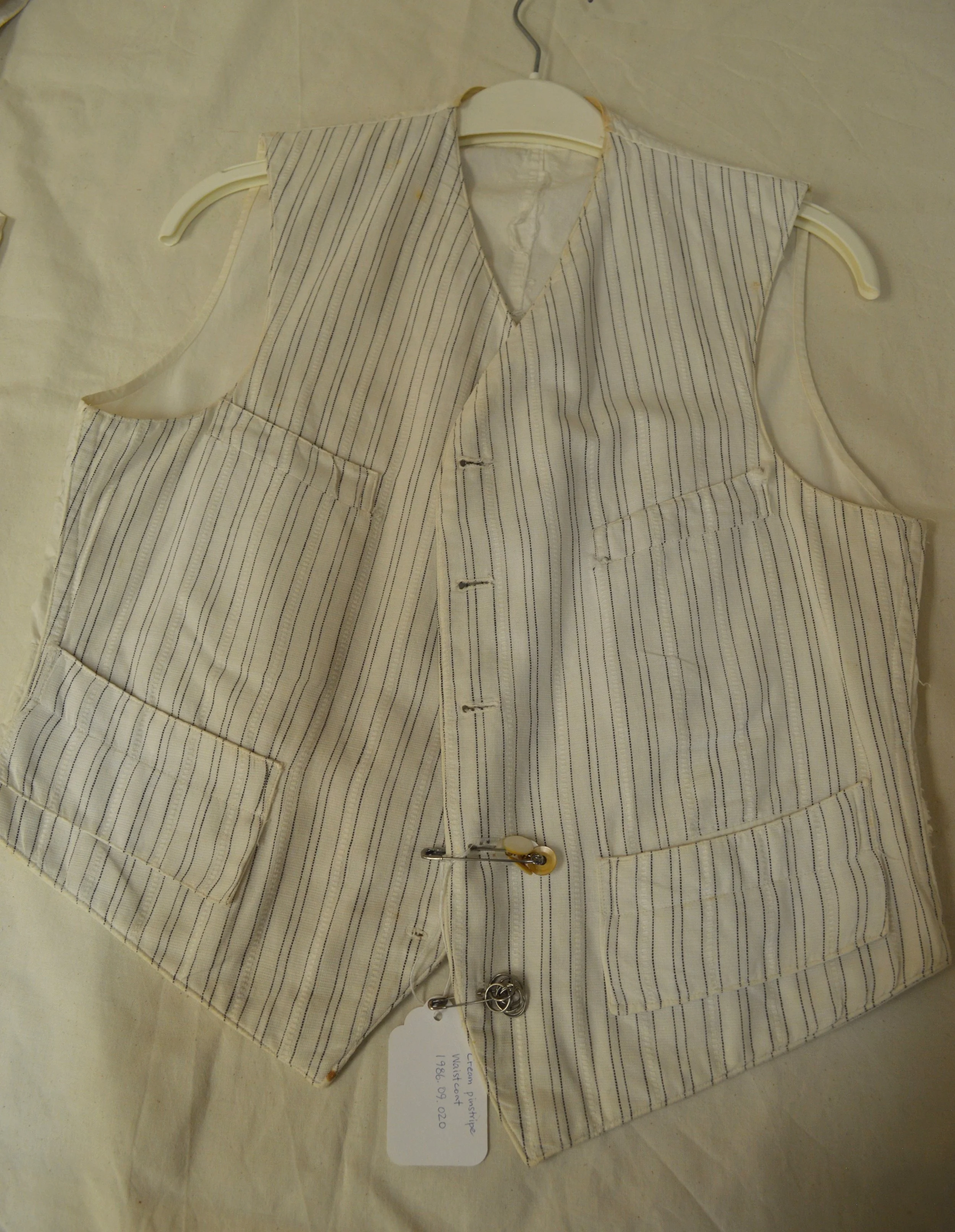
figure 1
Cream Pinstriped Cotton Waistcoat. Toronto Metropolitan University Fashion Research Collection. Call No. 1986.09.020. Photograph by Author, 2025.
This vest is constructed of woven cotton in a cream white colour. The black pinstripe pattern is interlaced into the fabric using a combination stripe method: stripes of decorative tone-on-tone checks run between wider pairs, followed by a more narrowly spaced pair in a repeating sequence.[25] The breast pockets are set-in with a flap cover, and the waist pockets are patched onto the face of the garment. The front button placket is self-faced with the same pinstripe fabric, as is the front hem. Otherwise, the front panels are lined with a plain cream cotton.
The vest’s key features are its cotton material, pinstripe design, and detachable pearl buttons. Similar vests were marketed in Eaton’s warm weather catalogues as “washable.” An 1884 Eaton’s catalogue listing offers two options for single-breasted white vests with detachable pearl buttons and cotton “double back[s] (Fig. 2).”[26] The preceding description for these summer garments markets them as unlined, so I read the “double back” identifier as referring to the back being cut from two pieces of cloth. However, the vest studied here has front panels lined with plain cotton—it is unclear whether this partial lining would be considered “unlined” in 1884.
[25] International Correspondence Schools, Weave Construction and Cloth Analysis (International Textbook Co., 1905), 179–84.
[26] T. Eaton Co., Eaton’s Catalogue 1884 (T. Eaton Co., 1884), 59, University of Toronto Fisher Collection.
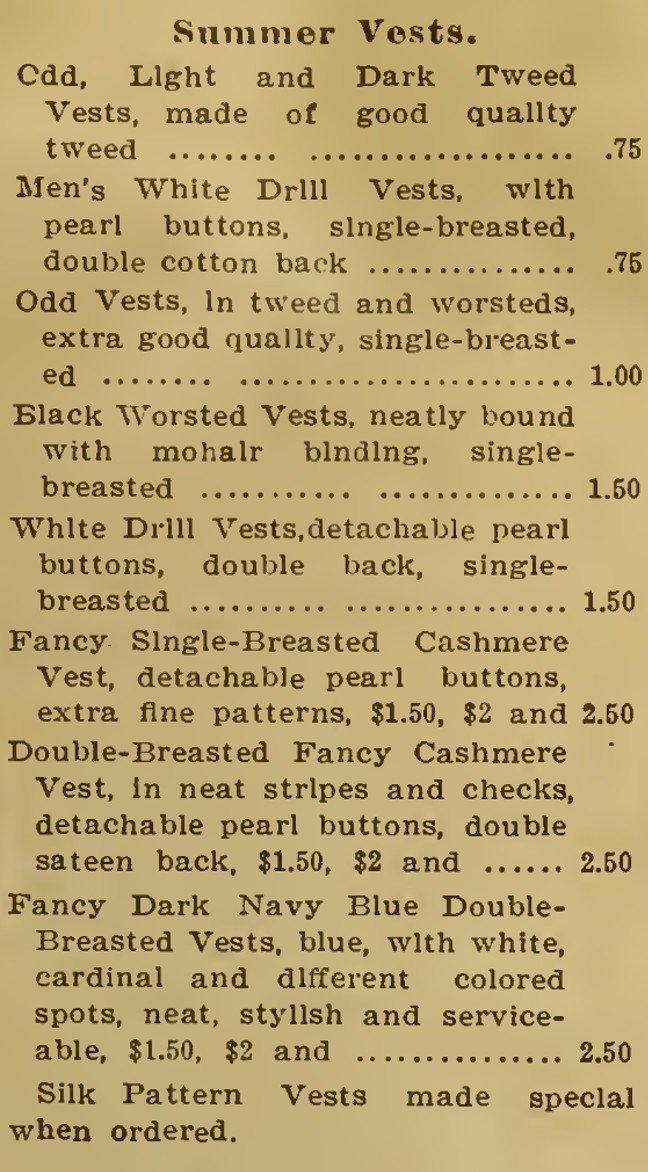
Figure 2
Eaton’s Catalogue 1884, p. 59. University of Toronto Fischer Collection. Accessed online via Internet Archive, 2025.
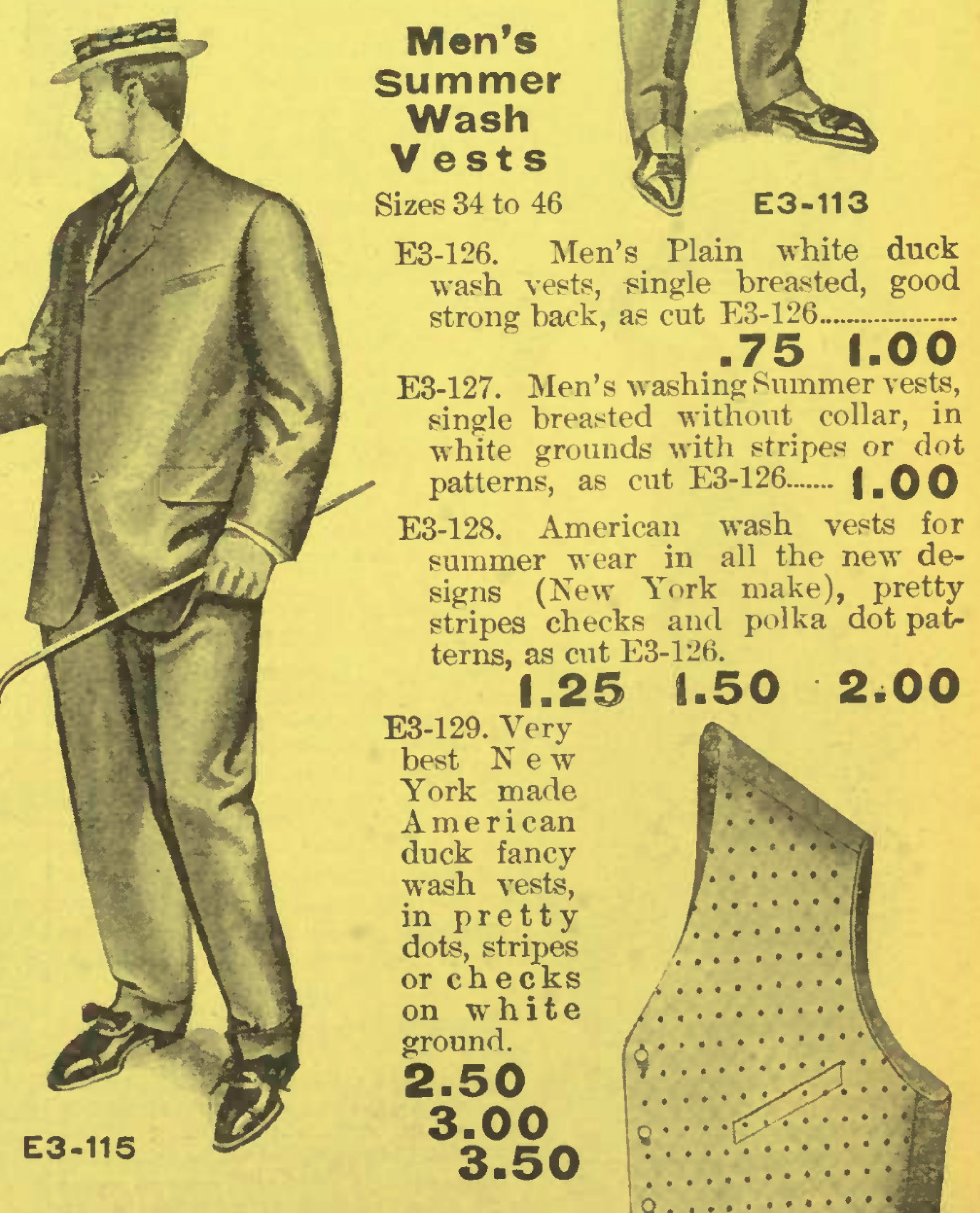
Another vest from its accession cohort bears comparable measurements and sports a dotted design.[27] A listing in the Eaton’s Spring/Summer catalogue of 1907 advertises “washing Summer vests… in white grounds with stripes or dot patterns” (Fig. 3).[28] While the dotted vest, with its angled welt pockets and six buttonholes, appears nearly identical to the advertisement (Fig. 4), the pinstripe vest sports five buttonholes and two pocket styles. Another Eaton’s Spring/Summer catalogue, ten years later, reflects at least one of these changes (five detachable buttons) in the washable line (Fig. 5).[29] Vests of white cotton and simple patterns appear to have been a common budget summer menswear style available from Eaton’s catalogues during the late 19th and early 20th centuries.
[27] Cream Cotton Waistcoat, n.d., Textile, Toronto Metropolitan University Fashion Research Collection, Call No. 1986.09.019.
[28] T. Eaton Co., Eaton’s Spring and Summer Catalogue 1907 (T. Eaton Co, 1907), 61, Toronto Public Library: Toronto Reference Library.
[29] T. Eaton Co., Eaton’s Spring and Summer Catalogue 1917 (T. Eaton Co., 1917), 242, Toronto Public Library: Toronto Reference Library.
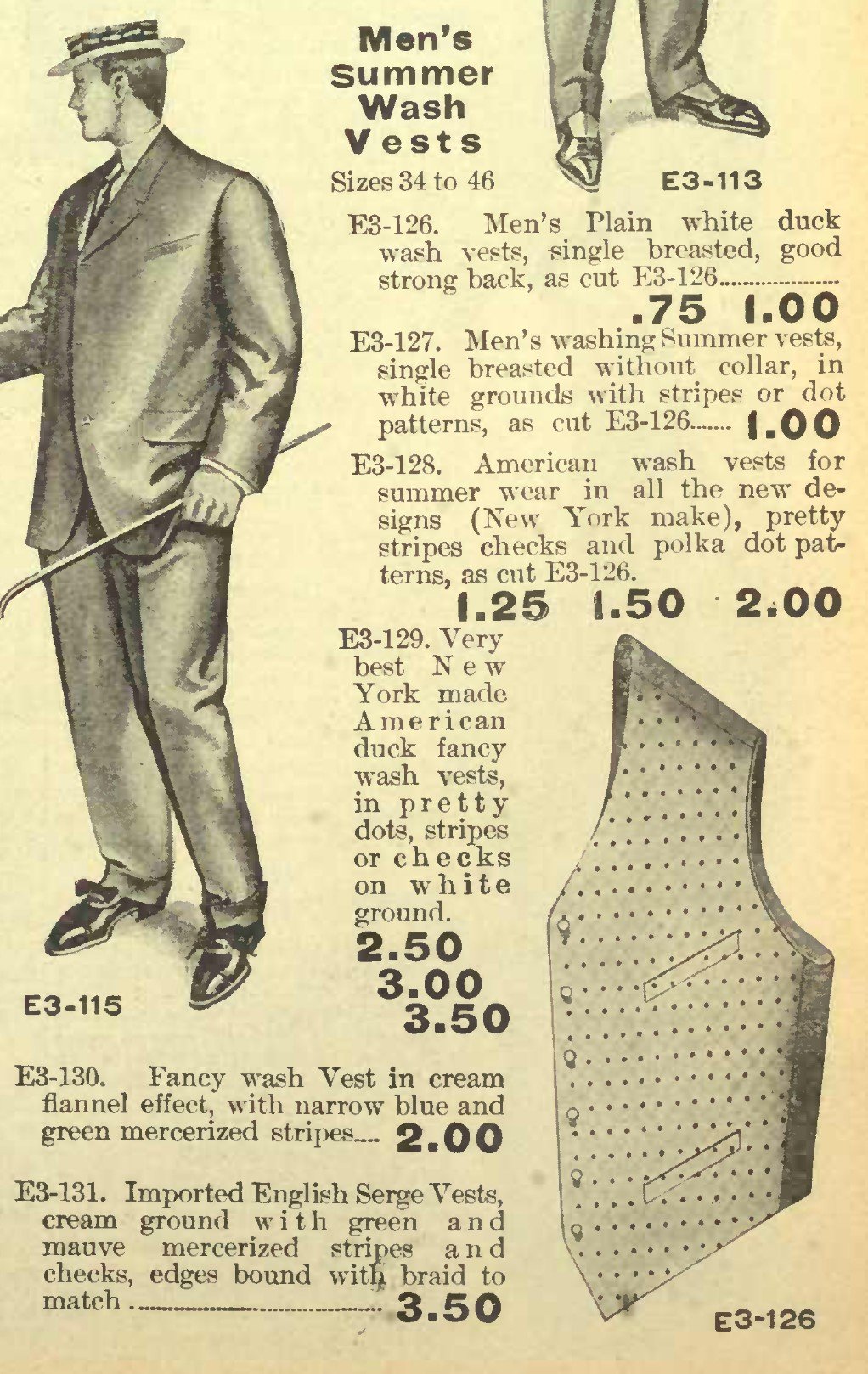
Figure 3
Eaton’s Spring and Summer Catalogue 1907, p. 61. Toronto Reference Library. Accessed online via Internet Archive, 2025.
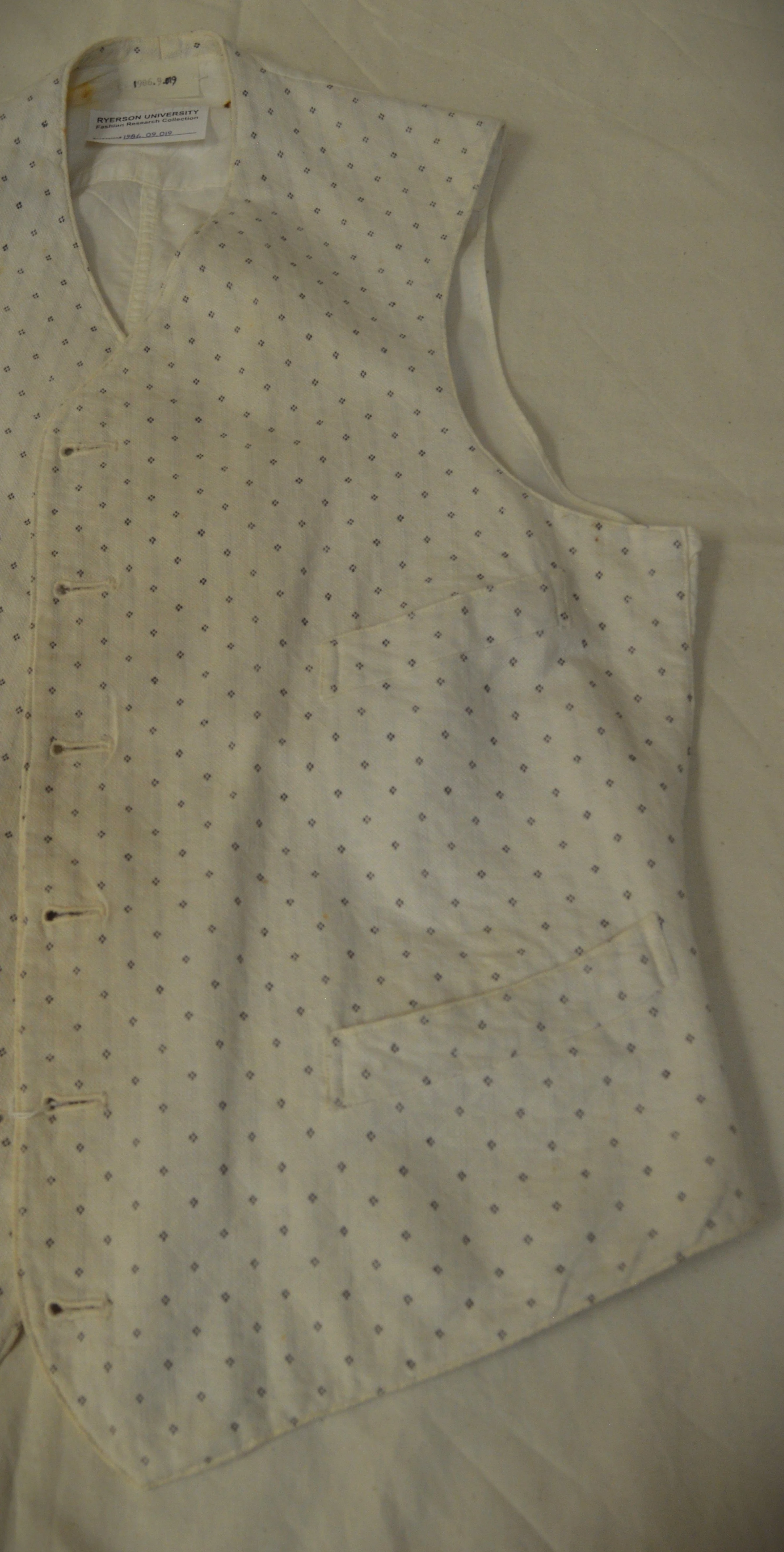
Figure 4
Cream Cotton Waistcoat. Toronto Metropolitan University Fashion Research Collection. Call No. 1986.09.019. Photograph by Author, 2025.
Two lining panels, seamed together, form the back of the garment. The internal seam has been graded and felled flat with two rows of machine topstitching. The folded edge of the seam allowance remains tucked away on the top and bottom of the garment, but the mid-length is frayed. Priced at under two dollars, it may have been constructed with seam allowance too narrow to survive heavy washing or wear as a cost-cutting measure.[30] If it was indeed marketed as washable, was the wearer frustrated by the damage? At this low price point, did they even blink at replacing it?
[30] T. Eaton Co., Eaton’s Spring and Summer Catalogue 1907; T. Eaton Co., Eaton’s Spring and Summer Catalogue 1917.
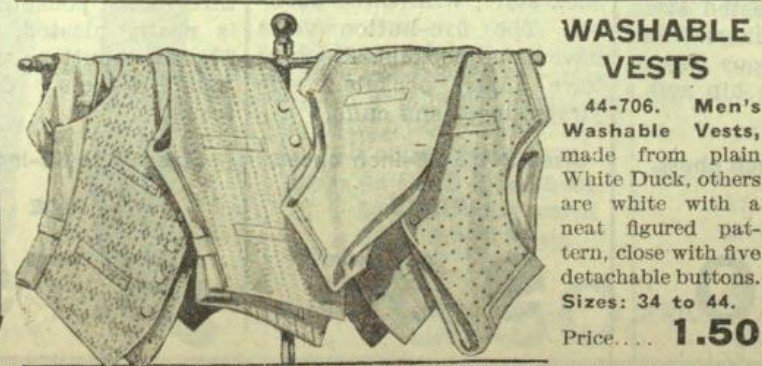
Figure 5
Eaton’s Spring and Summer Catalogue 1917, p. 242. Toronto Reference Library. Accessed online via Internet Archive, 2025.
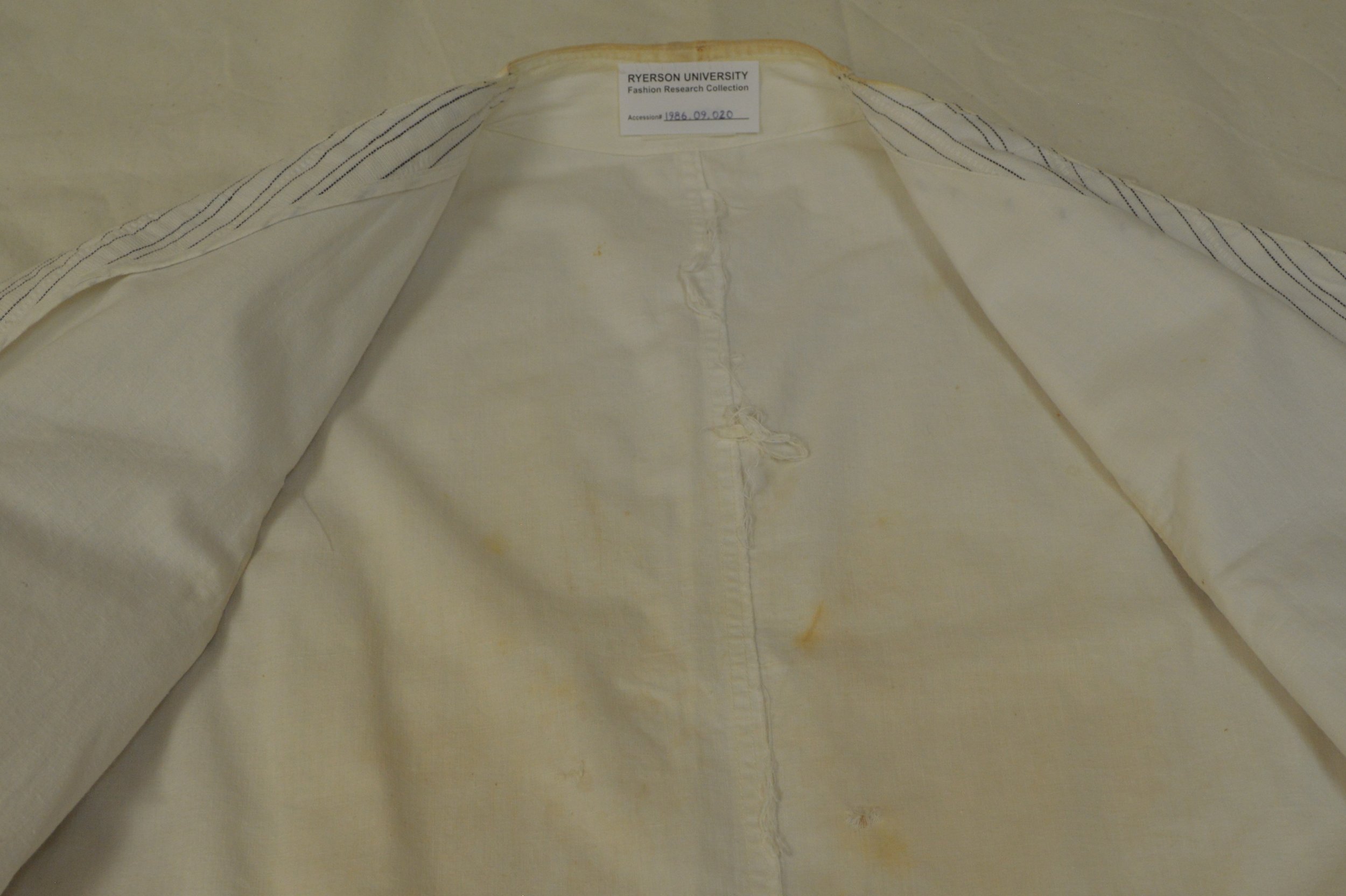
Figure 6
Cream Pinstriped Cotton Waistcoat. Toronto Metropolitan University Fashion Research Collection. Photograph by Author, 2025.
The back panel is yellowed with what appears to be sebum or sweat stains from regular use that have oxidized over time (Figs. 7, 8).[31] The rust-coloured mark on the front right panel may be residue from cosmetics that has oxidized, or it may be organic matter. Its location and asymmetry suggest an accident, rather than being consequence of normal wear and tear.
Despite heavy soiling, the vest shows no signs of repair. The hole on the back panel is particularly glaring. This supports my assessment of it as an inexpensive, somewhat disposable piece of summer clothing (or that the damage occurred after its acquisition by a collector, and before its archiving).
I note the absence of comment on production quality in the Eaton’s listings and think about the unknown worker(s). Would they be proud to know their work survives to the present?
[31] Agnes Timar-Balazsy and Dinah Eastop, Chemical Principles of Textile Conservation (Routledge, 2012), 158.
[32] Entwistle and Townsend, “On Fashioning Anatomy,” 291.
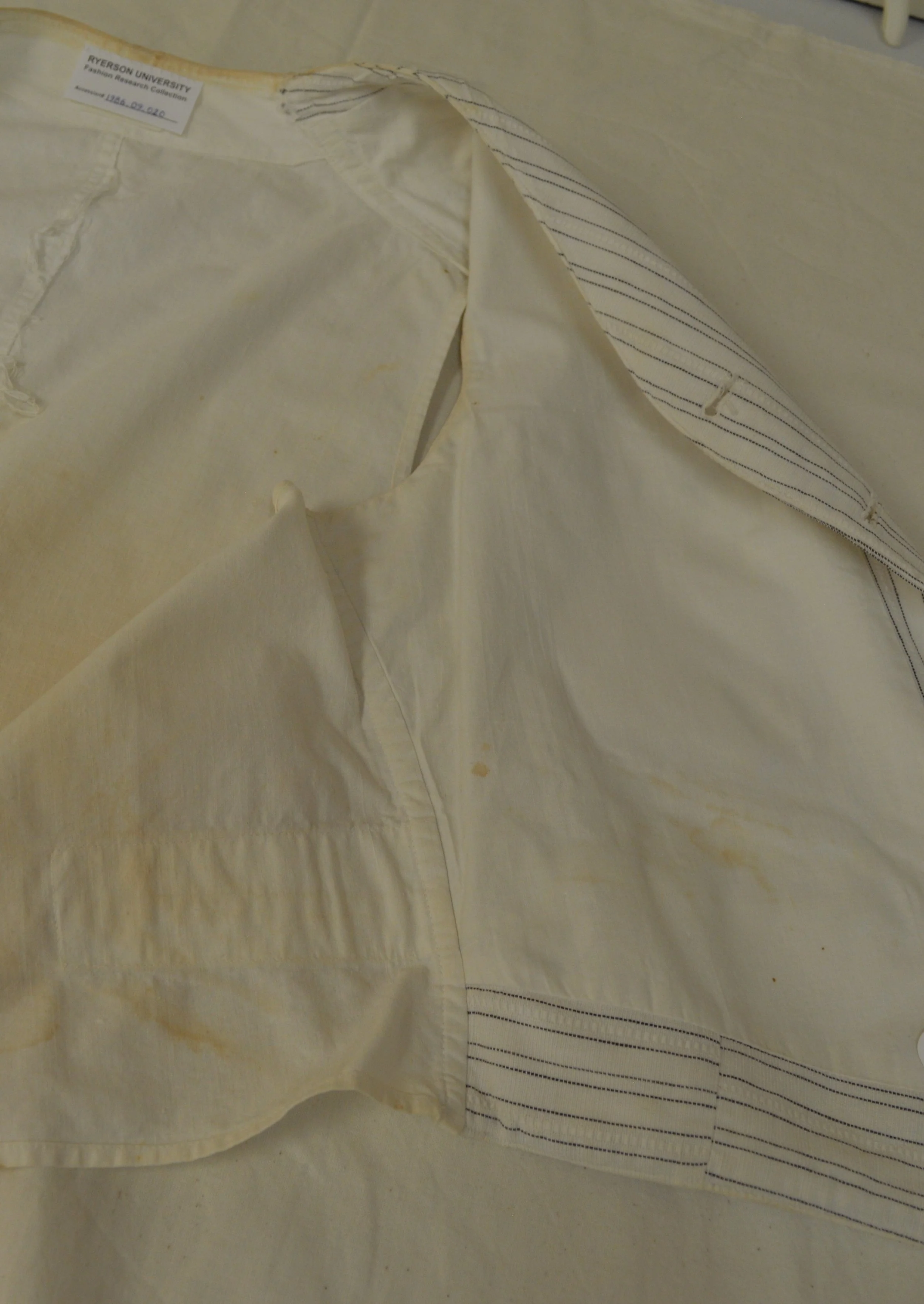
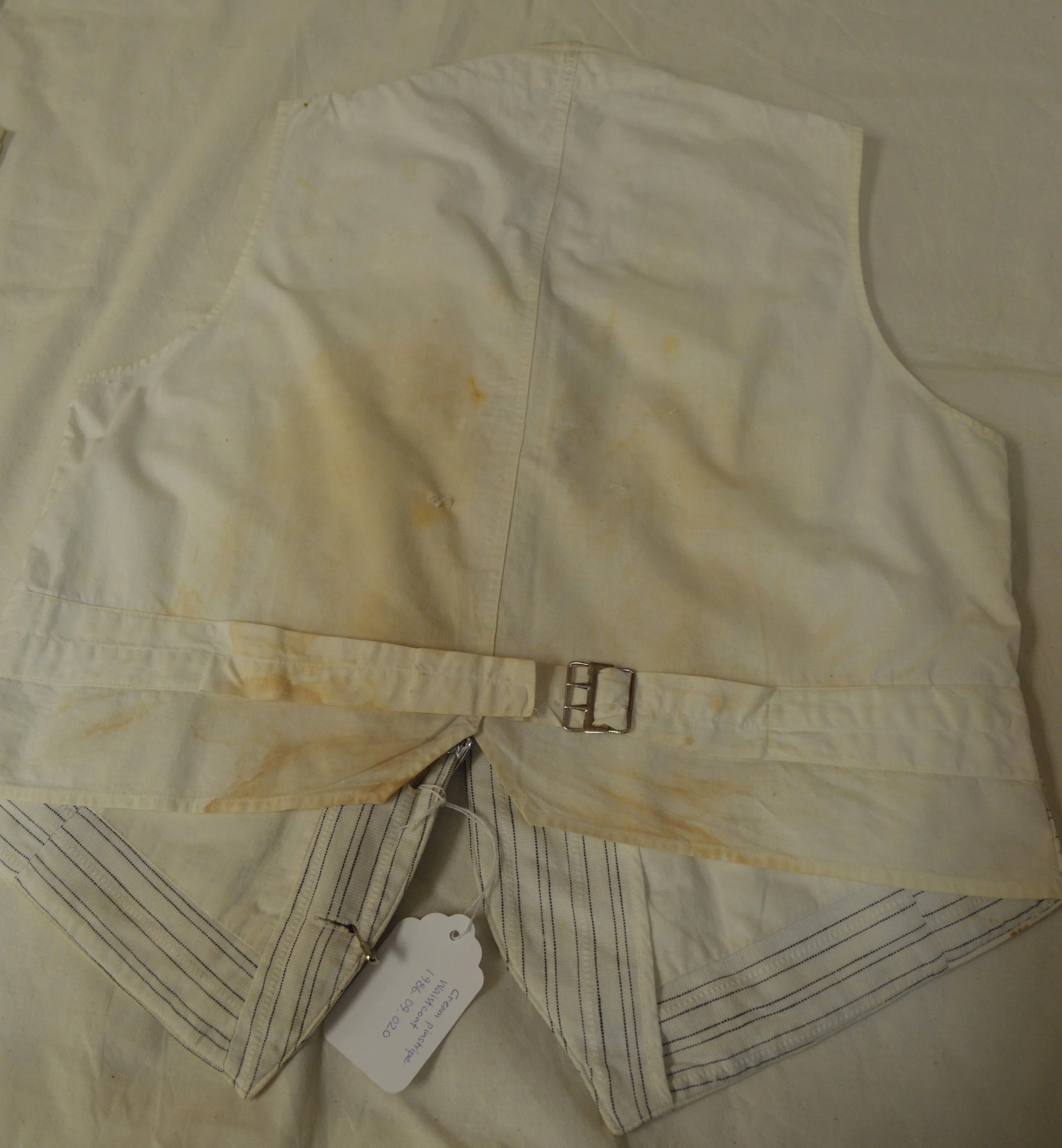
Figures 7, 8
Cream Pinstriped Cotton Waistcoat. Toronto Metropolitan University Fashion Research Collection. Photograph by Author, 2025.
The wearer would have been small in stature. The waist measures approximately 90cm (35.4 inches), though the adjustable waistband at the back would allow further reduction. The bulk of the shaping relies on these waist ties. Taken in front of J. & W. Townley on Yonge Street, a promotional photograph depicts men and boys of varied body types, all wearing vests (Fig. 9).[33] Their profession and posing—some wielding tools of the trade—give me reason to believe that their clothing is representative of a “good” fit. Furthermore, this shows how necessary a vest was for public life. Its buckled tie was, consequently, a socially acceptable means of shaping the body and defining the waist. The horizontal drag lines indicate that the garment is pulled taut. If these men are indeed affecting a fashionable mode of dress, these signs of strain on the garment were clearly an acceptable consequence.[34]
[33] Park Brothers, Townley, J. & W., Tailors, Yonge Street, West Side, South of Teraulay, 1889, Photograph, Toronto Public Library Archives, Baldwin Collection of Canadiana.
As I have warned against assumptions, I should point out that one man is all but fully hidden behind his compatriots. I cannot be certain that he is wearing a vest.
[34] I note the diversity of clothing in the tailors’ photograph. This small slice of men’s fashion in 1889 captures a variety of fashionable menswear, defying conventional wisdom that men’s fashion of this period was conservative, unchanging, or otherwise uninteresting.
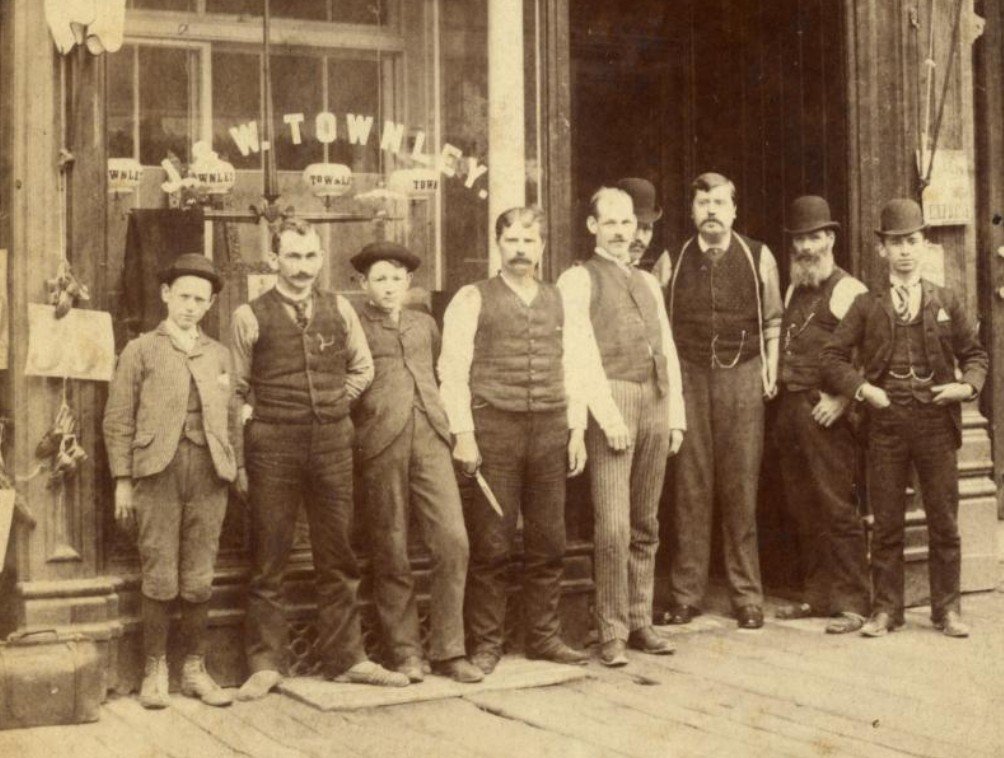
figure 9
J. & W. Townley Tailors, Yonge Street, West Side, South of Teraulay, 1889. Toronto Public Library Archives, Baldwin Collection of Canadiana. Accessed online, 2025. Photograph by the Park Brothers.
The close fit of vests in this period begins on the drafting table. In the pinstripe vest from the FRC, the shoulder slope and side seams create slight volume in the chest, draw in at the waist, and flare out slightly above the hips, a pattern mostly unchanged from the mid-19th century.[35] Lamotte acknowledges the utility of skilfully tailored outerwear for body-conscious men skeptical of outright corsetry.[36] Cottenden’s deconstruction of a c. 1900-1910 casual waistcoat distributes the curves to the upper back and lower centre front opening.[37] In all cases, the pattern draws in at the waistline, emphasizing the width of the shoulders while drawing the eye to the waist.
From drafting table, to mail-order catalogue, to daily adjustments by the end user, the vest was a crucial element of the Torontonian male wardrobe and for many, the foundation of their silhouette.
Other stories are possible. By the Victorian age, “passing women” of varied motives were common enough to become a literary trope.[38] “Passing women” were perceived as threatening social balance by disrupting the iconic “hierarchical and complementary relationship between masculinity and femininity.”[39] Even in urban environments, those who “passed” faced public ridicule, questioning, and suspicion.[40] Clara Ford, a Toronto Black woman who stood trial for the murder of her neighbour in 1894, proves how race compounded this prejudice into assumptions of criminality: her case rested on the assertion that she purposefully disguised herself as a man, based on her regular practice of wearing a vest, jacket, and trousers.[41] But these fraught interactions with the written archive prove that these people lived queer lives despite the danger.
[35] Joseph Couts, A Practical Guide for the Tailor’s Cutting-Room; Being a Treatise on Measuring and Cutting Clothing in All Styles, and for Every Period of Life from Childhood to Old Age (Blackie, 1848), 248.
[36] Lamotte, “Corsets, Stomach Belts, and Padded Calves: The Masculine Silhouette Reconfigured,” 200.
[37] Cottenden, Men’s Tailoring, 341.
[38] Hindmarch-Watson, “Lois Schwich, the Female Errand Boy,” 73–78; Draucker, Sounding Bodies, 79–98.
[39] Mimi Schippers, “Recovering the Feminine Other: Masculinity, Femininity, and Gender Hegemony,” Theory and Society 36, no. 1 (2007): 92.
[40] The Woman Who Wore Men’s Clothes, (New York), February 21, 1882, ProQuest Historical Newspapers; “Coney Island Etiquette: Wearing of Trousers by Women Barred by Its Code – Miss Penrose Violated the Rule,” The New York Times (New York), May 3, 1897, ProQuest Historical Newspapers; Hindmarch-Watson, “Lois Schwich, the Female Errand Boy,” 85; Joseph, Exquisite Materials, 106–8.
[41] Carolyn Whitzman, Clara at the Door with a Revolver: The Scandalous Black Suspect, the Exemplary White Son, and the Murder That Shocked Toronto, 1st ed. (University of British Columbia Press, 2023), 161.
An imagined possibility for this vest takes shape: a passing woman, donning the smallest men’s vest that might still accommodate her bust. As an affordable basic, she can stand to be careless, so she hangs it on a branch while lounging in the sweltering summer sun. She spends the afternoon in good company, only to notice the new staining and a puncture in the left back panel. Grinning and cursing, she shrugs her jacket back on, her face a blur as she rejoins the teaming Toronto crowds.
Silk and Stitching: Tales of a Tailcoat
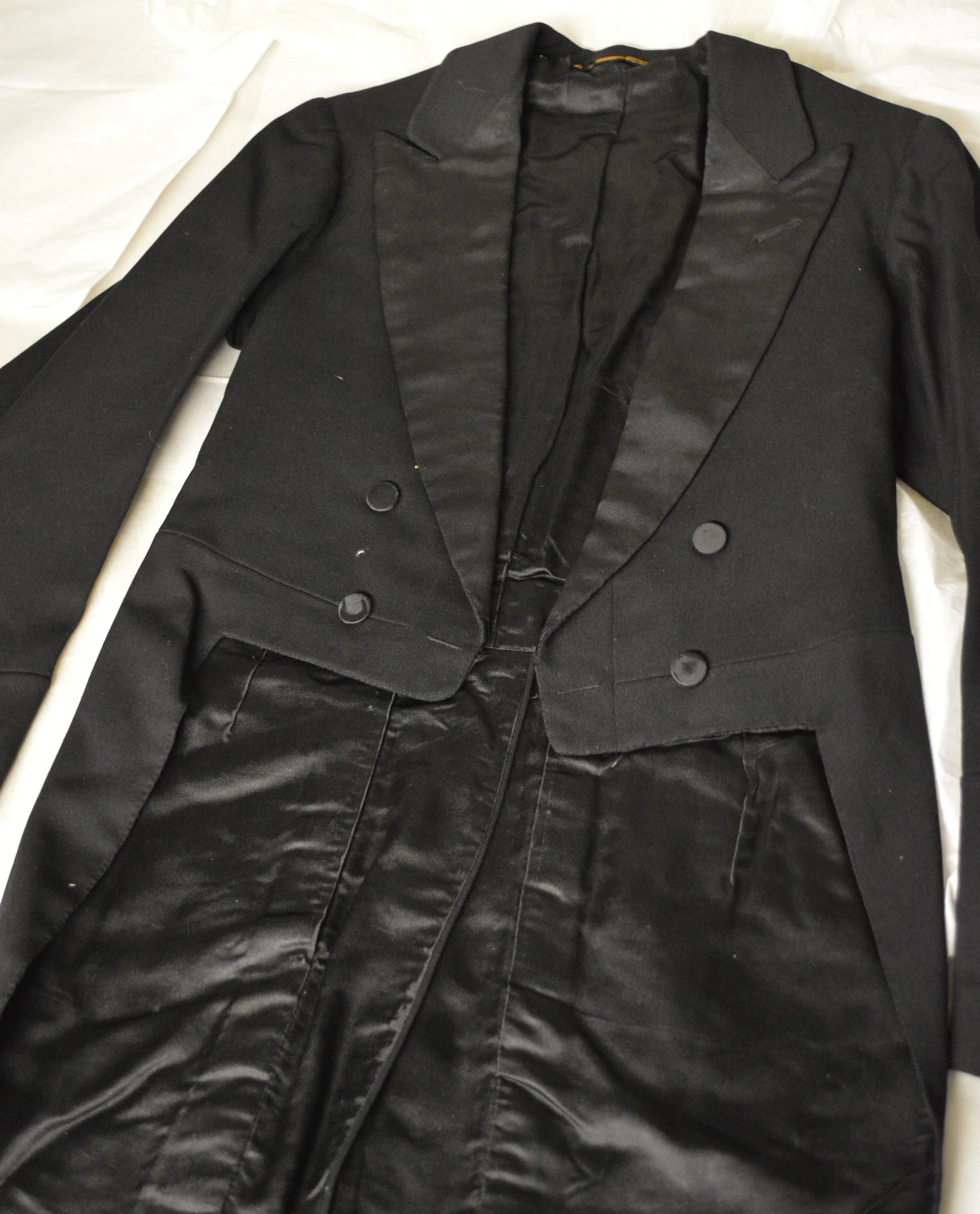
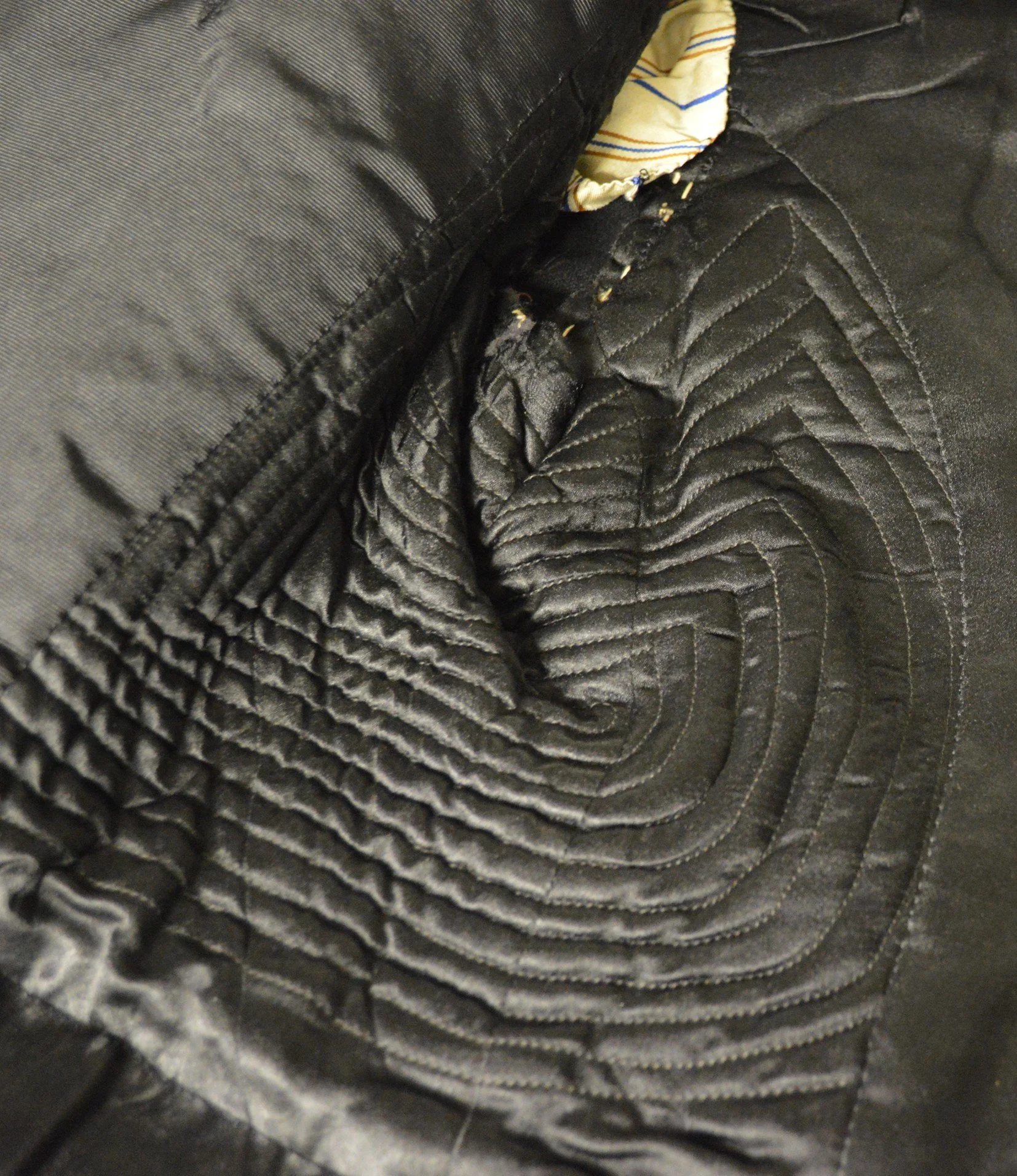
Figures 10, 11
Men’s Tailcoat, c. 1870s-1920s. The Village at Black Creek archives. Call No. 979.59.2a. Photographs by Author, 2025.
This tailcoat has a black wool exterior with a right-angle waist, full length step collar lapels, and four decorative buttons in a double-breasted style. The bodice is lined in black silk satin, and the arms lined in yellow twill with golden brown and dark blue vertical stripes. There is slight fraying of the front seam at the bottom of the lapels where it may have been pinned closed or fastened to a vest worn underneath.
The most prominent construction detail of the Black Creek tailcoat is the quilting or pad stitching detail on the lining under the arms (Fig. 12). Tailcoats bearing this detail are held at the Worthing Museum & Art Gallery in the United Kingdom and Toronto Metropolitan University’s FRC, dating to the 1870s and 1912-1922, respectively.[42] This broad range demonstrates that this stitching was employed to shape the underarm and waist of formal wear throughout this period. Cottenden notes that this technique was used throughout the 19th century, but not consistently.[43]
Typically used on lapels, shoulder pads, and collars, pad stitching is an organized collection of stitches that shape and stiffen portions of the garment while marrying lining, interfacing, and exterior layers of fabric.[44] It gives the tailor an opportunity to manipulate the shape of a component with thread work, helping to cement a desired shape in place permanently.[45] Cottenden, Mida, and Kim refer to the technique employed under the arms as quilting.[46] However, consultation with an American tailor suggests that the reinforcing quality of pad stitching makes it an equally appropriate term.[47] Supporting this, Cottenden’s observations of tight pad stitching yielding “a much firmer, tighter feel and a closer fit” ring true when assessing the Black Creek tailcoat: the underarm retains a conical shape even when held at the shoulders.[48] He notes a 19th century technique where “semi-circular, zig-zagged, or diagonal” hand stitches were used to shape the undercollar of some jackets, invisible when viewed right side out, which seems most similar to the strategy employed here, albeit with machine stitches.
[42] Cottenden, Men’s Tailoring, 295–98; Mida and Kim, The Dress Detective, 140–42; Menswear Black Wool Formal Tailcoat and Trousers, 1890s-1910s, Textile, Toronto Metropolitan University Fashion Research Collection, Call No. 2013.99.034 AB.
[43] Cottenden, Men’s Tailoring, 269.
[44] Cottenden, Men’s Tailoring, 187.
[45] Cottenden, Men’s Tailoring, 229.
[46] Cottenden, Men’s Tailoring, 298; Mida and Kim, The Dress Detective, 142.
[47] Jessie Dalton Jordan, personal communication, March 31, 2025.
[48] Cottenden, Men’s Tailoring, 241.
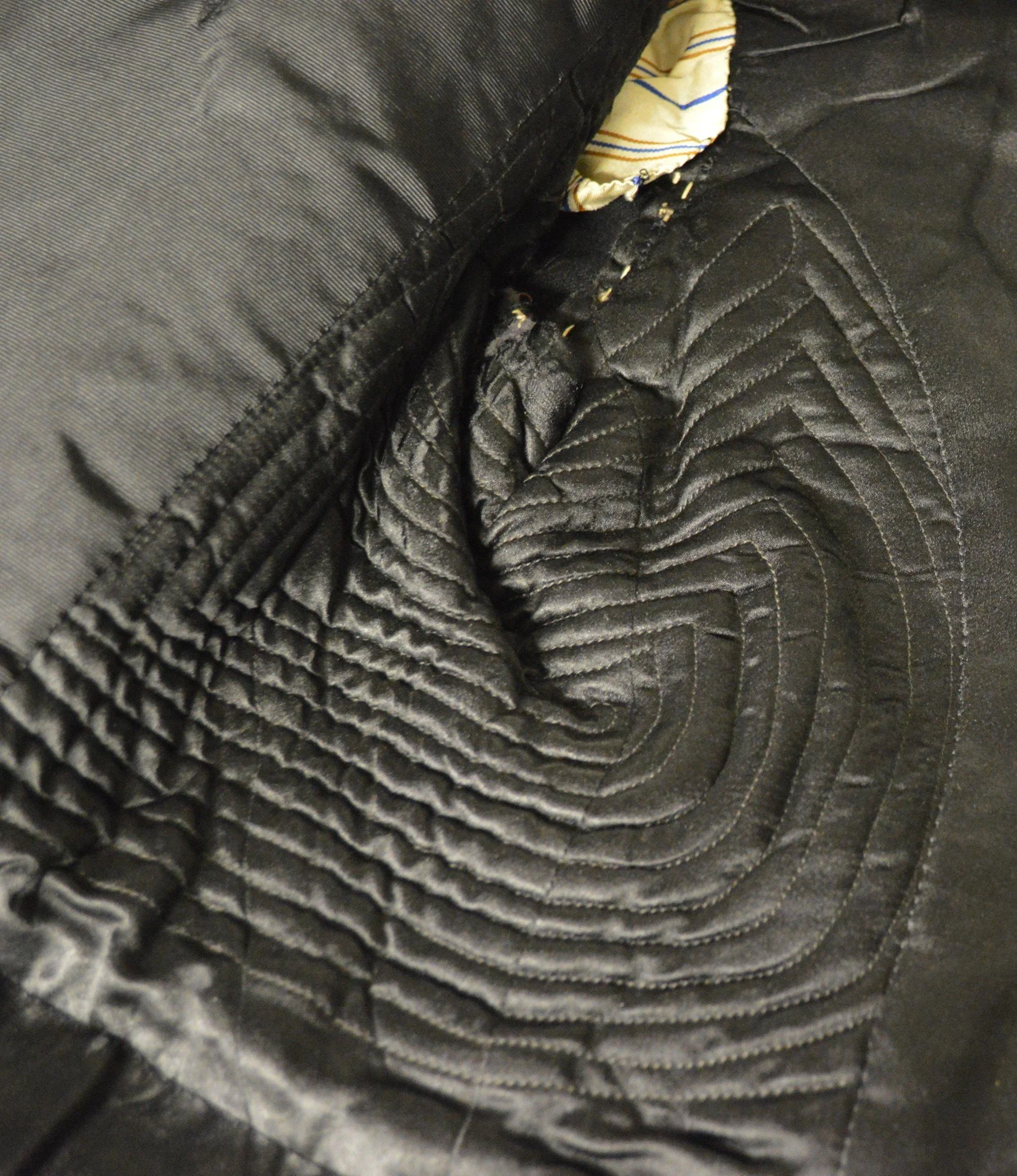
Figure 12
Stitching visible on interior of the coat. The Village at Black Creek. Photograph by Author, 2025.
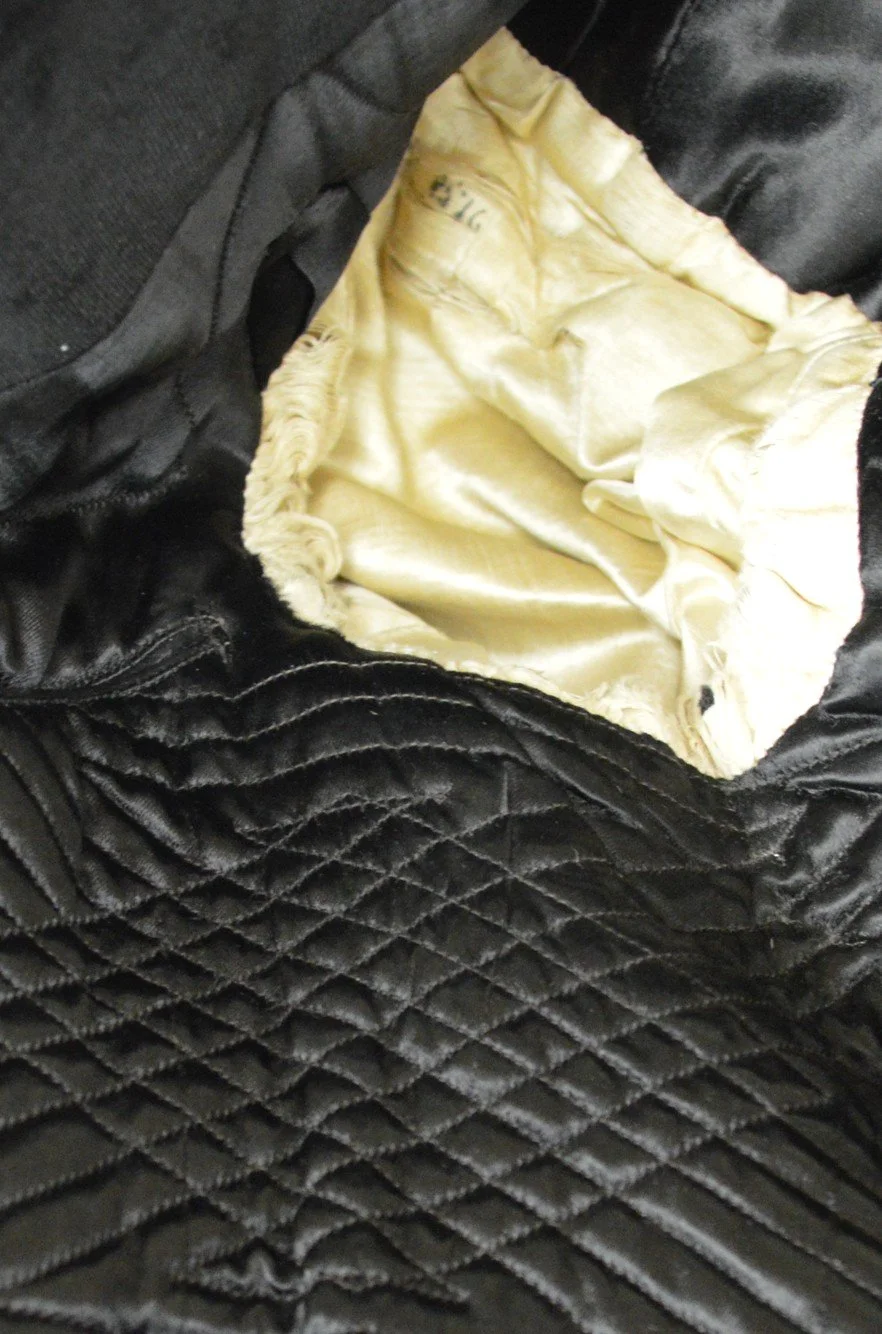
Figure 13
Interior stitching in the FRC tailcoat. Toronto Metropolitan University Fashion Research Collection. Call No. 2013.99.034 A. Photograph by Author, 2025.
Rather than single side seams, the front of the coat traces the majority of the armscye, meeting side panels extending to the back of the body. These panels are darted toward the waist. Another panel covers the remainder of the armscye, the shoulders, and the centre back, before ending in a short tail marked by two decorative buttons. Cottenden demonstrates that versions of this multi-panel mirrored construction are typical of jackets in this period.[49] He identifies additional dart(s) in tailcoats as providing “more waist suppression.”[50] The overall effect is of a dramatically narrowed waist, accentuated by a long, pointed skirt.
[49] Cottenden, Men’s Tailoring, 299.
[50] Cottenden, Men’s Tailoring, 241.
The Black Creek coat’s tails curve toward the centre and split in the middle. The tails are seamed to the bottom of the waist around its full circumference, elongating at a right angle approximately 8cm (3.15 inches) ahead of the sides of the body—this style, according to Cottenden, is known as “strap tails.”[51] The rounded tail shape seems to have been an especially popular evening wear choice in Canada, at least according to its staying power in the mail-order market. Similar coat styles are sold as premium dress suits in Eaton’s 1884, Fall/Winter 1899-1900, and Spring/Summer 1907 catalogue (Figs. 14, 15, 16).
None of the Eaton’s advertisements depicting tailcoats mention structural underarm stitching, but they do emphasize fit and craftsmanship.[52] Might this include built-in shapewear? While Cottenden’s analyses of extant men’s coats prove that pad stitching was common in English menswear, the archivists at both Black Creek and the FRC both indicated that it was an atypical feature for Toronto-area coats. The latter observation rings true for daywear: dress coats like these, being more expensive with narrower use cases, are already exceptional finds in the archive.[53] That two distinct tailcoats—only a few kilometres from each other—exhibit this stitching may suggest a standard tailoring practice by the same manufacturer.
I return to the production floor. Unlike the worker who made the vest, the tailcoat’s maker (rather, the fruit of their labour) is lauded for their attention to detail and quality. Were the workers tasked with sewing these jackets also responsible for the vests? This tailcoat bore witness to hissing industrial irons, clattering machines, and warm hands all before it was ever worn.
A c. 1920-1939 photograph of an unknown man, attributed to James F. Phillips, shows how effective this tailoring could be (Fig. 17).[55]
[51] Cottenden, Men’s Tailoring, 241.
[52] T. Eaton Co., Eaton’s Catalogue 1884, 50.
[53] In all listings where they appear, the tailcoats are significantly more expensive than Eaton’s other suit offerings.
[54] Cottenden, Men’s Tailoring, 241.
[55] James F. Phillips, Unidentified Man in Tophat, ca. 1920-1939, Glass Plate Negative, City of Toronto Archives, Fonds 1548, Series 403, File 118.
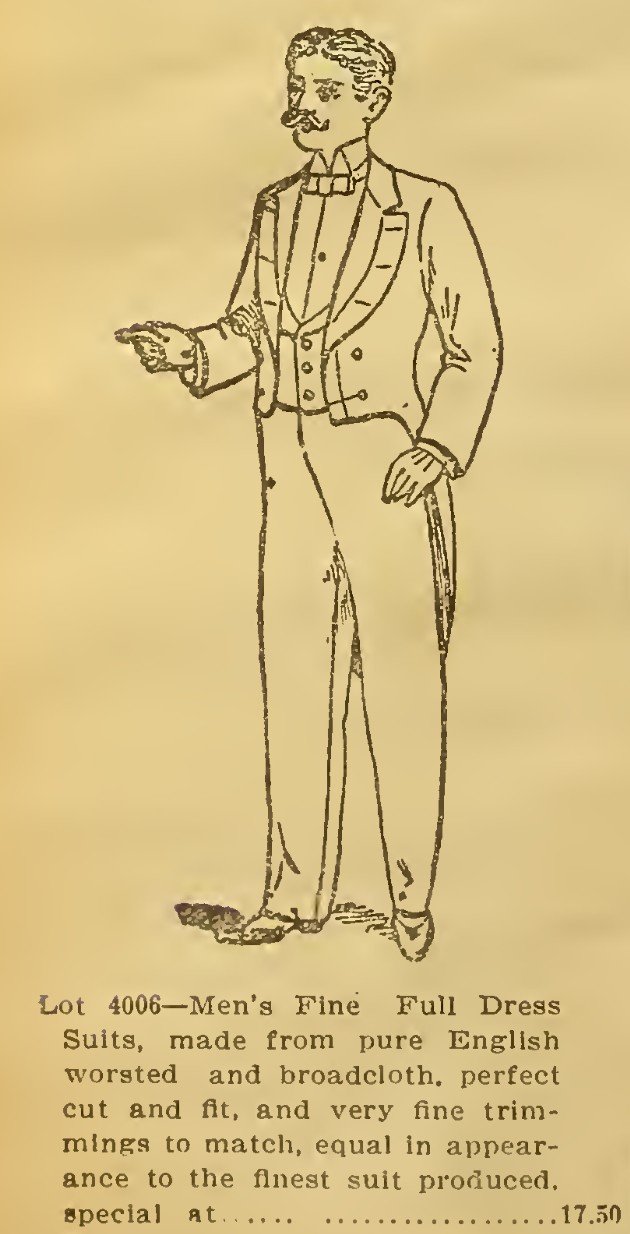
Figure 14
Eaton’s Catalogue 1884, p. 50. University of Toronto Fisher Collection. Accessed online via Internet Archive, 2025.
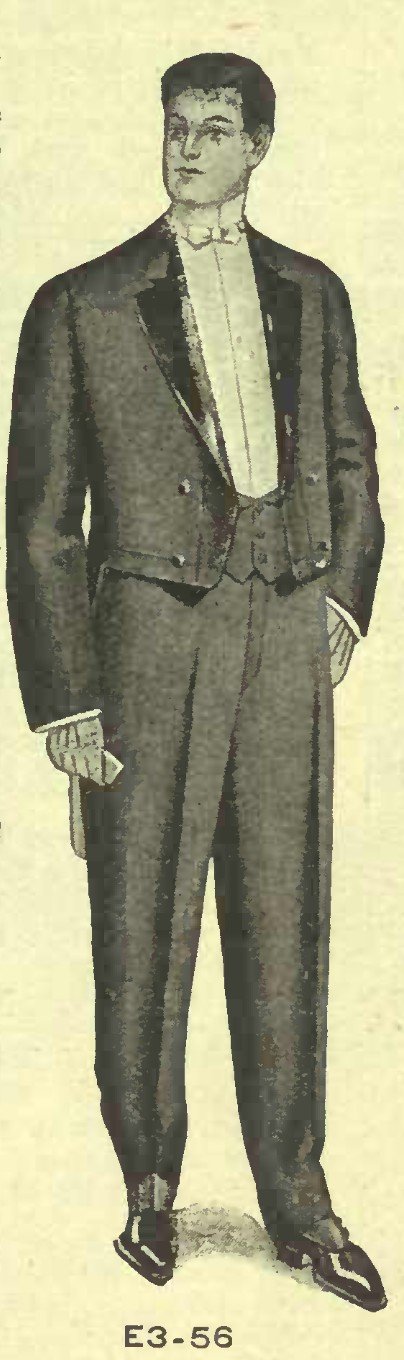
figure 16
Eaton’s Spring and Summer Catalogue 1907, p. 57. Toronto Reference Library. Accessed online via Internet Archive, 2025.
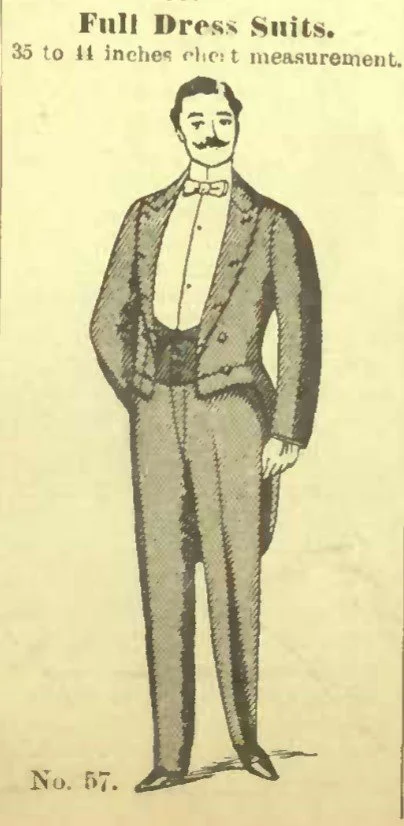
figure 15
Eaton’s Fall and Winter Catalogue 1899-1900, p. 120. Toronto Reference Library. Accessed online via Internet Archive, 2025.
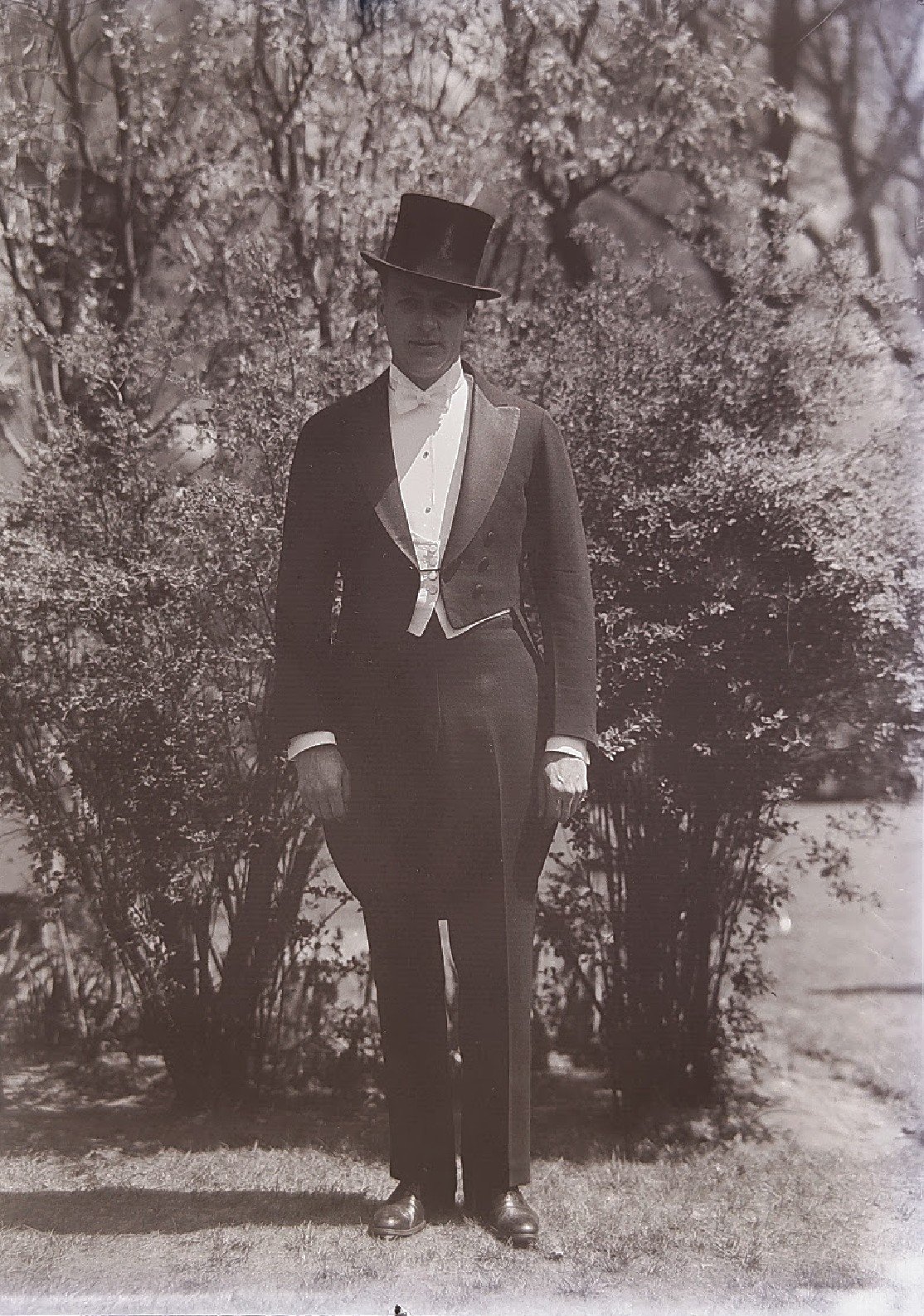
figure 17
Unidentified Man in Tophat, c. 1920-1939. Glass Plate Negative. City of Toronto Archives, Fonds 1548, Series 403, File 118. Photograph by James S. Phillips. Copied and edited (colour inverted) by Author, 2025.
In 1902, one New York Times correspondent attributed the persistence of male waist reduction to a revival of dandyism, announcing that “dandies desire waist curves.”[56] But what is dandyism, and what does it mean to revive it? The term and its history are contested. Writing against the sartorial legacy of so-called “King of the Dandies,” English court favourite Beau Brummell (1778-1840), Chloe Chapin offers two definitions for the term: “First, a man who pays unusual attention to his dress and appearance, and second, a man who dresses outside the sartorial conventions of his time.”[57] This definition accommodates the shifting sensibilities across time and space, but as Chapin notes, is explicitly gendered, referring to a man as unusual amongst his peers, and readily identifiable by his physical presentation.
Chapin also describes the bisected temporality of dandyism: in the early to mid-19th century, aristocratic men sporting padded chests and hips with narrow, corseted waists were known as dandies; toward the end of the century, the term captured men like Oscar Wilde, whose flamboyance extended well beyond the confines of the wardrobe.[58] This is no coincidence. In her seminal book on corset history, Valerie Steele chronicles the merciless caricaturizing of the first dandies in the European press, depicting them as tightlacing gender inverts.[59] Thus, the public image of “effeminate” men extended to waist reduction. If we accept queer theorist Michael Kimmel’s definition of homophobia as the “animating condition” of American hegemonic masculinity, we can read these caricatures as an assertion of dominant manliness at the expense of so-called effeminate or homosexual men.[60]
[56] N. Y. Times, “Dandies Desire Waist Curves.”
[57] Chloe Chapin, “‘His Ghost Walks Among Us Still’: Troubling the Sartorial Legacy of Beau Brummell,” Fashion Theory (Abingdon) 29, no. 1 (2025): 89.
[58] Chapin, “His Ghost Walks Among Us Still,” 89; Steele, The Corset, 36.
[59] Steele, The Corset, 36–38.
[60] Kimmel, “Masculinity as Homophobia,” 193.
[61] Joseph, Exquisite Materials, 133.
Despite invoking such a loaded term, the 1902 article is not critical of dandies. While it acknowledges the need for discretion, the article cites a wide cohort of American and English men as proponents of corsetry and reduction. The reporting style prompts questions: were there enough men preoccupied with fashion in New York to rehabilitate dandyism into a neutral term? Or, having already become a shorthand for homosexuality, does the dandy revival point to a growing subculture of queer expression? Could the turn-of-the-century effeminate man have reclaimed the term?
A 1911 article in Life magazine on “corset coats” asserts a divide between men who “regard” fashion and men who do not.[62] According to the author, the latter represent the average man, the former exactly the kind of effeminate outliers who might adopt the “new” coat style. The article describes the “corset coats” as being drafted with narrow backs and high waists.[63] The design echoes the stiff military coats that “form[ed] a ‘V’ silhouette” integral to dandyism.[64] Perhaps this report describes an adoption of evening dress styles into daywear? It seems an odd denigration of well-established norms in evening tailcoat manufacture, unless we consider the possibility that tailcoats were popular among men who “regarded” fashion—and if, like dandy, this language was coded.
Another imagined possibility takes shape here, of a man donning the Black Creek coat as a signal to his community. Perhaps this man met the wearer of the tailcoat held at the FRC, which was selected by Mida and Kim as a case study for their guidebook on dress analysis.[65] The piece is in excellent condition, with only fraying of the silk lining at the armscye.[66] It has been kept with the matching trousers. In comparison, the Black Creek coat’s lining is baggy, its edges worn, and the sleeve lining has pulled away from the black silk in multiple places. Still, the garments share notable details: a lack of maker’s marks (Mida and Kim identify a location where the FRC coat’s label had been removed), a worn ribbon at the collar, and the distinctive structural stitching at the underarm.[67]
[62] “Males and Modes,” Life 57, no. 1492 (1911): 1071.
[63] Life, “Males and Modes.”
[64] Lamotte, “Corsets, Stomach Belts, and Padded Calves: The Masculine Silhouette Reconfigured,” 200.
[65] Mida and Kim, The Dress Detective, 139–57.
[66] Mida and Kim, The Dress Detective, 147–48; Menswear Black Wool Formal Tailcoat and Trousers.
[67] Mida and Kim, The Dress Detective, 145.
What might the FRC coat’s wearer have thought about the Black Creek coat? Would they have found it outdated, or a poor imitation? Or did they view its wearer with the reverence of an elder? There is the ghost of a meeting here, real or imagined, of two silhouetted figures sharing a laugh by lamplight.
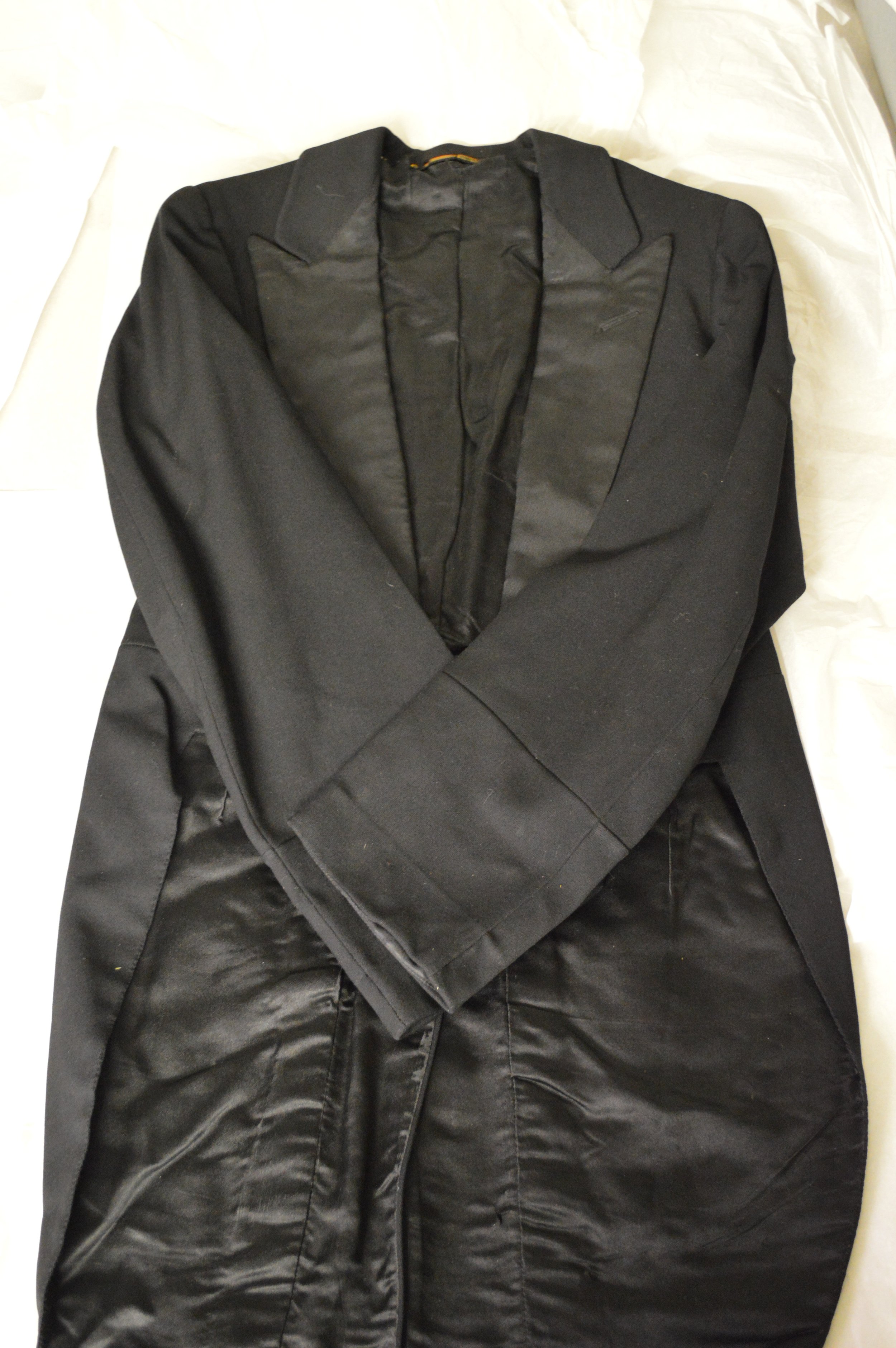
figure 19
Men’s Tailcoat, c. 1870s-1920s. The Village at Black Creek archives. Photograph by Author, 2025.
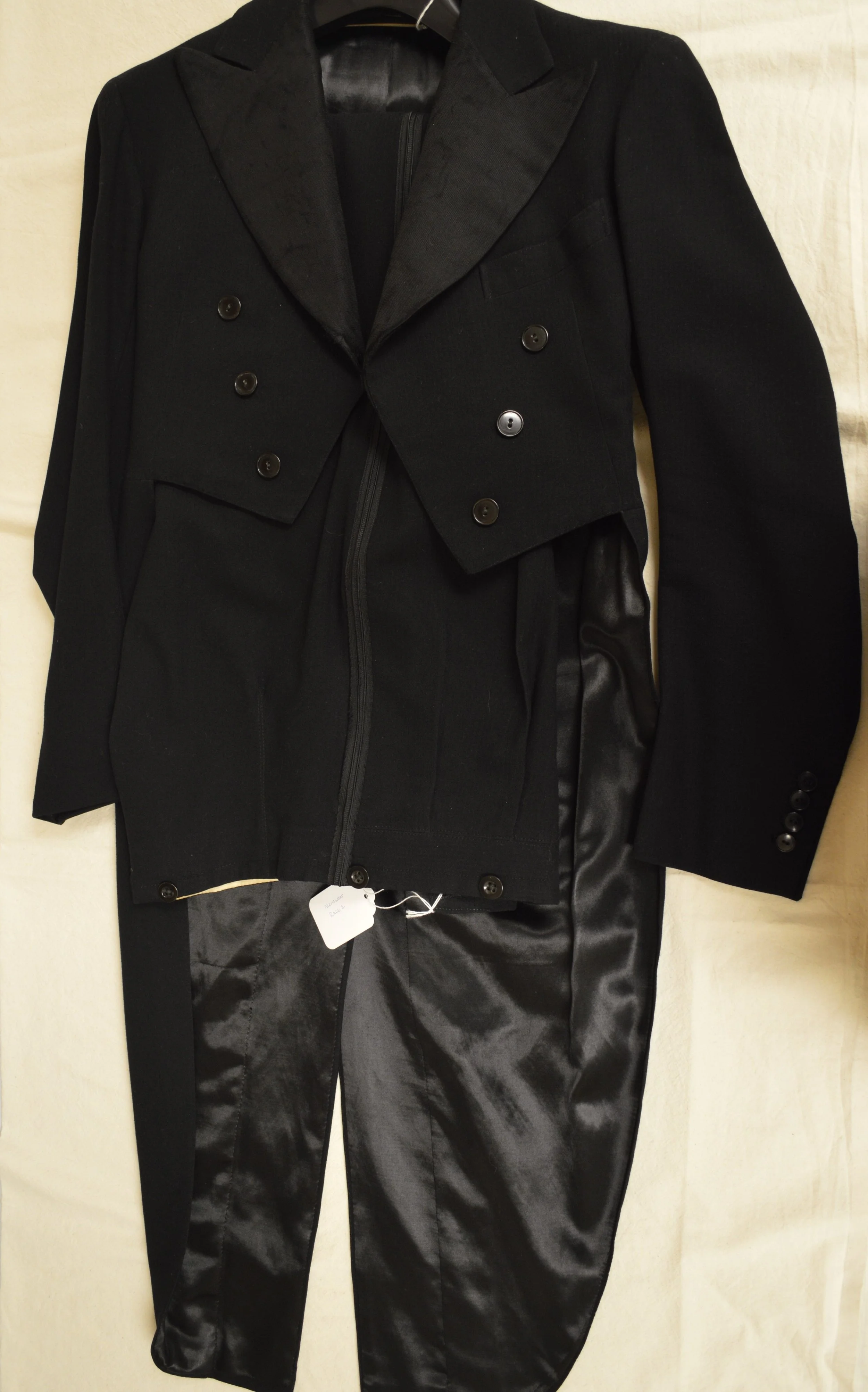
figure 20
Menswear Black Wool Formal Tailcoat and Trousers. Toronto Metropolitan University Fashion Research Collection. Photograph by Author, 2025.
Conclusion: Making Do and Mending with Menswear
This is a study of the 1870s-1920s masculine silhouette with a queer agenda. I propose a queering of methodology, a queering of analysis, and a queering of storytelling. I argue that we cannot divorce the late 19th and early 20th century men from a cultural context that branded them abnormal for concerning themselves with achieving a fashionable silhouette, nor can we ignore the fact that they cared anyway. Even mass-produced menswear modified the body. Understanding this prompts an inclusive definition of male shapewear, encompassing shaping features of outerwear. Working from these features, I have drawn from supplementary primary and secondary sources to analyze the details of construction, wear, and repair.
The vest was an uncontroversial way to shape the body while conforming to the norms of masculine dress. The cotton pinstripe vest is an example of how accessible these items could be: sold as washable summer wear, vests like this one democratized shapewear for men and could be styled as tightly or loosely as one preferred without judgment. However, women slipping into menswear had to do so covertly, facing ridicule and suspicion if discovered. The “male” vest, like the “female” corset, was therefore policed along gender lines.
Even everyday garments could be conceived of as queer, so long as they denoted too-prompt adherence to fashion’s changing trends. While the vest’s longevity and stability of form absolved it of this crime, coats were not always so lucky.
Despite this, the staying power of the tailcoat—with many, like the Black Creek specimen, sporting structural stitching to further reduce the waist—in evening wear suggests that for some men there was an appropriate time and place to “regard” fashion.
In advocating for queer storytelling, I construe the absence of the human body as a presence of potential.[68] Drawing from Miles’ emotionally informed interpretation of Fuentes’ bias grain framework, I darn new stories over the echoes of old. In places where provenance is a mystery, this is an opportunity to repair gaps in the queer archive with speculative moments of joy and understanding. I write for ghosts of the “now” and “then” together, tracing an emotional ancestry through one of the foundations of human expression: clothing. The passing woman and the dandy man are here (or they were, or they would be) as I hold a vest to my chest and laugh with the archivist about “snatching” the waist and pairing it with a miniskirt.
[68] Townsend et al., “The Electric Corset and Other Future Histories,” 94.
Bibliography
Case Studies
Cream Pinstriped Cotton Waistcoat. n.d. Textile. Toronto Metropolitan University Fashion Research Collection, Call No. 1986.09.020. https://ryersonfashion.pastperfectonline.com/webobject/B99524C9-6995-4E83-AC5B-405750028111.
Men’s Tailcoat. c. 1870s-1920s. Textile. The Village at Black Creek, Call No. 979.59.2a.
Archival Sources
Couts, Joseph. A Practical Guide for the Tailor’s Cutting-Room; Being a Treatise on Measuring and Cutting Clothing in All Styles, and for Every Period of Life from Childhood to Old Age. Blackie, 1848. https://catalog.hathitrust.org/Record/101834769.
Cream Cotton Waistcoat. n.d. Textile. Toronto Metropolitan University Fashion Research Collection, Call No. 1986.09.019. https://ryersonfashion.pastperfectonline.com/webobject/26798686-147D-4679-843A-566520457300.
International Correspondence Schools. Weave Construction and Cloth Analysis. International Textbook Co., 1905.
Life. “Males and Modes.” 1911, vol. 57, no. 1492: 1071. ProQuest. https://www.proquest.com/c19index/docview/90739771/abstract/6EA02E0AC8634188PQ/1?sourcetype=Magazines.
Menswear Black Wool Formal Tailcoat and Trousers. 1890s-1910s. Textile. Toronto Metropolitan University Fashion Research Collection, Call No. 2013.99.034 AB. https://ryersonfashion.pastperfectonline.com/webobject/6CA031FE-32D0-4F50-96E8-701425285041.
Park Brothers. Townley, J. & W., Tailors, Yonge Street, West Side, South of Teraulay. 1889. Photograph. Toronto Public Library Archives, Baldwin Collection of Canadiana. https://digitalarchive.tpl.ca/objects/347773/townley-j--w-tailors-yonge-street-west-side-south-of.
Phillips, James F. Unidentified Man in Tophat. c. 1920-1939. Glass Plate Negative. City of Toronto Archives, Fonds 1548, Series 403, File 118.
T. Eaton Co. Eaton’s Catalogue 1884. T. Eaton Co., 1884. University of Toronto Fisher Collection. http://archive.org/details/eatonscatalogue02teat.
T. Eaton Co. Eaton’s Fall and Winter Catalogue 1899-1900. Toronto: T. Eaton Co, 1899. Toronto Public Library: Toronto Reference Library. http://archive.org/details/eatons1899190000eatouoft.
T. Eaton Co. Eaton’s Spring and Summer Catalogue 1907. T. Eaton Co, 1907. Toronto Public Library: Toronto Reference Library. http://archive.org/details/eatons190700eatouoft.
T. Eaton Co. Eaton’s Spring and Summer Catalogue 1917. T. Eaton Co., 1917. Toronto Public Library: Toronto Reference Library. http://archive.org/details/eatons191700eatouoft.
The New York Times (New York). “Coney Island Etiquette: Wearing of Trousers by Women Barred by Its Code – Miss Penrose Violated the Rule.” May 3, 1897. ProQuest. https://www.proquest.com/docview/95485342/62127EEF60A0492FPQ/60
The New York Times (New York). “Dandies Desire Waist Curves: Comparatively Few of Them in New York, but These Few Are Well Known to Leading Tailors and Haberdashers.” October 26, 1902. ProQuest. https://www.proquest.com/c19index/docview/96218958/abstract/5E92D62F19D643E5PQ/3?segment=C19News&sourcetype=Historical%20 Newspapers.
The Woman Who Wore Men’s Clothes. (New York), February 21, 1882. ProQuest Historical Newspapers. https://www.proquest.com/docview/93993910/fulltextPDF/E834A942A5C049DFPQ/2.
Scholarly Sources
Chapin, Chloe. “‘His Ghost Walks Among Us Still’: Troubling the Sartorial Legacy of Beau Brummell.” Fashion Theory (Abingdon) 29, no. 1 (2025): 75–101. https://doi.org/10.1080/1362704X.2024.2437839.
Connell, R. W., and James W. Messerschmidt. “Hegemonic Masculinity: Rethinking the Concept.” Gender & Society (Thousand Oaks, CA) 19, no. 6 (2005): 829–59. https://doi.org/10.1177/0891243205278639.
Cottenden, Graham. Men’s Tailoring: Bespoke, Theatrical and Historical Tailoring 1830-1950. 1st ed. Taylor & Francis Group, 2019. https://doi.org/10.4324/9780429442414.
Draucker, Shannon. Sounding Bodies: Acoustical Science and Musical Erotics in Victorian Literature. State University of New York Press, 2024. https://muse.jhu.edu/pub/163/oa_monograph/book/125647.
Eastop, Dinah, and Mary M. Brooks. “Interactions of Meaning and Matter.” In Refashioning and Redress: Conserving and Displaying Dress. Getty Conservation Institute, Getty Publications, 2016.
Farrer, Peter, ed. Men in Petticoats: A Selection of Letters from Victorian Newspapers. Karn Publications, 1987. The Kinsey Institute Library & Special Collections. https://www.sexandsexuality.amdigital.co.uk/Documents/Details/KIA_PF_BOOKS_MENINPETTICOATS.
Farrer, Peter, ed. The Regime of the Stay-Lace: A Further Selection of Letters from Victorian Newspapers. Karn Publications, 1995. The Kinsey Institute Library & Special Collections. https://www.sexandsexuality.amdigital.co.uk/Documents/Details/KIA_PF_BOOKS_STAYLACE.
Francis, Martin. “The Domestication of the Male? Recent Research on Nineteenth- and Twentieth-Century British Masculinity.” The Historical Journal (Cambridge, UK) 45, no. 3 (2002): 637–52. https://doi.org/10.1017/S0018246X02002583.
Fuentes, Marisa J. Dispossessed Lives: Enslaved Women, Violence, and the Archive. University of Pennsylvania Press, 2016. https://doi.org/10.9783/9780812293005.
Hartman, Saidiya. “Venus in Two Acts.” Small Axe: A Journal of Criticism (Bloomington) 12, no. 2 (2008): 1–14. https://doi.org/10.1215/-12-2-1.
Hindmarch-Watson, Katie. “Lois Schwich, the Female Errand Boy: Narratives of Female Cross-Dressing in Late-Victorian London.” GLQ: A Journal of Lesbian and Gay Studies 14, no. 1 (2008): 69–98. https://doi.org/10.1215/10642684-2007-023.
Joseph, Abigail. Exquisite Materials: Episodes in the Queer History of Victorian Style. University of Delaware Press, 2019.
Kimmel, Michael S. “Masculinity as Homophobia: Fear, Shame, and Silence in the Construction of Gender Identity.” In Feminism and Masculinities, edited by Peter F. Murphy. Oxford University Press, 2004. https://doi.org/10.1093/oso/9780199267248.003.0015.
Koven, Seth. Slumming: Sexual and Social Politics in Victorian London. Princeton University Press, 2006. https://www.degruyter.com/document/doi/10.1515/9781400843589/html.
Lamotte, Sophie. “Corsets, Stomach Belts, and Padded Calves: The Masculine Silhouette Reconfigured.” In Fashioning the Body: An Intimate History of the Silhouette. Bard Graduate Center, 2015. http://archive.org/details/fashioningbodyin0000unse.
McKnight, Alanna. “Chapter 2: Hard and Straight: The Creation of Nineteenth-Century Masculinity Through Corsetry.” In Crossing Gender Boundaries: Fashion to Create, Disrupt and Transcend. Intellect, 2020. https://library.oapen.org/handle/20.500.12657/44083.
Mida, Ingrid, and Alexandra Kim. The Dress Detective: A Practical Guide to Object-Based Research in Fashion. Bloomsbury Academic edition. With Society of Antiquaries of London. Bloomsbury Visual Arts, 2018.
Miles, Tiya. All That She Carried: The Journey of Ashley’s Sack, a Black Family Keepsake. Random House Publishing Group, 2021. http://ebookcentral.proquest.com/lib/york/detail.action?docID=6630886.
Roper, Michael. “Slipping Out of View: Subjectivity and Emotion in Gender History.” History Workshop Journal 59, no. 1 (2005): 57–72. https://doi.org/10.1093/hwj/dbi006.
Schippers, Mimi. “Recovering the Feminine Other: Masculinity, Femininity, and Gender Hegemony.” Theory and Society 36, no. 1 (2007): 85–102. https://doi.org/10.1007/s11186-007-9022-4.
Shannon, Brent. “Refashioning Men: Fashion, Masculinity, and the Cultivation of the Male Consumer in Britain, 1860-1914.” Victorian Studies 46, no. 4 (2004): 597–630. https://doi.org/10.2979/VIC.2004.46.4.597.
Steele, Valerie. The Corset: A Cultural History. Yale University Press, 2001.
Timar-Balazsy, Agnes, and Dinah Eastop. Chemical Principles of Textile Conservation. Routledge, 2012. https://doi.org/10.4324/9780080501048.
Townsend, Katherine, Rhian Solomon, and Amanda Briggs-Goode, eds. Crafting Anatomies: Archives, Dialogues, Fabrications. Bloomsbury Visual Arts, 2020.
1. Entwistle, Joanne, and Katherine Townsend. “On Fashioning Anatomy.”
2. Townsend, Katherine, Sarah Kettley, and Sarah Walker. “The Electric
Corset and Other Future Histories.”
Ullman, Sharon. “The ‘Self-Made Man:’ Male Impersonation and the New Woman.” In Passing: Identity and Interpretation in Sexuality, Race, and Religion, edited by Maria C. Sanchez and Linda Schlossberg. New York University Press, 2001. https://www.degruyterbrill.com/document/doi/10.18574/nyu/9780814786819.003.0010/html.
Whitzman, Carolyn. Clara at the Door with a Revolver: The Scandalous Black Suspect, the Exemplary White Son, and the Murder That Shocked Toronto. University of British Columbia Press, 2023. https://doi.org/10.59962/9780774890625.
Wood, Janet. Creating the Perfect Form: How to Interpret and Display Historical Dress. Bloomsbury, 2024.
Yarrow, Simon. “Masculinity as a World Historical Category of Analysis.” In What Is Masculinity?, with John H. Arnold and Sean Brady. Genders and Sexualities in History. Palgrave Macmillan UK, 2011. https://doi.org/10.1057/9780230307254_7.
Author Bio

Lex Flavelle (she/they) is an artist and researcher based in Tsi tkarón:to/Toronto. She holds a Master’s and Bachelor’s degree in History from York University, and previously completed Sheridan College’s programs in Makeup for Media and Creative Arts and Advanced Prosthetics, Props and Special Effects. Their experience as an artist and maker informs their historical practice as they seek to understand the artists and makers of the past. She is most interested in how humans express themselves and their identities through ornamentation, and how these signaling methods might help historians trace throughlines between queer and alternative people of the present and past. They hope that the field’s recent focus on experiential learning and public history will open new avenues of research to meet the queer archive where it lives, rather than forcing it to conform to academic expectations. Lex has researched, written, and curated two digital exhibitions for the ArQuives, Canada’s largest 2SLGBTQIA+ archives: Coming Up Aces (2024) and Maggie’s: 4 Decades of Sex Worker Activism in Toronto (2025).

“Lose” by Hannah Jadagu
Article Citation
Flavelle, Lex. “Summoning Ghosts in the Fashion Archive: Reparative Case Studies of 1870s-1920s Menswear.” Unravelling Fashion Narratives, special issue of Fashion Studies, vol. 5, no. 2, 2026, pp. 1-30. https://doi.org/10.38055/UFN050201
Copyright © 2026 Fashion Studies - All Rights Reserved
Creative Commons Attribution-NonCommercial-NoDerivatives 4.0 International (CC BY-NC-ND 4.0) license (see: https://creativecommons.org/licenses/by-nc-nd/4.0/)